


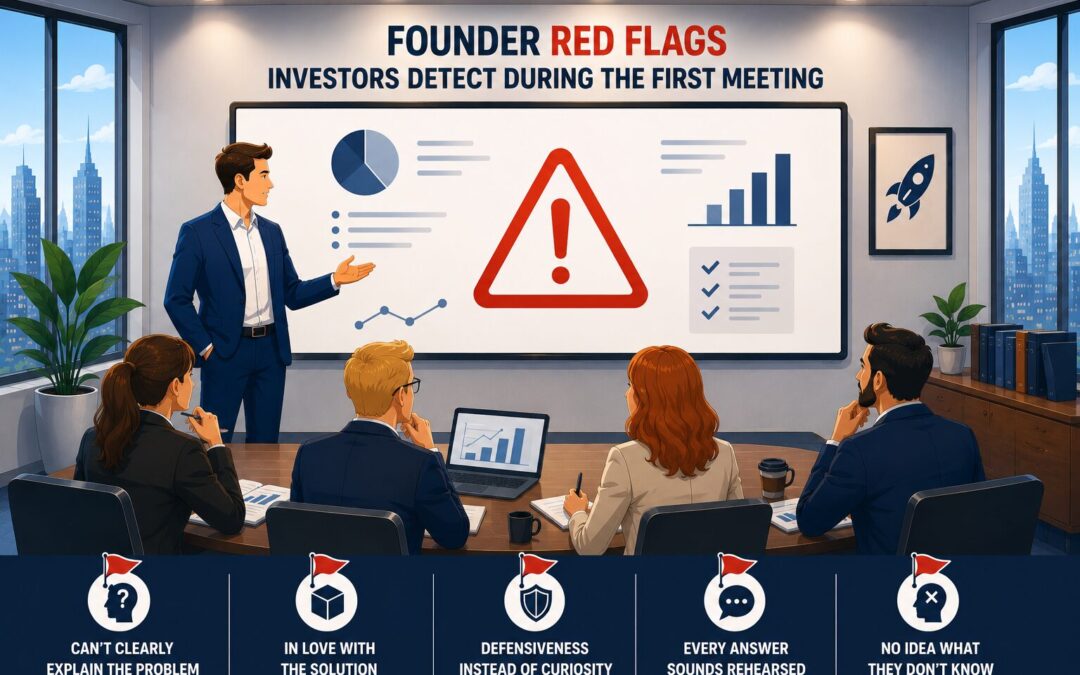
Your nervousness before entering the presentation room isn’t one of the founder red flags investors detect during the first meeting. Instead, other signals can undermine their conviction well before due diligence.
As expert fundraising consultants will advise you, investors unconsciously form judgments in the first 5 to 10 minutes. Understanding their psychology will help you eliminate their misgivings and quickly answer the core questions they’re asking—silently.
*FREE DOWNLOAD*
The Ultimate Guide To Pitch Decks
Investors Aren’t Just Evaluating Your Startup—They’re Evaluating You
The human brain has this subconscious instinct to find patterns and draw precise conclusions about a person’s traits, competence, and reliability. That’s what the principal/investor viewing your pitch is doing. Remember that they rarely conduct deep due diligence in that initial meeting.
Instead, the investor is running a rapid diagnostic to filter out risk. Eliminating founder risk is a top priority and one of the first on their list. They are studying nonverbal cues, tone of voice, and the structure of speech signals.
These subtle signals are about the founder’s judgment, leadership, communication style, and ability to navigate uncertainty. They have nothing to do with the product itself or the technology you’ve developed. All that comes later. The first meeting is about only pattern recognition.
The investor is assessing if you are a good fit for a viable 7- to 10-year partnership. At this point, they aren’t validating every claim—that can be done during due diligence by junior associates and analysts. They’re asking:
- Does this founder resemble successful founders I’ve backed?
- Would customers follow this person?
- Would employees?
- Would future investors?
Many startups don’t lose investors because of weak products; they lose them because subtle behavioral red flags gradually erode conviction. You could speed up the process of building this conviction using Tim Davis’ strategy, which helped him raise seed funding for Modular. Today, it has secured $140M.
On the Dealmakers Podcast, Tim explained how he sent over a three- to four-page memo explaining the business to investors—before the actual meeting. Investors appreciated the clarity and depth and dove right into whiteboarding. This strategy saved time for both parties, who then moved to the Q&A.
Red Flag #1: They Can’t Clearly Explain The Problem
A typical business pitch lasts 30 minutes, and you have the initial 10 to 15 minutes to explain the concept. If it interests your audience, the meeting could run longer, up to 45 minutes or more. That’s when you’ll answer in-depth questions about the technology, product, and business plan.
Some experts advise you to develop a compelling elevator pitch—even for an in-person investor meeting. You should be able to explain the startup in a few seconds. One of the fastest ways to lose an investor is to spend 20 minutes describing the technology. That’s not important. The customer is.
You’ll define the problem and customer pain point succinctly. Why it matters and why solutions are needed right now. A vague customer definition, a huge TAM but no QTAM or QSAM, and no obvious pain point are clear red flags. Without an interested customer base, the best innovations surely fail.
Successful founders demonstrate that they have identified this pain and that their solutions effectively alleviate it. Don’t forget to underscore why the solution is relevant right now.

Raise Capital Smarter, Not Harder
- AI Investor Matching: Get instantly connected with the right investors
- Pitch & Financial Model Tools: Sharpen your story with battle-tested frameworks
- Proven Results: Founders are closing 3× faster using StartupFundraising.com
Red Flag #2: The Founder Is In Love With The Solution
Pattern recognition always proves that successful founders obsess over customers. Their pitches typically include data collected through interviews with dozens of potential buyers facing a problem.
Just as Sankalp Arora did. When developing the concept for Gather AI, he and his team interviewed over 175 customers. They had built this amazing technology but wanted evidence that it could reach markets and have a global impact.
To secure investor interest, Sankalp built mock warehouses in Salesforce Tower offices and gave demos. He also had customer validation—potential buyers who said, “If you build it, we’ll buy it.” On the other hand, weak founders are obsessed with the tech they’ve built.
The founder red flags investors detect during the first meeting include endless product demos, AI for everything, and feature lists. These founders fill the pitch with complex technical jargon that typically blends in with dozens of similar pitches.
Without any real differentiation, investors forget the pitch in 24 hours. Worse, they notice when founders spend more time discussing product architecture than customer behavior.
Here’s how investors think: Yes, the product is great. The innovation is groundbreaking. But will customers buy it? What is the expected ROI here?
Red Flag #3: Defensiveness Instead Of Curiosity
Experienced investors deliberately challenge assumptions. If they are genuinely interested, expect in-depth questions designed to destabilize your pitch flow. They are not trying to prove your data and claims wrong. They are testing your emotional maturity and intellectual honesty.
If you’ve connected with the right investors, they likely operate within your space and understand the industry better than you. They fully intend to support viable startups with much more than just capital. They’ll provide expertise, technical support, assistance with hiring, and access to strategic partners.
When asking questions, investors are trying to determine coachability and whether you’re open to criticism and tactical direction. They want to know if you have what it takes to evolve with the startup and pivot if necessary.
Founders who become argumentative, overexplain their assumptions, and take questions personally raise red flags. Don’t get defensive when investors point out flaws in your pitch and don’t argue or try to prove you’re right. Listen carefully and take notes.
Red Flag #4: Every Answer Sounds Rehearsed
Founders tend to rehearse the pitch through and through to build confidence and poise. But investors don’t need confidence; they don’t need you to be perfect. They only want authenticity and transparent thinking. Interestingly, a well-rehearsed pitch and memorized answers are red flags.
Don’t set out to deliver a polished speech that clearly comes across as scripted. Thoughtful pauses show nuanced thought processes. Pauses also give you time to read the room. Direct your comments to the principal/investor who shows genuine interest, and give them time to ask questions.
Keep in mind that storytelling is everything in fundraising. In this regard, for a winning pitch deck to help you here, take a look at the template created by Peter Thiel, Silicon Valley legend (see it here), that I recently covered. Thiel was Facebook’s first angel investor, with a $500K check that grew into more than $1 billion in cash.
Remember to unlock the pitch deck template that founders worldwide are using to raise millions below.
Red Flag #5: They Have No Idea What They Don’t Know
To reiterate—investors are looking at a long-term partnership in which they’ll contribute to scaling and profitability. Understand that they are experts in your sector, so when they ask questions to which you have no answers, admit it. Overconfidence destroys credibility, but humility builds trust.
Strong founders say: “We haven’t solved that yet,” or “We haven’t accounted for that.” Claiming to be completely certain about every aspect of company-building can border on arrogance.
Investors use the initial meeting to gauge what it will be like to sit in a boardroom with you when things go wrong. A founder who covers up gaps with bravado signals that they will be defensive and difficult to work with during tough times.
Investors see hundreds of companies in your sector; they often know the standard pitfalls better than you do. Asking difficult questions tests the founder’s self-awareness and judgment to know when they are in over their head.
Red Flag #6: Weak Founder-Market Fit
Among the red flags investors detect during the first meeting is a complete unfamiliarity with the sector. Investors ask themselves: Why should we support this founder? They’re looking for signals indicating an understanding of how the industry works.
Actual insights, possibly from firsthand experience and personal encounters with the problem, are green flags. They indicate that you have empathy for customers and a unique perspective. That equips you better to develop a workable solution.
Without founder-market fit, even attractive markets feel riskier. A great case in point is David Velez, the founder of Nubank, a venture Frank Rotman invested in. On the Deamlaers Podcast, Frank talks about how David encountered gaps in the Brazilian credit card system.
For years, David carried the problem, discussing and analyzing it relentlessly. When he was finally ready to build a solution, Frank, one of the cofounders of QED Ventures, supported him with funding. Today, Nubank is a company worth tens of billions of dollars.
Red Flag #7: No Evidence Of Learning
Great founders evolve. They study market trends, customer purchasing behavior, tech innovations, geopolitical landscapes, and regulatory changes. Then they adapt to keep their companies running. On the other hand, weak founders defend their ideas, leaving little room to pivot if needed.
An interesting example is that of Isaiah Granet, who would later go on to build Bland AI and raise $56M for it. Having developed the technology for their first company, Isaiah and his co-founder entered the Y Combinator accelerator program.
However, they quickly realized that their first enterprise customer had misunderstood the product they were building and had no interest in it. Despite the YC acceptance, which is typically a turning point for many founders, the duo chose to close the company. They didn’t have the right product-market fit.
This is the maturity and professional mindset investors are looking for. They are keenly interested in the founder’s startup-building journey and the key inflection points along the way. They ask questions like: “What changed?” “What surprised you?”, and “What were you wrong about?”
Strong founders enjoy discussing how their thinking has evolved. Weak founders try to cover up their errors in judgment with excuses.
Red Flag #8: Blaming External Factors
Strong founders own their outcomes and won’t hesitate to admit when they’re wrong. They call it their learning experience. However, weak founders tend to blame errors on external factors. Phrases like: “Investors did not get it,” “Customers did not buy it,” or “The market isn’t ready” are red flags.
Investors read these signals as a lack of accountability, which also indicates poor leadership skills.
The right responses would be: “We misread the user onboarding data, which caused high churn, but we rectified the problem.” Or, “We changed our fundraising approach and included more data from X source to convince investors.”
Shifting the blame also points to a lack of adaptability and an inability to deal with external hurdles. Owning up, on the other hand, signals a sense of control over one’s actions and their consequences. These founders are likely to quickly pivot when necessary, retain top talent, and build the right culture.
Red Flag #9: No Clear Vision Beyond The Product
“Where do you expect to see the company in five years?” This is a question most principals/investors ask. The responses can quickly become founder red flags that investors detect during the first meeting. The psychology behind this query is that companies secure capital, not products.
Strong founders not only don’t focus on the product, but they also have an end-state vision and mission statement. They discuss the category they’re building and the future features they intend to develop. They also talk about the long-term competitive advantage and the moat they’re building.
A confident founder outlines further expansion strategies and a roadmap for investors’ exit. This exit framework is crucial because the timeline has to align with the venture capital fund’s lifecycle. Most VC firms expect to see returns within 8 to 10 years, and select opportunities accordingly.
The principal/investor is looking for signals that you foresee an acquisition deal or an Initial Public Offering (IPO) within their desired time frame. These signals prove the founder has a forward-thinking approach. A weak founder, on the other hand, only discusses the product they’re building RIGHT NOW.
Knowing how to schedule meetings with investors and prepare for them can help you take away some of the nervousness you might feel. Check out this video in which I have explained how to prep for the presentation.
How Investors Separate Nervousness From Real Risk
Experienced investors expect founders to be nervous. They understand that the startup’s future may hinge on the outcome of the meeting.
They’ll overlook anxiety, minor presentation mistakes, a forgotten metric, or a request for a moment to think. These are not the red flags investors detect in the first meeting.
Expect the principal/investor to be polite, courteous, patient, and even encouraging. They are more focused on the patterns they are trained to detect. Consistency, judgment, integrity, the ability to reason under pressure, and an in-depth understanding of the startup are the desired traits.
The first meeting is never about finalizing investment decisions. Investors are just gathering enough information to decide whether they want a second meeting. They are looking for someone they can believe in. The founders who advance aren’t necessarily the most polished or the most charismatic.
Investors don’t just ask whether the business can succeed. They ask whether they can trust the founder to navigate the inevitable challenges of building a great company.
You may also find our free library of business templates interesting. There, you will find every single template you need to build and scale your business completely, all for free. See it here.



Facebook Comments