


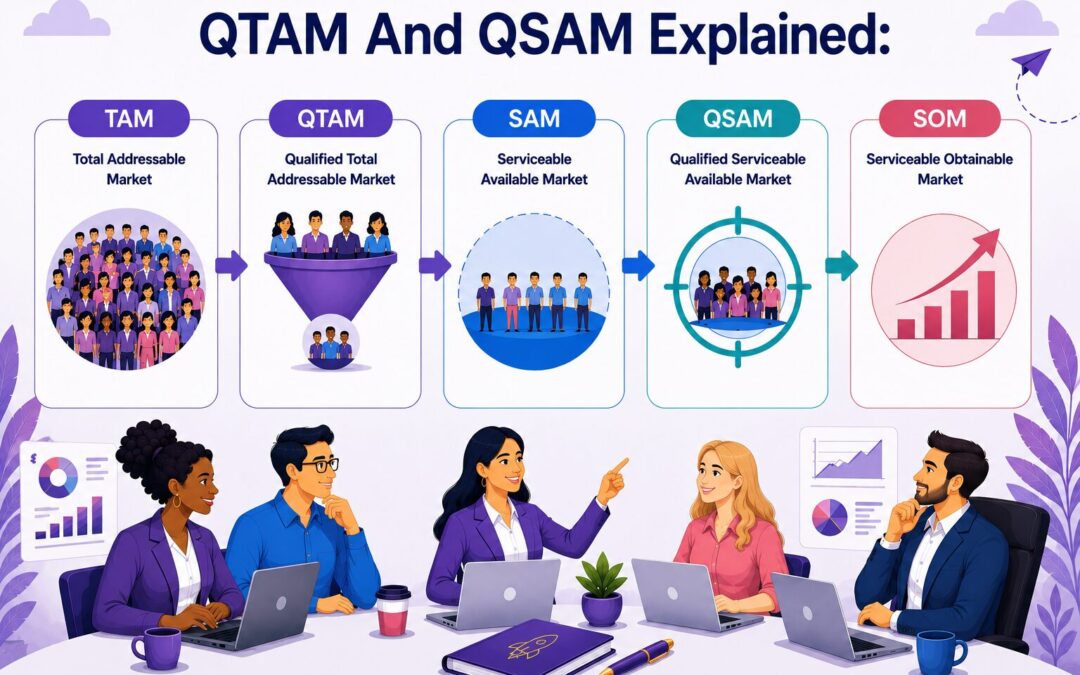
The core market sizing aspects that most founders overlook, such as QTAM and QSAM, are actually what investors focus on. When reviewing the pitch, they want to know: “How big can this company potentially become?” And, next, “Is this company capable of delivering venture-scale returns?”
Most venture capitalists (VCs) realize profits from the top 3% to 5% of companies in their investment portfolio. They are evaluating whether yours is one of them. Market sizing is not just a pitch deck exercise; it influences valuation, fundraising success, hiring plans, product strategy, and exit potential.
Most founders understand TAM, SAM, and SOM at a surface level. However, these metrics present unrealistic numbers that undermine their credibility and are just half the picture. Know that investors want to see additional market-sizing nuances that go beyond purely theoretical opportunities.
The five layers of market opportunity include:
- TAM (Total Addressable Market)
- SAM (Serviceable Addressable Market)
- SOM (Serviceable Obtainable Market)
- QTAM (Qualified Total Addressable Market)
- QSAM (Qualified Serviceable Addressable Market)
Founders are typically well aware of the TAM, SAM, and SOM, but only highly experienced fundraising consultants discuss QTAM and QSAM.

*FREE DOWNLOAD*
The Ultimate Guide To Pitch Decks
Understanding The Market Opportunity Funnel
An authentic market opportunity sizing funnel starts with the TAM. At each subsequent stage, it systematically eliminates customers unlikely to complete the purchase.
The progression looks like this: TAM → QTAM → SAM → QSAM → SOM
At each stage, the target audience becomes smaller, making marketing and advertising strategies more efficient. You’ll learn how to customize your approach to laser-focus on potential buyers. As a result, assumptions become more realistic, which, in turn, increases investor confidence.
What Is TAM (Total Addressable Market)?
When you talk about TAM, it represents the total revenue the startup can potentially earn. That is, if it captures 100% of its market. In simple terms, capturing a market in which the company has no competition, no geographic limitations, and unlimited resources.
Why TAM matters? Investors use this metric to determine if the market is large enough to generate venture-scale returns. Think about it. A startup operating in a $50M market can become a great business. However, a startup operating in a $50B market could become a unicorn.
When calculating TAM, investors use two methods:
- Top-down approach: Here, industry reports and analyst research outline the stats you need. For instance, the global customer relationship management (CRM) market is worth $100B. In that case, a startup targeting this market has a TAM of $100B.
- Bottom-up approach: Here, you’ll calculate the total number of customers you can serve and multiply that by annual revenue per customer. For instance, you anticipate serving 10 million customers with an annual spend of $100. Thus, you get a TAM of $1B.

Raise Capital Smarter, Not Harder
- AI Investor Matching: Get instantly connected with the right investors
- Pitch & Financial Model Tools: Sharpen your story with battle-tested frameworks
- Proven Results: Founders are closing 3× faster using StartupFundraising.com
Downsides of Conventional TAM
Conventional TAM metrics use industry reports that are often inflated and include customers who MAY or MAY NOT buy. Then again, this number does not account for market saturation or existing brands providing the same product. Moreover, it assumes that every potential user is equally valuable.
When investors view it, they see the TAM as the ceiling. But not how much of the market the startup can realistically capture. This is why the Qualified Total Addressable Market (QTAM) has more value.
What Is QTAM (Qualified Total Addressable Market)?
The QTAM is essentially TAM adjusted against the likelihood of real-world buying. When calculating this metric, you’ll factor in specific qualification criteria that enable you to arrive at a realistic figure. This is the actual number of customers most likely to purchase the product. Qualifying criteria are:
- Purchasing power
- Budget availability
- Industry fit
- Technology readiness
- Regulatory eligibility
- Customer urgency
- Adoption willingness
Let’s try an example. You’re building an AI software startup with a conventional TAM of 100 million businesses worldwide. Next, you calculate QTAM by eliminating microbusinesses without budgets, businesses lacking infrastructure, and companies in restricted jurisdictions.
After removing the non-qualified audience, you’re left with 15 million potential companies that might buy the product. The opportunity thus becomes dramatically smaller—but far more credible. Investors are likely to appreciate this market calibration much more than they would with a typical TAM.
That’s because the QTAM demonstrates that you understand the target audience and their buying limitations. It also shows that you have filtered the audience by carving out the unviable segments to arrive at a true target profile. This is a crucial aspect of market sizing.
Moreover, your metrics and financial projections are firmly grounded in reality, not over-inflated. The investor reviewing the pitch can see that you’ve anticipated market friction and the roadblocks to adoption. You know exactly which customers to target on day one, which raises the chances of success.
What Is SAM (Serviceable Addressable Market)?
SAM represents the portion of TAM that your startup can actually serve. It accounts for the operational limitations your startup is likely to face when serving the target market. For instance, geographical, compliance issues, language barriers, distribution and logistics concerns, and industry focus.
Let’s try an example. You’re building a startup developing healthcare software targeting a worldwide market or a TAM worth $100B. However, it can currently serve only English-speaking customers in North America. Further, the software is suitable only for mid-sized hospitals.
Accordingly, the SAM is now $12B—this is the market you can realistically sell to today. From your investor perspective, SAM attracts more attention because it reflects the company’s actual execution potential.
When you fail to calculate SAM accurately, you’ll overlook the startup’s selling capacity and assume global reach from day one. But, more than your startup’s ability to sell, you need to think about the customer’s ability, interest, or intent to purchase. That’s where QSAM comes in.
Keep in mind that storytelling is everything in fundraising. In this regard, for a winning pitch deck to help you here, take a look at the template created by Peter Thiel, Silicon Valley legend (see it here), that I recently covered. Thiel was the first angel investor in Facebook with a $500K check that turned into more than $1 billion in cash.
Remember to unlock the pitch deck template that founders worldwide are using to raise millions below.
What Is QSAM (Qualified Serviceable Addressable Market)?
The missing layer that most founders ignore is the QSAM—they simply stop at SAM. When you add QSAM metrics to the pitch, it quickly builds investor conviction. You’ll use qualifying criteria like:
- Ideal customer profile
- Have buying authority
- Have budget
- Have urgency
- Can be reached through existing channels
QSAM connects market size to go-to-market reality, and that’s what makes it a powerful calibration. It answers the question: “Among the customers we can serve, who is actually likely to buy?” Let’s try an example. Your startup is developing a product targeting 500,000 potential customers.
After factoring in the qualifying criteria, you find that just 50,000 fit the ideal customer profile (ICP). Your analysis also indicates that 80,000 don’t have the urgency and 120,000 lack the budget. As a result, your QSAM is 50,000 customers.
Now that you have a narrower targeted customer profile, it helps investors examine other factors more closely. For instance, the efficiency of your sales strategies, customer acquisition programs, product-market fit, and conversion assumptions. Decision-making is more streamlined and quicker.
What Is SOM (Serviceable Obtainable Market)?
The SOM is the next market sizing aspect. It represents the share of the opportunity a startup can realistically capture, but within a specific time frame. Here’s where calibrating market sizes takes on an actionable dimension. Several factors can influence the size of the customer base you can serve.
- The company’s current available resources, such as team size, marketing budget, and the number of dedicated sales representatives actively working.
- The competitive landscape, including existing competitors, market leaders, and the adoption costs customers must bear.
- Scaling challenges the startup faces, such as the availability of capital, product development capacity, and the pace at which it can attract talent.
- The distribution channels you can tap include strategic partners, direct sales, or self-serve or product-led growth.
Let’s try an example. Your qualified serviceable addressable market (QSAM) is 50,000 customers. You estimate you can reach 5% of this number in 5 years, which amounts to 2,500 customers. Assuming the annual recurring revenue (ARR) is $10K, your SOM is $25M ARR.
Investors appreciate these numbers because they help build the connection between opportunity and execution. They demonstrate that the founder understands reality.
Nascent companies that have yet to generate actual profits often rely on projections to prove their viability and profitability. But when you present additional layers to the conventional TAM, SAM, and SOM, it indicates that these projections are rooted in reality.
How Investors Evaluate Market Size Using All Five Layers
Sophisticated investors increasingly think in stages when evaluating startups for funding. Here’s what happens:
- TAM: How large is the opportunity in theory?
- QTAM: How many customers are actually likely to purchase the product?
- SAM: How many customers, and which ones, can the startup actually serve?
- QSAM: Who are the customers capable of and interested in buying?
- SOM: How many customers can the startup serve considering its current production capacity?
Each layer thus eliminates uncertainty, resulting in a far more credible investment opportunity.
Common Market Sizing Red Flags Investors Detect
Relying on conventional TAM, SAM, and SOM market sizing aspects isn’t likely to impress potential investors. You’ll only raise red flags, making them discount your pitch entirely. Here’s what they see:
- Massive TAM, but a small SOM indicates that the founders have grossly overstated the market size. For instance, the TAM could be $500B, but without efficient distribution, the execution cannot capture that market.
- The absence of QTAM indicates that the founder has failed to apply segmentation. The entire market is a customer, but without qualifying actual buyers who will actually buy the products. Without the right go-to-market sizing, TAM becomes immaterial. Investors immediately discount these assumptions.
- Demonstrating only TAM indicates a total lack of qualification logic. A Total Addressable Market includes all customers within the market without accounting for their budgets, needs, or purchasing authority.
- An unrealistic SOM is another red flag. Although this metric centers on the company’s execution capability, it should be viewed in relation to the additional aspects. For instance, assuming 10% market share within three years in a highly competitive market. When founders fail to account for competing brands, SOM values become meaningless.
- Ignoring customer adoption friction can quickly discredit all calibrations. The existence of a market does not guarantee demand. Although better solutions to their problems are available, customers may choose to disregard them if the costs of deployment or transitioning are too high. Then again, disruptions to their day-to-day operations may also lead customers to rethink their purchase. Simply pricing, suitability, and purchasing authority may not be enough to push buyers to finalize the deal.
Building A Market Sizing Model Investors Trust
Your pitch deck must include a strong framework that progresses sequentially through the various market-sizing layers.
- You’ll start by calculating the TAM, which enables you to determine the total demand in theory.
- Step 2 is when you eliminate unqualified prospects by matching them against the different criteria.
- Step 3 is when you look inward and apply operational limitations to realistically determine which segment of the market you can actually serve.
- Step 4 matches your execution abilities to the ideal customer profile most likely to purchase products.
- Step 5 involves the SOM, in which you’ll apply realistic market-penetration assumptions. This metric helps investors estimate the annual recurring revenue (ARR) the startup can generate.
Adopting this process results in a market-sizing model grounded in reality rather than optimism.
Conclusion: Why The Future Of Market Sizing Aspects Is Qualification
Conventionally, founders have focused solely on the Total Addressable Market (TAM). They fixate on the total worldwide market they can eventually capture. But investors are now much more sophisticated. They understand that not every customer is reachable, qualified, or willing to buy.
To earn investor confidence, you must move beyond the market size in theory and demonstrate the ability to execute. You’ll also prove that you have deep insights into customers who are actually interested in purchasing the product. And, will finalize their purchase.
That is why the future of market sizing is no longer just TAM, SAM, and SOM. It is a sequence that includes TAM → QTAM → SAM → QSAM → SOM. Founders who master this framework don’t just present bigger opportunities—they present more believable ones.
You may also find our free library of business templates interesting. There, you will find every single template you need to build and scale your business completely, all for free. See it here.



Facebook Comments