

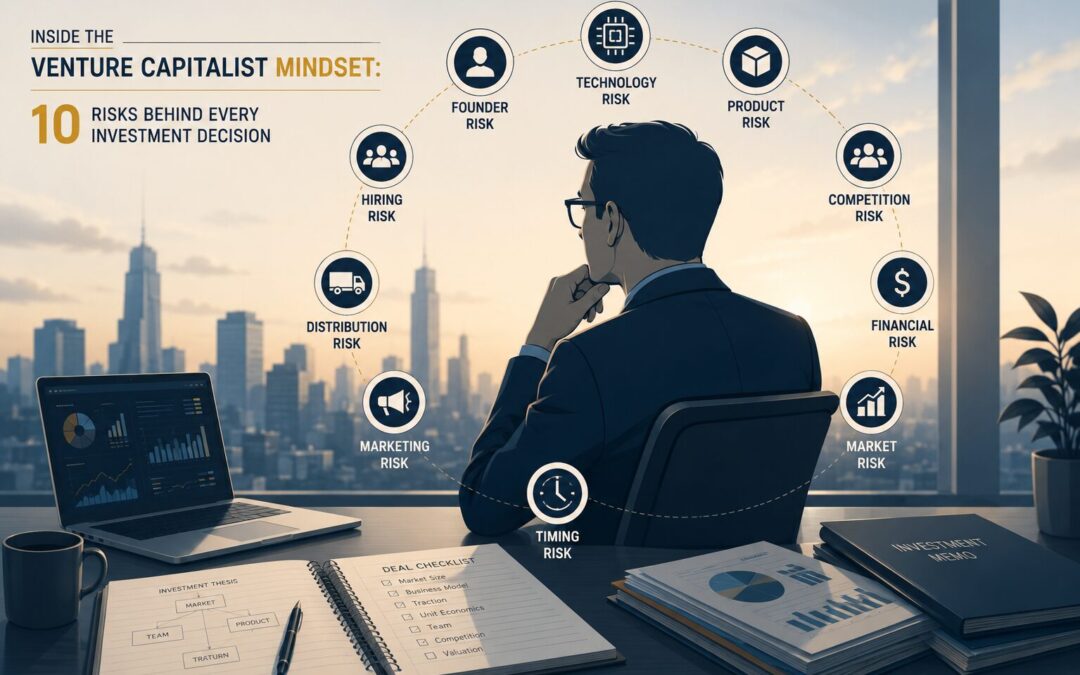
Investors don’t just invest in startups based on pitch decks; they evaluate 10 risks behind every investment decision. When reviewing the deck, they’re looking for opportunities with the least risk.
Most founders believe investors are searching for reasons to invest. In reality, investors begin from the opposite position. Every startup represents uncertainty, and every investment decision is an exercise in eliminating another layer of uncertainty.
If the investment committee can arrive at a point where writing the check becomes rational, that’s when it accepts the proposal. You can help move the needle by designing a pitch that addresses and removes every risk. Your job is to systematically eliminate every reason for rejecting the pitch.
Through each consecutive funding round and growth stage, you’ll laser-focus on risks and work on eliminating them. For instance, at the pre-seed stage, you’ll ensure that you’ve accurately identified customer pain points. You’ll also create a workable, cost-effective solution that’s easy to deploy.
As a savvy founder, you’ll work to understand the venture capitalist mindset and how they perceive risk. Keep in mind that most VC firms earn profits from the top ~3% to 5% of the startups in their portfolio. Worse, they lose around 75% of their invested capital when startups fail.
When evaluating the 10 risks behind every investment decision, VCs are looking for signals that your startup isn’t likely to cost them capital. Read ahead to understand how they think.
*FREE DOWNLOAD*
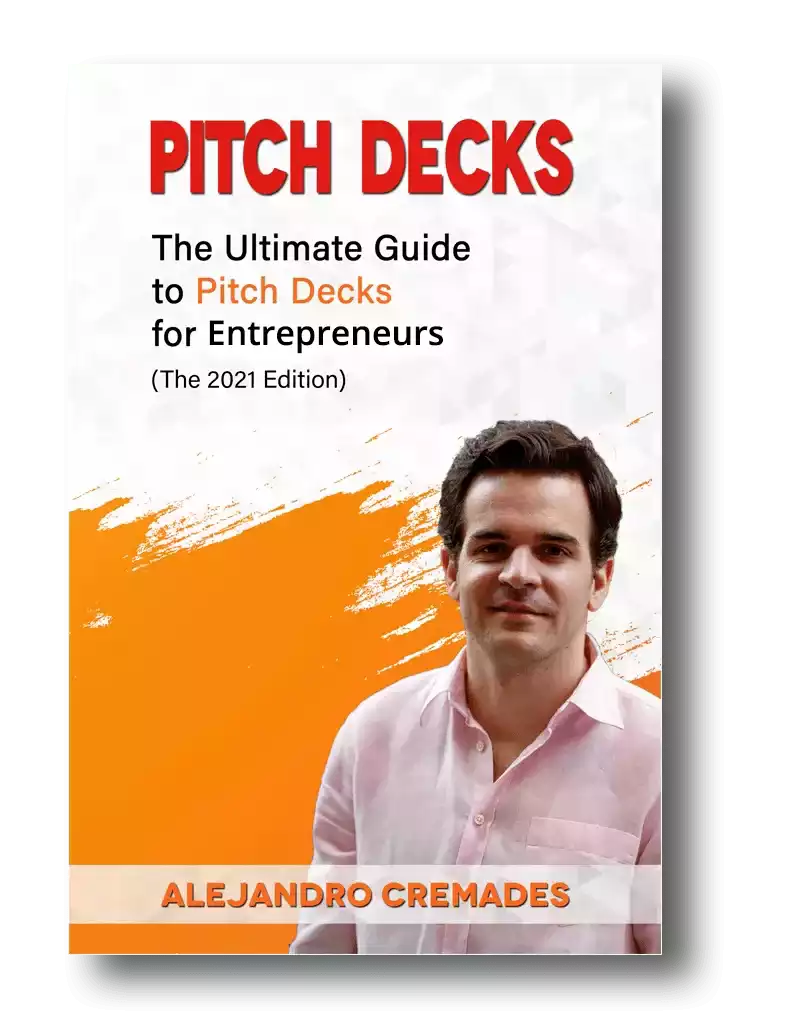
The Ultimate Guide To Pitch Decks
Understanding Venture Risk
Venture investing isn’t about predicting winners or identifying ideas that can potentially become the next unicorns. It’s about determining whether the founders have addressed enough of the major risks. These 10 risks include founder, market, competition, timing, financing, and marketing, for starters.
Venture risks are not standalone milestones that you’ll resolve sequentially. Each of them is deeply layered and tightly interconnected, and resolving one or two directly impacts multiple others. For instance, a well-experienced founder with domain expertise is likely to attract top talent.
Once you hire top talent, you’ll develop high-quality products that customers appreciate and are open to purchasing. Word-of-mouth advertising, referrals, and rave reviews address competition risk and product-market fit issues. These are the signals investors are looking for.
1. Founder Risk—Can This Team Execute?
The cofounders/founder developing the startup is the first layer of risk. Investors back people, their domain expertise, and track record with companies they have successfully built and exited. A great example is Alex Haro, founder of Life360, which IPO’d in the USA and Australia.
When Alex developed his next company, Hubble Network, a highly capital-intensive venture, previous investors blindly supported him. His success with Life360 prompted them to believe in his ideas, no matter how crazy they sounded.
Investors are also looking for founders with impressive leadership qualities, their ability to recruit talent, and resilience. An understanding of customer needs and purchasing behaviors is another trait they look for. If you can provide references from notable entities, that’s an added plus.
Above all, investors support people who are open to criticism and receptive to the advice and guidance investors share. Keep in mind that investors are not always passive observers; some believe in hands-on involvement in driving the company forward.

Raise Capital Smarter, Not Harder
- AI Investor Matching: Get instantly connected with the right investors
- Pitch & Financial Model Tools: Sharpen your story with battle-tested frameworks
- Proven Results: Founders are closing 3× faster using StartupFundraising.com
2. Technology Risk
Many founders develop disruptive technologies and seek funding to build startups around them. But not every invention has the potential to become a product that solves a customer pain point. For that to happen, you need to build a workable product complete with a stable infrastructure.
You also need to hire top talent and create a product roadmap driven by the technical capability to manufacture at scale. Only then can you hope to lower per-unit costs and sell the product at a price that makes sense to the buyer.
These are the lessons Ali Agha learned when building FieldAI, which went on to raise an astounding $400M. When developing robots to operate in dangerous, dirty environments, he realized that building for millions of users requires a different way of thinking.
The focus is on clear ROI, cost efficiency, seamless usability, and driving the exact value the customer wants.
3. Product Risk
Although the technology and product seem similar, from an investor’s perspective, the risk profiles are entirely distinct. Regardless of how innovative a solution is, customers must want to genuinely buy it.
Investors need to see that the product is not a one-time impulse purchase. But something that users continue to deploy repeatedly, which can translate into consistent revenue and profits. Your pitch needs to prove product usage with Net Revenue Retention (NRR) numbers and customer feedback.
Include metrics in the deck to prove high customer retention with low churn. Talk about regular engagement with users and the improvements you’ve been making based on feedback. If you can prove traction, you’ll address another of the 10 risks behind every investment decision.
4. Market Risk—Will Customers Actually Buy?
The market is flooded with dozens of competing products and solutions. When investors evaluate 10 risks behind every investment decision, they’re looking for what sets your brand apart. Founders make exceptional claims about their innovations, but the question remains: Will customers buy?
Your pitch should demonstrate that the product bridges an important gap in the market. Furthermore, it addresses a critical pain point that customers need solved right now. Urgency is the key here. And to do that, you’ll include data that validates your claims.
Include customer testimonials and reviews about the product as well as their experiences with its features and performance. Don’t forget to add referrals and decrease in customer acquisition costs.
Also, add numbers outlining the number of customers who purchased the product, and those who placed repeat orders. Retention rates and the revenue you’ve earned are critical signals for investors.
When you prove real customers have validated the product and its design, it builds conviction. And that conviction transforms into checks.
5. Competition Risk
Product differentiation is one of the key risks investors want to eliminate. They must believe that the product has a competitive moat, such as proprietary intellectual property (IP) or a patent. In short, a defensible advantage that gives it an edge.
A great product by itself is sometimes not enough. Customers have to want to make the transition to a new brand, not just because it is cost-effective. You have to assure them that the transition will be streamlined, low-cost, and cause them the minimum operational disruption.
Most importantly, transitioning to your brand should improve their bottom line. Not investing in your product should seem like leaving money on the table.
Investors want to see how your brand wins against incumbents or existing market players. And if you can demonstrate clear market positioning. To do that, you’ll present metrics on the number of buyers who have switched brands, along with their testimonials.
Keep in mind that a lack of competition is a much more significant risk. It tells investors that there’s no market for the product and you’re trying to solve a problem that probably doesn’t exist.
6. Timing Risk
Timing is often crucial for any product launching in the market. It’s one of the primary concerns investors have when evaluating the 10 risks behind every investment decision. Historically, products have failed because the technology was in its nascent stage and the infrastructure was just not ready.
A great example is the 1993 Apple Newton, a handheld “Personal Digital Assistant” (PDA) that featured a touchscreen and handwriting recognition. The downside? Processors in the early 1990s were just not powerful enough, and the World Wide Web was in its infancy. It failed completely.
This is why investors back products that align with industry trends, technology shifts, and changing customer perceptions and purchasing preferences. They know that macro tailwinds, as well as supporting regulatory frameworks, are crucial for a product’s success.
Dan Wertman’s company, Noetica, is possibly one of the best examples of perfect timing—the kind that helped win $29M in funding. Discussing its inception on the Dealmakers Podcast, Dan reveals how he uncovered a gap in the market.
While studying a 500-page, multibillion-dollar agreement, he realized there was no database that could explain how the terms worked. Dan combined this pain point with fast-emerging AI language models well before consumer-grade GPT, and AI became mainstream. The timing was perfect.
7. Financing Risk—Can This Company Reach The Next Milestone?
One of the most significant risks investors understand is the startup running out of money before its next milestone. This situation triggers a domino effect of disasters, such as a low valuation. This is why they scrutinize the financials slide carefully.
Investors want to fund a company that demonstrates progress, not one that is fighting for survival. This is why they ensure that it has a sensible financial model, a realistic hiring plan, and clear capital allocation. They want to know how much money you want to raise and what you’ll use it for.
Your pitch must clearly outline the milestone roadmap and how you intend to get there. That’s the proof investors are looking for. They also analyze capital efficiency, burn rate, runway, and your ability to accurately estimate the money you need. Your fundraising has to be milestone-driven, not vague.
Keep in mind that storytelling is everything in fundraising. In this regard, for a winning pitch deck to help you here, take a look at the template created by Peter Thiel, Silicon Valley legend (see it here), that I recently covered. Thiel was the first angel investor in Facebook with a $500K check that turned into more than $1 billion in cash.
Remember to unlock the pitch deck template that founders worldwide are using to raise millions below.
8. Marketing Risk
Initial demand alone is not enough to win investor conviction; you need to demonstrate that demand can be generated consistently. Investors back brands and products with repeat customers and organic sales growth, rather than relying solely on paid advertising.
The numbers under scrutiny here are declining customer acquisition costs (CAC) and a lower CAC-to-conversion ratio. For every dollar you spend on advertising, conversions are growing consistently. It also indicates how advertising initiatives continue to generate sales without effort.
9. Distribution Risk
Distribution challenges are another of the 10 risks behind every investment decision that investors evaluate. Although marketing and distribution are closely interlinked, they view numbers through separate lenses. Generating demand is easy, but can the company distribute products efficiently?
Your pitch should answer questions about your ability to reach customers at scale. Efficient sales channels, strategic partnerships, enterprise customers, and international expansion modules win investor confidence. Product-led growth in sales, particularly in SaaS startups, is a win.
In the self-serve go-to-market model, customers find, evaluate, purchase, and onboard themselves onto a product without ever needing to interact with a human sales representative. Automated workflows guide the user through understanding the product design, purchase, and onboarding.
Strategies like these signal lowering marketing and advertising costs, but with low-friction entry for users. This is a company worth backing—from the investor perspective.
10. Hiring Risk—Can The Organization Scale?
The ultimate test of any startup is whether it has the potential to scale. The founder should have the leadership skills to hire and retain top talent essential to take the company forward. Scaling a company involves several additional aspects and expertise that the founder may not possess.
This is why investors scrutinize the hiring process, company culture, and management capabilities, along with, most importantly, low turnover and employee attrition rates. Companies often outgrow founders, and they must bring in outside experts to handle their growth.
Moreover, founders should have the maturity to recognize when it’s time to exit the company through an acquisition deal. That’s what David Dorfman did with his first company, YAPI. In 2021, as consolidation in the dental tech industry was gaining traction, he received several buyout offers.
However, David and his cofounders were seeking investment backing to enable YAPI to deliver 5x to 10x the value they were contributing to the industry. That’s when they received an offer from M33 and accepted the eight-figure acquisition deal.
Investors prefer to work with founders who present clearly defined exit pathways that will enable them to realize returns. This exit can be through an acquisition or with the company going public with an Initial Public Offering (IPO).
Risk Is Layered—Not Sequential
One of the biggest misconceptions among founders is believing that once a milestone is reached, the work is done. However, it is crucial to understand that risks evolve with changing market conditions and the overall macroeconomic landscape.
New tech emerges, customer buying preferences change, and regulatory issues can arise. Moreover, none of the 10 risks behind every investment decision is standalone.
Every startup faces intertwined hurdles, and dealing with each helps address others. The winning pitch is one that weaves these risks into the narrative.
Investors are not asking: “Is this startup perfect?” They’re asking: “Has the founder grasped the significance of each risk? What risks remain, and are they acceptable given the potential upside?”
At every fundraising round, you’ll clarify the risks that the previous milestone has successfully eliminated. You’ll also present a realistic view of the remaining risks and how the next round of funding will remove the next set of risks.
This is how you’ll transform fundraising from a narrative about vision into a narrative about steadily increasing investor confidence.
You may also find our free library of business templates interesting. There, you will find every single template you need to build and scale your business completely, all for free. See it here.


Facebook Comments