


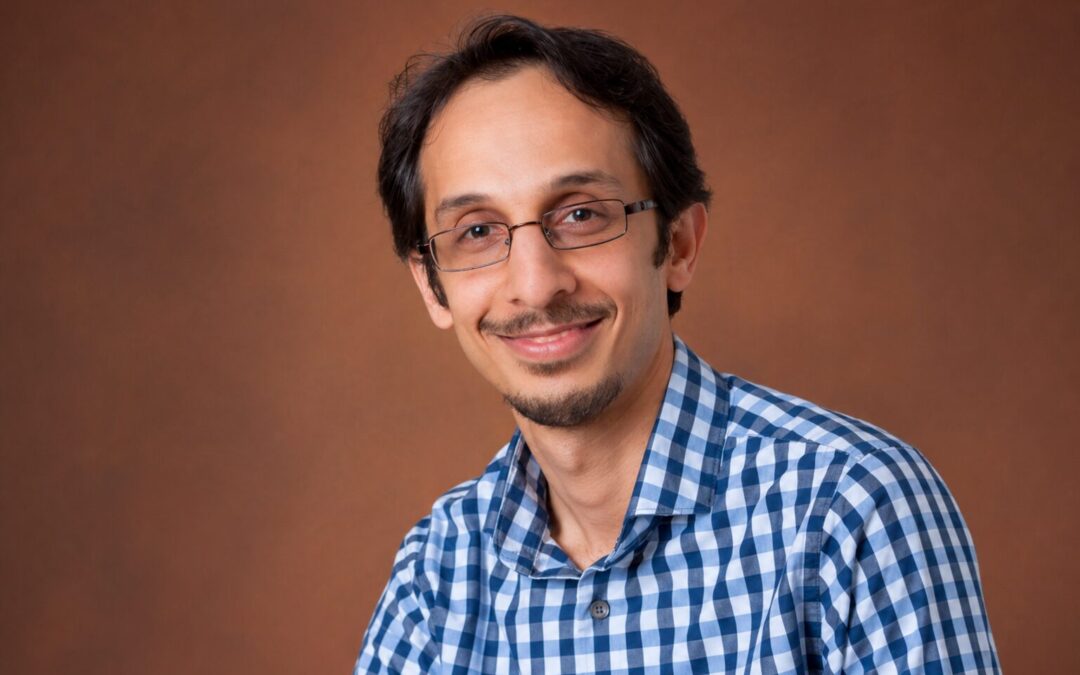
Ali Agha is among the rare founders who have bridged the gap between the fascinating world of theoretical robotics and reliable, real-world applications. He has overcome the challenges in the promising field of robotics, which, up until now, has only been impressive in controlled spaces.
Ali’s path—from tinkering with motors as a kid to leading a company that has raised over $400M—is not just about building robots. It’s about redefining how machines think, operate, and scale in the real world. At FieldAI, Ali isn’t building robots. He’s building their brains.
Listen to the full podcast episode and review the transcript here.

*FREE DOWNLOAD*
The Ultimate Guide To Pitch Decks
The Early Spark: A Lifelong Obsession With Math and Machines
Ali’s story begins with curiosity. Growing up in a snowy region, he was drawn early to math, tools, engineering, and the simple joy of making things move.
Whether it was wiring batteries to spin motors or playing with toys that had even a hint of autonomy, the fascination was always the same: creating systems that could act on their own. That curiosity matured quickly as Ali learned to code and realized that software could perform tasks.
During his undergraduate years, Ali joined robotics teams and began building increasingly complex programs and systems—from simple line-following robots to autonomous soccer bots competing in RoboCup tournaments.
The Realization: Theory Alone Isn’t Enough
Ali did his undergraduate and master’s in a program combining electrical engineering and computer science. Even before coming to the US, he had started working on more sophisticated platforms.
Sometime in 2006-2007, Ali moved from a small school on the other side of the world to Georgia, Atlanta, and won the best mobility in RoboCup competitions there. Working on the early RoboCup competitions, one insight stood out. Real-world robotics is far harder than it looks.
Ali realized how much work needed to be done on the theoretical side and in improving the algorithms for these platforms to actually deliver real-world performance.
Ali then moved on to a different league of more complex robotics systems, where they were building rescue bots. These bots had flippers and navigated unstructured environments, which truly fascinated him.
Ali began to appreciate how critical it is to have robust methodologies, advanced technologies, and theoretical frameworks for understanding the world, the robot’s state, and its behavior. The robot must identify its environment, learn to make decisions safely, and consistently improve its learning.
As Ali points out, getting robots to operate reliably is beyond the theories and methodologies available in textbooks. When robots operate in the real world, they are not dealing with linear systems or Gaussian noise.
Basic assumptions that are incredibly important to learn and build on don’t directly apply. To build robots, you need to move beyond assumptions and develop solutions that actually survive off-nominal cases and the complexities of the real world.

Raise Capital Smarter, Not Harder
- AI Investor Matching: Get instantly connected with the right investors
- Pitch & Financial Model Tools: Sharpen your story with battle-tested frameworks
- Proven Results: Founders are closing 3× faster using StartupFundraising.com
Pursuing a PhD in Texas
The pivotal moment came when Ali was pursuing his PhD in computer science in Texas. He immersed himself in advanced mathematics, probability theory, stochastic differential equations, and risk identification and quantification.
Ali reiterates that deploying the robots in the real world, ironically, helped him appreciate the depth of theory. He wasn’t just learning existing frameworks—he was extending them, building new approaches to quantify uncertainty and risk in dynamic environments.
The result was a set of breakthroughs and seminal papers that made robots more capable, more adaptive, and more reliable in the real world.
From Academia to Impact: MIT and Qualcomm
After his PhD, Ali continued pushing the boundaries of robotics at MIT, where he expanded his work from single-robot autonomy to multi-agent systems—teams of robots coordinating in decentralized ways. For instance, coordinating flying platforms with ground platforms together to take action.
This phase also led to a pivotal relationship: meeting his future co-founder, who would go on to work at DeepMind, build models, and advance the foundations of machine learning.
From MIT, Ali moved to Qualcomm, where the focus shifted to efficiency—bringing autonomy to resource-constrained hardware. At Qualcomm, they were working on robotics, drones, and self-driving cars. Ali and his team were exploring the idea of putting algorithms on their processors.
Here, he worked on deploying perception and autonomy systems onto chips, a step that would later influence one of NASA’s most ambitious projects. Ali recalls how they organized the first CES show on the robotics and drones side—a continuous progression in his work.
That work caught NASA’s attention. At the time, the Mars helicopter was not a publicly announced mission, but NASA was in discussions with Qualcomm about using its lightweight, low-power processor on the Mars helicopter. That’s how Ali moved to NASA—a once-in-a-lifetime opportunity.
The Move to NASA
Ali enjoyed the level of intensity at NASA. His work involved two separate sections. On the management track, he was a group supervisor in aerial mobility and later also worked in the perception group.
The Mars helicopter flew on Mars, powered by a Qualcomm chip. Ali recalls how exciting it was to watch the incredible NASA team in operation. Since Earth and Mars’ relative positions cannot be altered, everything had to be ready for the launch date, which could not be changed.
At NASA’s Jet Propulsion Laboratory, Ali found himself at the center of some of the most demanding engineering challenges imaginable. From contributing to the Mars helicopter program to leading DARPA-backed initiatives, the work required not just innovation—but extreme reliability.
For Ali, working at NASA was an incredible phase of his career. Over his years of work in robotics, including his PhD and postdoctoral work, he had developed several theories for deploying robots. It was now time to apply them in the real world and test their impact.
Initiating Projects at the Jet Propulsion Laboratory
Around this time, Ali began applying for and securing grants that enabled him to initiate multiple projects at the Jet Propulsion Laboratory.
These initiatives ranged from early efforts focused on deploying legged platforms and dog robots in Mars-analog caves to search for signs of life and microbial colonies, to other projects. The legged robots would go into unknown environments with no communication in an analog setting.
Ali also led projects for DARPA challenges—competitions like the DARPA Subterranean Challenge and DARPA RACER. As he explains, these are probably among the major breakthroughs of the last decade in deploying robots in complex environments.
The task was to send a team of robots—wheeled, legged, and flying—to environments that they had never seen before—from underground to industrial facilities.
Here, the robots had to perform various tasks, from building a model of the world to detecting specific objects ahead of first responders. Ali recalls that it was a very unique experience. Teams had one hour to execute what took years to build. The margin for error was effectively zero.
This environment sharpened Ali’s understanding of what truly matters—systems that don’t just work in theory, but survive in the harshest real-world conditions. The urban phase was organized pre-COVID, and Ali’s team won the competition against some of the world’s best players.
Post-COVID, although Ali and his team scrapped the project, it was a huge learning process. They had pushed the state of the art significantly on many fronts—from common wear autonomy to computer wear autonomy to multi-agent operations, all the way to a single brain operating across many different embodiments.
Post-COVID, another DARPA RACER competition was organized, focused on large vehicles traveling tens of miles into off-road environments with no GPS, no satellite imagery, and no map. They had to travel many miles to hit another flag.
Most of the team from the DARPA Subtraining Challenge moved to DARPA RACER. Ali recalls how they created a deeper, stronger bond and pushed the industry and technology much further forward. They enabled and fostered many new theoretical and technological breakthroughs there.
These competitions were behind many major innovations in robotics, and Ali was part of the key groups that enabled them. The intensity was on another level altogether.
The Breakthrough Insight: Bridging Two Worlds of AI
Talking about the inspiration behind FieldAI, Ali goes back to his time at NASA, where a critical insight began to take shape. At NASA, they were seeing the evolution of methodologies and doing things that were years ahead.
The teams were identifying the roadmap ahead and where it could go, vis-à-vis timing and hardware commoditization. This resulted in million-dollar robots and other hardware becoming available at more cost-effective levels.
Computing was also evolving quickly. This meant that robots could do much more without direct, consistent connectivity. When Ali started discussing these developments with his DeepMind cofounder and other colleagues, they concluded that there are two ends of the spectrum.
On one side of the AI spectrum were foundation models—powerful, data-driven systems capable of generalization but prone to hallucination and lacking physical grounding.
On the other side were physics-based robotics systems—highly reliable and interpretable, but difficult to scale and adapt across environments. What if you could combine both? That question became the foundation of FieldAI.
Instead of building traditional transformer-based systems, Ali and his team designed a new architecture—one that embeds physics, uncertainty, and risk awareness directly into the model from day one. The goal wasn’t just intelligence—it was deployable intelligence.
Systems that could operate safely, adapt quickly, and function in real-world environments without needing massive datasets or perfect conditions. Because that architecture was the key, FieldAI could quickly develop a go-to-market product and approach customers.
As Ali explains, the architecture enabled them to penetrate the market because it is deployable and has also helped them attract incredible talent from all the different institutions. Customers can get all the benefits from day one. And because it’s safe to deploy them, the momentum has been incredible.
FieldAI: Building the Brain for Every Robot
FieldAI’s core idea is deceptively simple: create a universal “brain” that can operate across different robots, environments, and tasks. In the sense that it is a highly horizontal company.
Rather than building specialized solutions for each use case, the company is developing a general-purpose autonomy layer that can power everything from multi-ton industrial vehicles to humanoid robots.
At a high level, its business model is software or robot-as-a-service (RaaS), reflecting this flexibility. Some customers can purchase the full solution. Others can buy the brain and expand it within their ecosystem, so they just license the software.
FieldAI is deploying a range of platforms, from multi-ton, very large vehicles and wheeled platforms, to small dog robots and humanoids. These options are highly generalizable across modalities and can be deployed across different business units, including construction, the main sector.
The company focuses on what Ali calls “DDD environments”—dirty, dull, and dangerous settings where traditional automation struggles. These include construction sites, energy infrastructure, manufacturing, and urban operations such as last-mile delivery, security, and federal operations.
What sets FieldAI apart is its ability to deploy robots without pre-mapped environments, GPS, or extensive prior data. The system interprets the world in real time, much like a human worker would, and continuously improves through a data flywheel created by real-world usage.
As Ali explains, even if billions of tokens of data from that environment are unavailable, the physics and uncertainty-quantification pieces baked into these architectures kick in as soon as the robots are about to hallucinate. They adjust the platform’s behavior to ensure they can be safe and deploy.
The robots can perform tasks that humans use their hands for, such as opening doors, picking up objects, and coordinating different assets in a multi-agent fashion.
Scaling Fast: From Deployment to Data Flywheel
Despite operating in a capital-intensive industry, FieldAI has maintained a relatively lean approach. Its architecture allows it to learn from smaller datasets, and early deployments have generated real revenue.
This combination—efficient learning and immediate deployment—has created strong momentum. Interest in the physical AI world, the applications of robots, the tasks they can accomplish, and the speed at which they can deliver ROI has spurred demand.
The company’s fundraising journey reflects that traction. With over $400M raised, much of the interest has been inbound, backed by investors including Bezos Expeditions, BHP Ventures, Canaan Partners, Emerson Collective, Intel Capital, Khosla Ventures, NVentures (NVIDIA’s venture capital arm), Prysm, and Temasek.
Storytelling is everything that Ali was able to master. The key is capturing the essence of what you are doing in 15 to 20 slides. For a winning deck, take a look at the pitch deck template created by Peter Thiel, Silicon Valley legend (see it here), where the most critical slides are highlighted.
Remember to unlock the pitch deck template that founders worldwide are using to raise millions below.
But for Ali, capital is not the end goal—it’s an accelerator. The focus remains on expanding deployments, accelerating deployment, strengthening the data-model feedback loop, and delivering measurable ROI to customers.
The Bigger Vision: Millions of Robots, One Brain
As Ali points out, FieldAL performs across many different types of platforms, including, for instance, vehicle dynamics. The world model adapts to four-legged and two-legged robots in different environments and variations across hundreds of sites, from construction to manufacturing and more.
The market is highly expansive, and the solutions are maturing quickly. Looking ahead, Ali envisions a world where millions of machines operate autonomously across industries, safely and responsibly, thanks to physics-awareness of uncertainty and risk.
In the future, robots can be deployed in places beyond the limits of traditional and multi-agent solutions in the industrial sector.
FieldAI is building a brain that operates across a heterogeneous fleet of assets and can grow and penetrate markets that were traditionally off-limits to robotic solutions.
As Ali sees it, robots will be incredibly critical going forward, from construction to operation, to increasing productivity and increasing safety, and addressing massive labor shortages across many of the sectors in which they are being deployed.
FieldAI aims to be at the center of that transformation—providing the intelligence layer that powers these systems. And the opportunity extends far beyond Earth. From industrial applications to lunar operations, Ali sees robotics as essential infrastructure for the future.
The Defining Factor: Software, Not Hardware
While much attention in robotics focuses on hardware, Ali believes the real bottleneck—and opportunity—is software. Today’s robots are already capable of far more than we extract from them. In expert hands, they can deliver tremendous value.
Ali concedes that hardware needs a lot more improvement, and a variety of different robots will soon be launched. He foresees more robust, more cost-effective platforms coming up. The challenge is replicating that expertise through AI.
Ali asks—Can you build an AI and a solution that can do what the world champion at controlling a drone or a robot can do? The progress and speed in improving software are getting there.
The moment software reaches and surpasses human-level control across tasks, the market unlocks at an entirely new scale. That, in Ali’s view, is robotics’ “ChatGPT moment.”
A Founder’s Lesson: Obsession With Product and Customer
If there’s one lesson Ali emphasizes, it’s this: technical excellence alone is not enough. For deeply technical founders, the ability to solve complex problems can become a trap. It’s easy to build impressive solutions that lack real-world adoption.
The key is obsession—not just with the technology, but with the customer and the product’s deployment at scale. Building for millions of users requires a different way of thinking, with a focus on clear ROI, cost efficiency, seamless usability, and driving the exact value the customer wants.
Those constraints must shape both the business and the technology from day one. The focus should be on what would actually enable the solution to be deployed at scale. This aspect should be baked into the framework, on both the business and technology sides.
In Ali’s view, that would be the most critical thing for building the type of startup they are building—a deep tech startup.
Closing Thoughts
Ali Agha’s journey is a case study in what happens when deep technical rigor meets real-world execution. From academic breakthroughs to DARPA competitions to a fast-scaling startup, the throughline is consistent: build systems that work where it matters most.
Because in robotics, the future doesn’t belong to the smartest machines. It belongs to those who actually show up—and deliver.
Listen to the full podcast episode to know more, including:
- Real-world robotics demands systems that can survive uncertainty, not just perform in controlled environments.
- Ali Agha’s journey shows how deep theory becomes powerful when tested against real-world complexity.
- FieldAI is building robot brains that combine physics, uncertainty, and AI to operate safely at scale.
- The biggest opportunity in robotics may not be hardware, but the software that unlocks its full potential.
- Robots that work without GPS, maps, or perfect data can transform dirty, dull, and dangerous industries.
- Raising $400M gave FieldAI the fuel to accelerate deployment, data collection, and customer adoption.
- For deep-tech founders, technical brilliance matters only when it translates into product value and customer ROI.
SUBSCRIBE ON:
 iTunes
 Google Play
 Stitcher
 TuneIn
 RSS
RSS SoundCloud
 Spotify
Keep in mind that storytelling is everything in fundraising. In this regard, for a winning pitch deck to help you, take a look at the template created by Peter Thiel, the Silicon Valley legend (see it here), which I recently covered. Thiel was the first angel investor in Facebook with a $500K check that turned into more than $1 billion in cash.
*FREE DOWNLOAD*
The Ultimate Guide To Pitch Decks
Remember to unlock for free the pitch deck template that founders worldwide are using to raise millions below.
Podcast: Play in new window | Download
Subscribe: Apple Podcasts | Spotify | TuneIn | RSS | More


Facebook Comments