


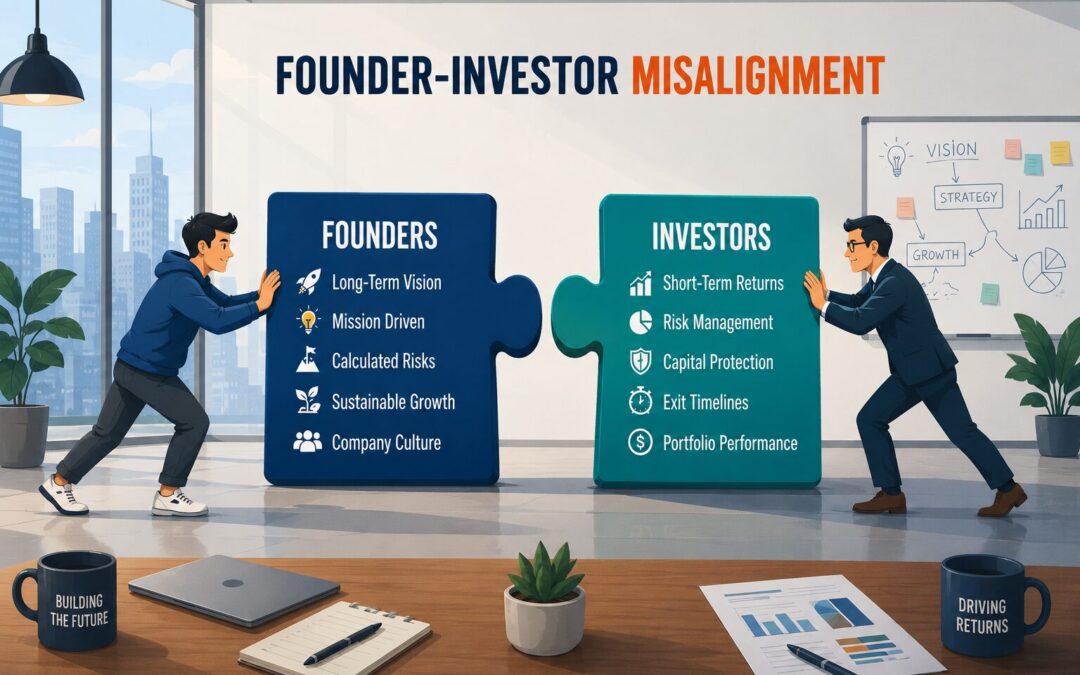
Founder-investor misalignment can have serious consequences for an emerging startup, impacting its growth, stability, and future fundraising success. Always remember that conflicts and disagreements typically start with small, seemingly inconsequential issues.
If left unaddressed, these issues can transform into damaged relationships and hindered progress. You’ll identify potential areas of misalignment and eliminate the triggering factors through open communication. These factors include differing objectives and growth-driving strategies.
Founder-investor relationships are not just about funding a startup; they can also shape its growth trajectory. When compiling a list of potential investors to approach, you’ll likely also list the strengths and additional resources they’ll contribute.
For instance, industry-specific expertise and know-how, guidance through a seat at the board table, and access to their networks. You’ll need these contacts when entering into strategic partnerships and when running future fundraising campaigns.
Founder-investor misalignment not only means that you lose these benefits, but you’ll also face the risks resulting from disgruntled investors. Without mutual trust, predetermined goals, and a shared vision, even the most promising startups can flounder.
Avoid this risk by analyzing the triggers and understanding how to avoid them. Here’s how.

*FREE DOWNLOAD*
The Ultimate Guide To Pitch Decks
Control Over Operations and Decision-Making
As the founder, it’s understandable that you’ll want to secure your control over the startup’s strategies, direction, and decision-making. However, investors often expect a board seat and voting rights in exchange for capital. That’s how they manage risk if they have a significant stake in the company.
The board representative that investors send could be a board observer who attends meetings but does not have voting rights. Or, they may have voting rights proportional to their equity stake. Board reps can be valuable as advisors, guiding policies regarding, say, product development and recruiting.
They can also help with expansion strategies, marketing, distribution, and other operations. Conflicts begin when this advice misaligns with the founder’s vision and mission statement. You may choose to disregard recommendations, particularly vis-à-vis high-profile hiring and timing expansion.
Your Workaround
Avoid founder-investor misalignment by drawing clear lines in the sand early on—preferably when drafting the investor agreement. You’ll include provisions that clearly demarcate the areas where the board rep’s advice and guidance are welcome.
Also, clearly specify the issues on which your authority will be final without any interference. This strategy enables you to avoid giving up rights that you’re not entirely comfortable with. Remember that investors’ priorities, strategic objectives, and risk tolerance may not necessarily evolve with the company’s.
You might want to offer several concessions that seem reasonable when the startup is still in its early growth stage. However, these concessions can quickly become constraints if interests become misaligned. Be wary of granting rights that have long-term consequences on flexibility and execution.
Don’t compromise on your ability to lead the company in the direction aligned with your vision and mission. Only the person with the most in-depth knowledge of the business should have the power to make tough calls. Particularly when it comes to long-term scaling.
Misaligned Growth Expectations
Yet another area of founder-investor misalignment centers on the startup’s growth expectations. As the founder, you’ll push for gradual but sustainable growth while maintaining stability. An important case in point is Frank Rotman, who recently appeared on the Dealmakers Podcast.
In the interview, Frank talks about his experience scaling one of Capital One’s business units. At one point, he made the call to aggressively scale customer acquisition. The strategy worked exceptionally well–except that the company’s infrastructure wasn’t ready to handle the influx.
Although Frank eventually expanded the workforce and overcame the hurdle, it is an important lesson for aspiring founders. Premature scaling without suitable prepping can break a company, he advises. Similarly, your focus should be on maintaining product quality, long-term viability, and internal culture.
Investors can have different priorities that can trigger founder-investor misalignment. Remember that venture capital funds have a fixed lifecycle and must realize their gains before the end of the cycle. Further, general partners (GPs) are accountable to their limited partners (LPs).
Thus, investors may push for accelerated scaling to increase valuation and position the company for a viable exit. Typically, they receive returns when the company gets acquired or goes public with an Initial Public Offering (IPO). That’s how they can deliver substantial returns to the LPs.
However, your startup may not be ready for this accelerated growth. Premature burn rates, hiring, and expansion programs can potentially break the company. Always remember that investors are only advisors at your table and not the actual operator. These decisions should be yours.
Founders should remain in control of the startup’s growth trajectory, particularly in uncertain market conditions. You’ll balance the realities of execution and team bandwidth to ensure capital efficiency while managing risk. Create momentum—but only when the infrastructure is ready.

Raise Capital Smarter, Not Harder
- AI Investor Matching: Get instantly connected with the right investors
- Pitch & Financial Model Tools: Sharpen your story with battle-tested frameworks
- Proven Results: Founders are closing 3× faster using StartupFundraising.com
Your Workaround
Maintain a clear-sighted focus on the capital you have in the bank and allocate it carefully. Never lose sight of the challenges of fundraising, and not being able to achieve your milestones before the next round. Don’t risk the dilution that comes with each round.
Founders should be watchful of losing runway and the possibility of having to raise a down round. Never fall into the trap of artificial milestones and chasing inflated numbers. Instead, you’ll share updated data regularly with investors, informing them of your actual growth.
Most importantly, when raising funding, request transparency regarding fund lifecycles so you know exactly where you stand. Eliminate the possibility of unpleasant surprises. You’ll also discuss your vision for the company’s next five-year cycle and a roadmap for the future.
No investor will want to push for premature growth and a potential sale, leaving money on the table. You’ll also use every strategy possible to avoid founder-investor misalignment. Discuss your issues with the board rep. These professionals have deep industry experience but less fiduciary pressure.
Rely on them to act as mediators between your company and the venture capital fund. Leverage their assistance to communicate your long-term vision and align it with the fund’s short-term needs.
Financial Strategy and Outlook
Investors often disagree with how the founder allocates the capital they’ve invested. Your mindset likely centers on rolling revenue back into the company to fuel expansion and lower your dependence on fundraising. For instance, R&D, product portfolio expansion, market growth, and acquiring talent.
However, founder-investor misalignment begins when investors seek payouts to deliver returns to their LPs. They must extract value in accordance with the fund’s predetermined financial schedule. Your decisions to invest in customer acquisition strategies and infrastructure may not sit well.
Investors could push for more dividends and share buybacks instead. Secondary sales and early recapitalization may not work well for founders who want to preserve strategic independence and maintain control.
By reducing your dependence on external capital, you can negotiate from a position of strength. Reinvestment should be your choice and a guardrail against running out of cash and further dilutive funding rounds. Your startup will also be better-equipped to navigate uncertain market conditions.
Keep in mind that storytelling is everything in fundraising. In this regard, for a winning pitch deck to help you here, take a look at the template created by Peter Thiel, Silicon Valley legend (see it here), that I recently covered. Thiel was the first angel investor in Facebook with a $500K check that turned into more than $1 billion in cash.
Remember to unlock the pitch deck template that founders worldwide are using to raise millions below.
Your Workaround
A savvy founder should anticipate this founder-investor misalignment and bake failsafe measures into the investor agreement. You’ll start by carefully selecting investors, researching their investment philosophy, reputation during downturns, and the support they provide.
Try the case in point of Isaiah Granet, another founder who interviewed on the Dealmakers Podcast. When building his company, Bland AI, he took the critical decision to fire 50% of his customers.
The business was generating $2M in revenue at the time, but Isaiah wanted product-market fit, not attention-market fit. His existing customers did not fully appreciate the full value of his product. Bland AI’s investor, Scale Venture Partners, fully supported the decision.
That’s the kind of investors you need—partners who understand and support your decisions and believe in your expertise. To reiterate, define the terms of the collaboration in detail and secure your control over the company.
Also, maintain open lines of communication to explain why you do what you do. Always focus on achieving financial independence through disciplined spending and resource conservation as part of a lean operations strategy.
Appetite for Risk Tolerance
Their appetite for risk can trigger founder-investor misalignment. Founders dive into entrepreneurship with an “all-in” perspective. That’s one of the reasons why investors back them—they have skin in the game. As a result, you’re open to taking high risks to realize your mission.
These risks extend to penetrating new markets, experimenting with unusual products, and pivoting quickly when the response isn’t favorable. Chasing breakthrough success likely defines your journey. Investors have an entirely different perspective. Their focus is on minimizing portfolio risk.
As a result, your board rep might adopt a more conservative approach when advising your strategies. For instance, you’re ready to invest 30% on the quarter’s revenue in research and development. But an investor focused on returns may advise you to invest that money in expanding sales and distribution.
You’re thinking long-term scalability and success; the board rep is thinking returns. That’s where the conflict arises. Safety vs. reward-driving risks.
Your Workaround
The key to managing this friction is to determine risk thresholds. For instance, you’ll agree on a dollar amount that you’ll safely invest in taking risks and diving into new ideas. Anything higher than that which can risk the company’s stability is subject to board approval and decisions.
Also, use verifiable data to base your high-risk experimentation. You’ll demonstrate the early success you’ve achieved by testing the data and the response from early adopters. That’s how you’ll secure buy-ins from the board reps and their support for larger strategic bets.
Let’s try another example. You want to expand the brand’s reach into a new, untested market. Counter the board’s hesitation with data demonstrating competitors’ success in the location. Or, you’ll show why the competition failed and your strategy for overcoming the barrier more effectively.
Leverage your board as a sounding board to bounce ideas off and as a guardrail against unfounded risks. This balance is crucial for ensuring the company’s long-term stability and success.
Yet another strategy for avoiding misalignment is to be careful about the information you share with investors. While transparency is a good thing, there are things entrepreneurs should never say to investors. Check out this video in which I have explained what they are.
Exit Timelines and Strategies
Exit timelines are one of the leading causes of founder-investor misalignment. Venture capital funds must realize their gains before the end of the 7 to 10-year lifecycle. As this cycle ends, the fund must show liquidated returns to its Limited Partners (LPs).
This rule creates a “ticking clock” situation that influences most investor decisions. Accordingly, they may push for valuation spikes—such as aggressive cost-cutting or premature pivots. Basically, any strategy that enables an immediate sale or IPO.
You could prioritize a long-term impact and legacy over long-term financial gains, which are not investor goals—hence the conflicts. An investor might view a $200M acquisition offer as a “home run” for their fund’s IRR (Internal Rate of Return).
However, a founder will likely disregard it if their goal is to build a multi-billion-dollar category leader. They may also disregard a push for an IPO, given that going public entails greater governance scrutiny and less control.
Your Workaround
To reiterate, it’s always preferable to understand your investors’ timelines and exit horizons before accepting capital. Being upfront about your goals before signing the agreement is advisable to avoid founder-investor misalignment. You can also adopt “pressure valve strategies” to provide liquidity.
For instance, secondary sales allow early investors to sell their shares to a new, later-stage investor. The lead investor can recover their capital and returns and make an exit without a forced M&A or IPO.
Also, consider raising venture debt to pay a one-time dividend, which can satisfy an investor’s return expectations. Investors also push for an acquisition or IPO when they lose confidence in the company’s potential to deliver returns.
Your move should be to provide regular updates to reduce anxiety and secure their support. Don’t forget to include clauses in the investor agreement to prevent hostile takeovers.
In Conclusion
Navigating complex founder-investor misalignment needs proactive reporting and transparency. Provide frequent updates to investors so they are aware of the company’s performance. Adopt the above-mentioned workarounds to secure your relationship with them.
Ultimately, the common goal here is to build a stable business and maximize returns. Focus on a collaborative partnership without sacrificing your mission for the company.
You may also find our free library of business templates interesting. There, you will find every single template you need to build and scale your business completely, all for free. See it here.



Facebook Comments