


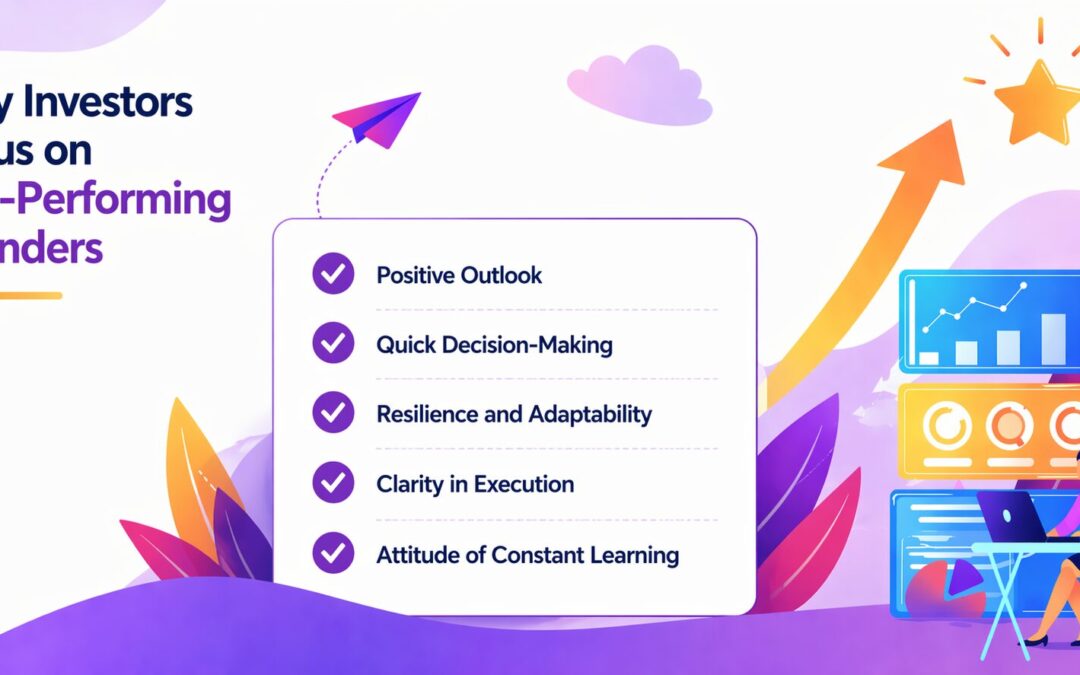
Understanding why investors focus on high-performing founders is a crucial step when analyzing the startup selection criteria they use. What are investors actually looking for?: That’s an age-old question entrepreneurs, consultants, and everyone in the fundraising industry asks.
The answers will surprise you. As your fundraising consultant will advise, it ultimately comes down to the team—the real drivers behind the startup. Even the most disruptive ideas and concepts have no value and will eventually fail without effective execution.

*FREE DOWNLOAD*
The Ultimate Guide To Pitch Decks
The Principle of “People Over Product” Rules
This is why the principle of “People Over Product” rules. The product, market, and traction are crucial, undoubtedly. However, investors in 2025-2026 continue to underscore that in the earliest stages, they are likely to back the founding team. The product and idea are secondary considerations.
Statistics indicate that 95% of venture capital firms base their funding approval decisions on who is on the founding team. By the time the company reaches the Series A or B growth stage, the weight shifts toward other factors. Traction, unit economics, and “proof of efficiency” become more critical.
Interestingly, unlike venture capitalists (VCs), angel investors are more likely to rely entirely on the founder when making investment decisions. Most of these entities lack the resources for in-depth technical or market due diligence—they simply look at prior experience.
At least 52% of entrepreneurs with a proven track record secure funding. This is a sharp contrast to 18% of founders who have never built a successful company before. Why is that? Why investors focus on high-performing founders is that they display the leadership qualities critical for success.
These founders have superior execution capabilities to transform ideas into value-driving, marketable products that have the potential to generate returns. Their strategic thinking abilities prompt investors to back them with capital, trusting them to maximize profits.
Resilience and the ability to think on their feet when faced with challenges are other differentiators. Startup-building involves volatility and navigating tricky situations. Further, every company faces at least one economic downturn during its lifecycle.
An experienced, high-performing founder will have the emotional stability and persistence to pivot in the face of crises. Problem-solving skills make them a safer bet when investing capital.

Raise Capital Smarter, Not Harder
- AI Investor Matching: Get instantly connected with the right investors
- Pitch & Financial Model Tools: Sharpen your story with battle-tested frameworks
- Proven Results: Founders are closing 3× faster using StartupFundraising.com
Why Investors Focus on High-Performing Founders
Robust leadership traits amplify outcomes faster than strategy alone. Founder behavior can quickly become the hidden driver behind execution speed, capital efficiency, and long-term outcomes. When investors assess startups, they use pattern-recognition skills honed over years of experience.
VCs base 80% of their decisions on behavioral drivers that indicate the founder can act quickly. As long as market conditions are favorable, all startups can thrive. The real test comes during periods of uncertainty, when markets fluctuate, and customer buying trends are affected.
At this time, high-performing founders demonstrate resilience that can translate into scalability and risk tolerance. The intelligence to pivot in the right direction and stabilize the company can be crucial for riding out downturns. These factors carry more weight than decks and projections.
Although market conditions influence the startup’s performance, investors base just 20% of their decisions on them. Launching a product at the right time can certainly affect the outcome. However, robust leadership ensures that the founder recognizes when the timing is right.
From the investors’ perspective, the founder’s personality traits can predict a startup’s outcomes well before it releases financial metrics. They focus on the company’s day-to-day decision-making to predict how the founder will react in a fast-paced business environment. Sometimes, acting quickly to capitalize on a rising trend can make or break a company.
In the end, psychology compounds execution. Investors also analyze the dynamics cofounders share and whether their thought processes align. Belief and trust in one another ensure stability and accelerate decision-making, while avoiding friction that can break the startup.
These signals tell investors everything they need to know—whether the founders have the necessary leadership skills to drive success, scalability, and long-term profitability. Are they committed to building an enduring company, or will they pull out after cashing in the small, short-term gains?
The Top High-Performing Traits that Matter
High-performing founders can drive disproportionate impact in the workplace. The top 1% of the startup’s team members achieve at least 10% of the team’s total productivity 10% of the team’s total productivity. They are also 4x as productive as the average worker.
The founding team also shapes the company culture and is typically responsible for recruiting and retaining top talent. It demonstrates the top traits that truly matter. These are only some of the reasons why investors focus on high-performing founders. Here are some of the notable traits.
Keep in mind that storytelling is everything in fundraising. In this regard, for a winning pitch deck to help you here, take a look at the template created by Peter Thiel, Silicon Valley legend (see it here), that I recently covered. Thiel was the first angel investor in Facebook with a $500K check that turned into more than $1 billion in cash.
Remember to unlock the pitch deck template that founders worldwide are using to raise millions below.
Positive Outlook
Top-performing founders, in turn, consistently attract and retain the top 10% of talent in their sector. They have excellent communication skills, which give them an edge when onboarding and working with new team members. They are aware of how their attitude can impact the workplace.
Regardless of the challenges the company faces and the outcomes, strong leaders take responsibility for the team. They’ll handle crises with a cool head and continue to lead the team toward success. The confidence they demonstrate inspires and motivates everyone to move forward.
Quick Decision-Making
Strong leaders don’t let unnecessary delays get in the way of success. They make decisions at least 2x more quickly based on the information available at the time. Their attitude is one of continuous progress, and they are unafraid to test hypotheses for success.
For instance, releasing a minimum viable product (MVP) with basic features is a strategic move. A strong leader understands that a product need not be perfect before launch. It makes sense to test the market and early users’ expectations rather than risk the competition getting ahead.
This approach is particularly relevant in sectors like tech, where capturing the market quickly is imperative for success. Adopting a faster OODA loop (Observe, Orient, Decide, Act) enables startups to ship products or new features more quickly.
Investors understand that an early-stage startup has limited capital and resources, and cannot wait out delays. Slow decisions and delayed execution can cost organizations 1%–5% of annual revenue.
Resilience and Adaptability
The most crucial trait is not being afraid to admit when they’re wrong. They’ll iterate, go back to the drawing board, and work on the next steps. A great example is Ritik Malhotra, a founder who recently appeared on the Dealmakers Podcast.
Ritik talks about his experiences with building Streem, a venture he and his cofounders eventually sold to Box. He candidly admits that their initial product idea was entirely wrong. But that didn’t deter them. They simply spent time interacting with customers to identify the design’s shortcomings.
The team would then go back to fix the faults, test, iterate, and reach out for feedback again. Most importantly, Ritik didn’t let criticism get in the way; he took it as a learning experience. When reality proves they are wrong, strong leaders quickly shift strategies and are open to pivoting.
Clarity in Execution
A startup’s success hinges on clarity in execution, which is why investors focus on high-performing founders. These professionals are not only clear and laser-focused on their vision for the company; they can also articulate that vision.
Clarity in execution is often the dividing line between a startup that stays a “great idea” and one that becomes a “great business.” When team members cannot understand execution strategies, their performance suffers. Clarity ensures that everyone knows the company’s immediate goals.
Each worker understands their role and specific tasks that can contribute to achieving that goal. They also know the metrics that can signal success within a particular time frame. All this is possible only with great communication skills that a strong leader possesses.
Communication ensures that the entire team aligns toward a common goal and eliminates a waste of resources and duplicated efforts. Lean execution strategies attract investor interest and capital.
Attitude of Constant Learning
Strong leadership skills are about learning consistently and moving forward. Learning is not restricted to times of crises, but it is a constant, dynamic process that leads the team. It shouldn’t be a reactive or damage-control tool, but an offensive strategy to stay ahead of industry shifts.
When learning is integrated into the team’s DNA, it creates a feedback loop in which every little action informs the next move. That is, regardless of whether it was a success or a failure. This attitude instills a culture of innovation, encouraging the team to constantly evolve.
As a result, the team doesn’t always wait for top-down instructions during a pivot. Instead, it is empowered to make autonomous decisions as it has up-to-date data and a minute understanding of the market and customers.
This market understanding helps leaders and their teams recognize shifts and emerging trends well before they occur. Thus, the startup is set up for success and develops that all-important edge over the competition.
Looking for more information on what investors look for in founding team? Check out this video in which I have explained in detail their founder evaluation criteria.
How to Develop the Top Traits that Matter to Investors
Whether you’re a founder testing the entrepreneurial waters or a seasoned founder, developing key traits can help you succeed. Here are some of the daily practices successful leaders adopt.
Deep Work
Strong leaders set aside at least three to four hours each day for high-impact tasks. You must learn to identify “shallow” tasks, such as routine meetings, email, and Slack messages. And impactful tasks like conducting market research, working on structural designs, and devising a strategy.
Also, be mindful of the “attention residue,” or the brainpower lost from switching between shallow and impactful tasks. To ensure maximum productivity, block off the three-hour time you need and avoid unwanted interruptions. Use this time to develop clarity in execution, which you’ll relay to the team.
Remember, the top 20% of high-impact activities actually drive 80% out of the outcomes. You can’t compromise on this time. Understand that shallow tasks are also essential to keep the lights on, but delegate wherever possible.
Learn by Interacting with Diverse People
Spend time interacting with people from diverse sectors, disciplines, and thought processes to broaden your perspectives. This exercise will help you learn to examine the big picture rather than focusing solely on your startup and industry. New ideas can emerge from the most unexpected sources—keep that in mind.
Seek Feedback
One reason investors focus on high-performing founders is that these professionals recognize the need for feedback. Startups cannot operate in a vacuum, and it’s crucial to interact with customers to understand how they perceive the brand.
Feedback will help you identify errors and understand what customers expect to see. This will help you refine the product to better align with their needs. Seeking feedback also indicates to customers that you’re mindful of their satisfaction, which in turn builds trust and loyalty.
These factors are crucial for minimizing churn and maximizing customer retention, supporting long-term profitability and scalability. In addition to customer feedback, you need team feedback. And that includes people working in every department of the startup.
For instance, customer-facing reps are better positioned to inform you on market trends and product value. Product designers can warn you about potential flaws and how to correct them. On the other hand, financial analysts will keep you updated on cash flows and revenue.
Reflect and Review Decisions
Simply making decisions is not enough. A high-performing founder is also mindful of the impact of those decisions and whether they are achieving the desired outcomes. Infusing flexibility into your decision-making process is crucial to keep pace with customer needs, market trends, and competitor activity. Never hesitate to pivot when necessary.
The Takeaway!
Investors are well aware that the team is the dynamic force and the primary driver propelling the startup forward. At the helm is the core founder and leader who needs to have the top traits that they bank on. Often, angels and venture capitalists support a founder even if the product idea is weak.
That’s because the founder demonstrates conviction in their ability to transform their ideas into marketable products. Further, they have the mental skills and business aptitude to refine their ideas and pivot if needed. They can also recruit, retain, and train top talent to run the company and realize their vision. That’s a founder worth backing.
You may also find our free library of business templates interesting. There, you will find every single template you need to build and scale your business completely, all for free. See it here.



Facebook Comments