


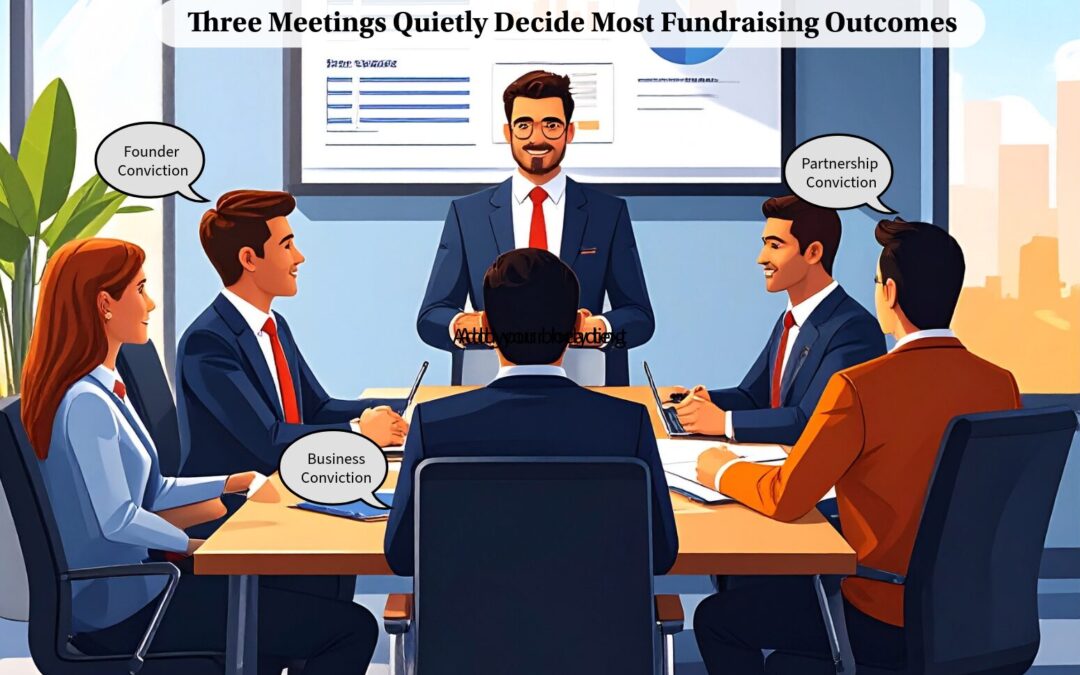
Contrary to what most founders think, three meetings quietly decide most fundraising outcomes. Typically, they assume that a fundraising initiative is won or lost during the first meeting with potential investors. However, conviction is gradually built over at least three meetings—sequentially.
Every meeting has a specific objective and is designed to answer a question. When you provide the right answers, you build conviction and confidence, and that’s how to run a successful fundraising campaign. Seasoned founders understand what investors are really evaluating at each stage.
Three Meetings Quietly Decide Most Fundraising Outcomes
To give you an overview, the first meeting is about understanding the face behind the startup and its concepts. Every investment opportunity is an 8- to 10-year partnership that involves more than just money and resources. Investors are looking for people they can work with over the long term.
During the second meeting, the principal/investor viewing your pitch is evaluating scalability. How big can this company become? That’s the question they’re asking. They want to know if the company has what it takes to become the next unicorn and/or deliver venture-scale returns.
The third meeting is all about conviction. The principal representing the venture capital firm is looking for signals that enable them to champion your company. They want to be able to convince the venture capital (VC) investment committee that your startup is worth backing.
Your pathway to successful funding isn’t about pitching hard at every meeting. It’s about learning to recognize the investor’s decision-making framework and where they’re coming from. Need to know more about how this works?
*FREE DOWNLOAD*
The Ultimate Guide To Pitch Decks
Meeting #1: The Founder Evaluation Meeting
Most founders spend weeks perfecting their decks before fundraising, obsessing over slides, metrics, projections, and storytelling. However, at this stage, the principal/investor is evaluating the founder. They know that building a startup from the ground up involves several hurdles throughout its lifecycle.
Market conditions, geopolitical environments, customer buying preferences, tech innovations, and the regulatory landscape can alter drastically. Furthermore, the first seed round isn’t the only capital you’ll secure. Through every subsequent funding round, the founder is the only constant variable.
Investor pattern recognition focuses on the founder’s clarity of thought, founder-market fit, and an understanding of customer pain points. They are testing how you handle pressure and whether you have the professionalism and maturity to pivot when necessary.
Leadership qualities matter because ultimately it’s the team that drives the company forward, and you’ll need to hire top talent. More importantly, you’ll create the ideal company culture to retain that talent and guide it in developing products.
Humility, the grace to admit when they’re wrong, and an openness to learning are crucial traits investors look for in founders. On the other hand, a pitch that sounds rehearsed, complete obsession with the tech and product they’re developing, and lack of accountability for mistakes are red flags.
What should be your strategy?
Now that you understand the investor’s objective, focus on projecting confidence and competence. Don’t overpitch or rely entirely on the deck and metrics. Instead, work on building a relationship with the principal by adopting an easy conversational style.
At the first meeting, your pitch should focus entirely on the targeted customer and their pain points. You’ll talk about how you identified the problem and key inflection points that led to finding a good solution. Don’t stress the product or dive into its features and complex technical details just yet.
Keep the presentation short, offering only crucial points, and set aside more time for the actual Q&A session. Expect questions that counter your claims and assumptions. It’s a signal that investors are testing your understanding of the sector and its intricacies.
Listen more than you talk and take notes when you can’t answer a question. Don’t hesitate to accept when you don’t have answers or overlooked a metric, but commit to emailing the data later. By the time the investor leaves the room, you should have cleared the first hurdle—eliminating founder risk.
The first meeting should instill enough confidence in the investor to schedule a follow-up. If they leave believing the founder is exceptional, they’ll want to know more about the company you’re building. That’s what you’ll talk about in detail during the next session.

Raise Capital Smarter, Not Harder
- AI Investor Matching: Get instantly connected with the right investors
- Pitch & Financial Model Tools: Sharpen your story with battle-tested frameworks
- Proven Results: Founders are closing 3× faster using StartupFundraising.com
Meeting #2: The Business Evaluation Meeting
Once investors have established the founder’s credibility, they’re open to investing time in evaluating the company itself. At this stage, they ask, “Can this become a venture-scale company?” This is what the second meeting is all about—understanding the company and its potential.
Market Size
The first criterion is the size of the market the startup targets, which, in turn, reflects the size of the opportunity. And whether the market can support fund-level returns. You’ll address this concern by presenting numbers, such as:
- Total Addressable Market (TAM)
- Qualified Total Addressable Market (QTAM)
- Serviceable Addressable Market (SAM)
- Qualified Serviceable Addressable Market (QSAM)
- Serviceable Obtainable Market (SOM)
Each of these metrics measures not only the market as a whole. But also the portion of the market the startup can realistically capture. They also account for customers’ purchasing capacity, authority, need, and alignment with geographical location and regulatory compliance.
Problem Severity
The next criterion is the urgency of the problem and its frequency. More importantly, how the problem impacts the customer in terms of money, time, operational efficiency, and human resources. Investors want to know if buyers view the solution as a nice-to-have or a can’t-do-without.
Next, investors compare the solution to competing products and whether buyers are open to shifting to another brand. Often, the availability of better, cheaper solutions is not well received because of the complexities of the transition.
If that is the case, your pitch should present practical pathways for making the transition happen.
Product-Market Fit Signals
Investors look beyond revenue numbers you demonstrate in the pitch. Product-market fit is one of the concerns you’ll address. Three meetings quietly decide most fundraising outcomes, and the second is about providing verifiable evidence that customers appreciate the solution.
Not just appreciate it, but consider it valuable enough to build brand loyalty through repeat orders. At this stage, you’re providing metrics such as customer retention, month-over-month revenue growth, and customer referrals and reviews.
You’ll demonstrate a reduction in customer acquisition costs thanks to the organic demand you’re leveraging. Also discuss the shortening sales cycles you’re achieving. As customers understand the value proposition, sales teams spend less time chasing leads, resulting in better cash flow.
Competitive Positioning
Never make the mistake of projecting that your tech is so innovative that it has no competitors. Investors see it as a signal that there is no real market for the product. Instead, you’ll provide proof that your product improves on existing options, making it indispensable in the evolving landscape.
Next, you’ll talk about what sets the brand apart, such as groundbreaking technology, more efficient distribution, and economical transition costs. Present testimonials in which buyers reveal how using the product resulted in higher returns—no more money left on the table.
Timing
Many emerging startups are successful not just because they have a great idea or a disruptive tech. They’re successful because their launch occurs at the precise moment when market forces and buyer needs align. This is what investors are looking for.
Your Why Now slide should describe new regulatory changes, AI infrastructure maturity, or shifts in consumer behavior. Critical inflection points that have created an immediate, unaddressed demand.
Discuss how the friction to adopt this solution has never been lower, and the cost of inaction for your target customers has never been higher. Don’t forget to mention the constraints that would’ve made the model launch impossible, say, five years earlier.
Also, discuss what can make the product’s early adoption an industry benchmark in the coming five years. For instance, falling hardware costs, the availability of advanced datasets, or expanding AI literacy.
What should be your strategy?
Don’t lose sight of the fact that three meetings quietly decide most fundraising outcomes, and the second is about market sizing. Be mindful of the concerns investors are likely to have and address them with verifiable metrics and data. Every claim you make should be backed by authoritative sources.
Some startups receive term sheets faster than others because your pitch answers each of the core questions they ask. The first two meetings sufficiently build conviction, transforming the principal into your internal champion.
By the time they schedule their third meeting, they should have all the necessary tools to convince the investment committee.
Meeting #3: The Partnership Conviction Meeting
When the principal walks into this meeting, their question is: “Can I get everyone else to believe?” Most investments don’t happen because one investor likes a startup. They happen because one investor successfully sells the opportunity internally to their investment committee.
You need to give the principal or partner all the proof they need for the committee meeting where decisions are finalized. You’ve covered the main risks investors consider, upsides, and differentiation. It’s now time to build a robust narrative centering on proof and momentum.
The narrative has to be clear, simple to understand, and convey value easily. Most importantly, it has to survive scrutiny. Investment decisions are also based on social proof that effectively reduces risk and uncertainty.
To eliminate this risk, you’ll assist the principal with information about other notable investors who have backed the startup. Also, add data about the strategic partnerships you’ve entered into and the industry endorsements you’ve earned.
Customer validation carries exceptional weight, so add testimonials and reviews, along with social media posts. Round out validation with detailed reports of the month-over-month (MOM) revenue reports. Quarterly or half-yearly reports also work if your model is subscription-based.
Momentum also creates conviction, and you’ll provide evidence of traction with numbers that signal accelerated growth and hiring. List the interested enterprise customers you have lined up along with product adoption data. Momentum suggests the market is validating the startup.
Investors understand that viable startups eliminate a specific risk at every growth stage and with each funding round. When presenting your startup as a potential investment opportunity, the principal should demonstrate the risks you’ve successfully eliminated.
Listing the remaining risks and the framework for removing them again builds conviction through transparency. That’s a valuable green signal investors appreciate.
What should be your strategy?
Three meetings quietly decide most fundraising outcomes, and during the final meeting, the principal is gathering information for the decision-making. At this point, founders often make the critical error of introducing entirely new information, which complicates the pitch.
Understand that you’ve already delivered the winning pitch and the analysts doing due diligence will uncover the updated metrics. That will actually signal accelerated traction, which works in your favor. You’ll also avoid changing the narrative, as inconsistent storytelling can confuse viewers.
Don’t make the mistake of experimenting with a new strategy, no matter how compelling it seems. Let the pitch play out as-is and see it through. At the same time, creating a sense of urgency works. You can discuss the other investors interested in investing, and the timeline for closing the round.
Keep in mind that storytelling is everything in fundraising. In this regard, for a winning pitch deck to help you here, take a look at the template created by Peter Thiel, Silicon Valley legend (see it here), that I recently covered. Thiel was Facebook’s first angel investor, with a $500K check that grew into more than $1 billion in cash.
Remember to unlock the pitch deck template that founders worldwide are using to raise millions below.
Fundraising is Really a Progressive Trust-Building Process
Most founders think fundraising is about delivering a perfect pitch, but investors view it differently. Each meeting is designed to answer a different question. The first evaluates the founder, while the second evaluates the opportunity.
The third evaluates whether enough conviction exists to advocate for the investment opportunity. Understand that investors rarely offer term sheets because the first or second meeting went very well. In all, three meetings quietly decide most fundraising outcomes.
Of course, the principal may request further sessions if they need more information before the investment committee meeting. Your proposal is tabled for final decision-making only if the investors’ confidence compounds across all three stages.
Founders who understand this progression stop trying to close investors in every meeting. Instead, they focus on helping investors answer the specific question they’re asking at that stage. That’s how you eliminate the need for multiple meetings and receive the term sheet quickly.
You may also find our free library of business templates interesting. There, you will find every single template you need to build and scale your business completely, all for free. See it here.



Facebook Comments