


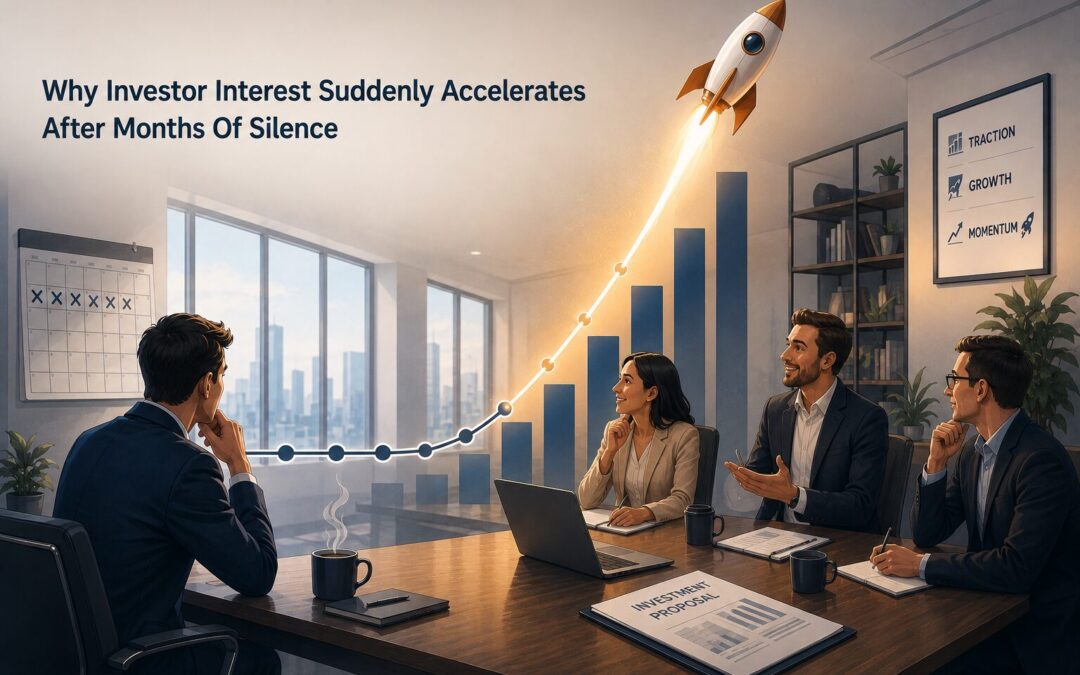
Why investor interest suddenly accelerates after months of silence is a question that often perplexes founders. You might have delivered the perfect pitch, and follow-up meetings may have ended on a positive note. Then you find yourself waiting for months for a term sheet that never appears.
Investors ghosting after a great first meeting is common, as is getting vague responses like “Let’s reconnect later” or “We’ll get back to you.” But even more confusing is hearing back from them after months—when you least expect it. Or, when the round is almost closed.
Understand that fundraising and investor behavior are rarely linear. You might anticipate the normal sequence of events:
Pitch investors -> Generate interest -> Conduct meetings -> Receive term sheet
In reality, fundraising doesn’t always work this way.
Expert consultants advise you to maintain momentum by periodically following up with investors. But you may note that their interest suddenly accelerates after months.
Investors who were previously unresponsive suddenly begin replying. Meetings get scheduled quickly, senior partners join calls, and you receive a term sheet. You also receive a request to access your data room so the due diligence process can begin. New investors appear unexpectedly.
What changed? That’s the question founders ask. The answer isn’t always about a milestone you’ve achieved or how the company has evolved since the last meeting. Though that impacts decisions too.
Several factors can contribute to this unexpected interest, including changing markets, technological, geopolitical, and regulatory conditions, and customer purchasing behaviors. The venture capital firm’s internal framework, capital availability, and investment thesis also influence interest.
Here’s a deep dive into the unspoken dynamics that impact conviction. You’ll understand why investor interest suddenly accelerates after months of silence.

*FREE DOWNLOAD*
The Ultimate Guide To Pitch Decks
Investor Conviction Builds Gradually, Not Instantly
One of the biggest fundraising misconceptions is that investors make decisions during first meetings. Most don’t. Instead, they build conviction sequentially through each follow-up meeting. The principal viewing your deck is quietly eliminating three crucial risks—founder, business, and partnership.
Each time you follow up with the investor and provide updated information, you’re adding data points. For instance, a product launch, hiring milestone, revenue growth, and spurt in customer acquisition numbers. As conviction grows, so does investor interest until the time they get back to you.
Founders think it’s a sudden occurrence, when in fact investors have been assessing the company for months. From your perspective, the term sheet seems like a breakthrough moment. From the investor’s perspective, it’s the result of evidence they’ve compiled incrementally.
Pattern Recognition Clicks
Venture capital investment decisions are driven purely by pattern recognition. The principal/investor brings psychological models into the presentation room. They are trained to recognize viable startups by matching them against previous investments, successful exits, industry trends, and top portfolios.
While a startup is still in its nascent stage, it may not fit the profile they know or identify with—even if it seems interesting. But as it grows and evolves, it may start to resemble other successful ventures the investor has supported earlier. With each growth stage, it may eliminate another risk.
The investor starts to recognize familiar growth trajectories, emerging category leadership signals, comparable customer behavior, or known customer acquisition pathways.
Many investors pass on an investment opportunity initially because they don’t know what they’re seeing. If it is interesting, they’ll place it on the back burner to revisit later. The accelerated interest happens when they realize the startup is starting on a success trajectory like one of their winners.

Raise Capital Smarter, Not Harder
- AI Investor Matching: Get instantly connected with the right investors
- Pitch & Financial Model Tools: Sharpen your story with battle-tested frameworks
- Proven Results: Founders are closing 3× faster using StartupFundraising.com
The Social Proof Effect
Social proof reduces uncertainty, and investment firms often exchange information about companies worth supporting. A notable angel investment, a prestigious seed funding joining, or a reputable lead investor on the cap table lends credibility to the startup.
Influential founders endorsing the company, industrial leaders on the advisory board, and strategic investors showing interest are other compelling signals. Each new investor increases the likelihood that additional investors will engage, and that builds momentum.
The question shifts from: Is this founder and startup worth backing? to “What am I missing that others see?” That’s one of the reasons why investor interest suddenly accelerates after months of silence. It’s all about information sharing.
Social proof also comes from customer reviews, testimonials, and feedback. Further, contracts with a top enterprise customer that openly advertises their partnership with your brand also build traction.
Investors Want Validation Over Time
Investors often adopt a wait-and-see approach before diving into supporting the startup. They want to see if the company can retain customers, achieve projected milestones, and sustain growth. If they see consistent execution over multiple quarters—not just one impressive quarter—that works well.
This is why experienced fundraising consultants suggest you regularly send emails with updates. Talk about how you’ve nailed the product-market fit and include numbers that demonstrate traction. For instance, month-over-month revenue growth and an organically expanding customer base.
If you haven’t heard back from an investor for some time, you’ll assume they’re quietly observing your progress—and taking notes.
Keep in mind that storytelling is everything in fundraising. In this regard, for a winning pitch deck to help you here, take a look at the template created by Peter Thiel, Silicon Valley legend (see it here), that I recently covered. Thiel was Facebook’s first angel investor, with a $500K check that grew into more than $1 billion in cash.
Remember to unlock the pitch deck template that founders worldwide are using to raise millions below.
Market Timing Finally Aligns
Market timing influences investment decisions more than founders anticipate. Investor interest may accelerate as broader macroeconomic conditions are favorable, allowing your sector to grow rapidly. Just as ESG-centric companies attracted significant capital in 2021, reaching a record $645B.
New regulatory changes, availability of new infrastructure, customer buying preferences, and industry disruptions can prompt investors to perceive opportunities differently. They may suddenly see more profit potential in an idea.
Other investors accelerating investment in a particular sector, as well as enterprise adoption trends, also drive investment. An excellent example is artificial intelligence (AI) and large language models (LLMs). Startups looking to capitalize on the growing interest in AI secure capital quickly.
Sometimes startups develop concepts and products that seem irrelevant in the existing landscape. That is, until the market catches up. That’s what Yoav Regev, founder of Sentra, did.
Yoav and his cofounders recognized that any meaningful technological advancement would depend on access to data and the ability to secure it. However, at the time, the Data Security Posture Management category simply didn’t exist. Only Yoav’s conviction did, eventually raising $100M for it.
The takeaway? If you strongly believe in the product, go ahead and build it. External conditions will shift, and once the timing aligns, investor enthusiasm will heat up, and capital will follow.
Fear Of Missing Out (FOMO) Begins to Spread
Investors have concerns about two crucial errors. Losing money by investing in a bad company is a primary concern. Typically, venture capital firms lose 90% to 95% of their capital when startups fail completely. Or are unable to return the investment. VC returns come from a scarce 3% to 5% only.
This risk makes them wary, and they are extremely selective when choosing investment opportunities. On the flip side, VCs don’t want to miss out on a potential unicorn that can offset their losses. This second fear is much stronger.
The Fear Of Missing Out (FOMO) sets in when the aforementioned factors align. Pattern recognition clicks, market conditions improve, and the startup gains traction with other investors offering capital. When conviction is real, and others are moving forward with deals, the real urgency emerges.
This psychological shift can dramatically accelerate decision timelines. Investors begin to view any inaction as a greater risk than investing in the company. That’s when term sheets appear.
The Startup Finally Becomes Easy to Explain
One of the foremost reasons investors hesitate to invest is that they are unsure what the startup does. This is why your funding consultant will advise you to ensure the pitch is simple and clear. You should be able to explain the concept in a single sentence, avoiding technical jargon.
Understand that the principal/investor viewing your deck must not only be convinced, but also able to explain the concept. When they table the proposal at the venture capital investment committee meeting, they must have a smooth narrative. The details are for the due diligence team to analyze.
Further, understand that such meetings may occur once every quarter when the firm selects viable proposals. You have to ensure the principal does not forget your pitch. That can actually happen if it sounds similar to the hundreds of others they’ve been viewing.
When the story becomes simple, investor conviction spreads faster. They can quickly explain the startup and get approval. It may seem like investor interest accelerates after months of silence.
The reality is that your pitch has to reach the decision-making panel. If it passes in-depth evaluation, you’ll get your term sheet.
Internal Factors & Availability of Capital
The venture capital firm’s internal dynamics play a significant role in investor inactivity. A typical VC firm gets funding from limited partners (LPs) who may or may not assume active roles in its operations. Some of these LPs invest capital all at once. Others invest in tranches made available periodically.
Aside from these drawdowns from partners, the firm also has capital from the investments they have liquidated. Investment decisions thus rely on the availability of capital in the firm during a particular quarter. Also understand that VCs invest only a specific amount of capital per quarter.
This is why they select a few startups to back and defer decisions on other proposals until the next quarter. You should take the time to understand how VC firms operate throughout the year. This info will help you organize your approach to align with their decision-making timelines.
Internal Champions Finally Emerge
As mentioned earlier, investor conviction develops in stages, and at each stage they address a specific risk. Once the principal is convinced your startup has value, you will have created an internal champion. This champion advocates for your startup at the investment committee meeting.
Founders should understand that deals rarely happen unless a principal is willing to champion your startup internally. For months, you may lack such a champion. Then one investor becomes convinced enough to take ownership. That’s when you’ll suddenly see momentum within the firm.
When delivering your pitch, you’ll focus on the question: Will this principal advocate for us inside the VC firm? If they are willing, they’ll push for follow-up meetings and address objections from GPs. They’ll also aggressively build support among the partners and proactively lead due diligence.
However, this process can take time and lead to delays from the time investors view the deck to the time the term sheet is executed. This is why investor interest suddenly accelerates after months of silence.
How Founders Should Interpret Silence
If you don’t hear back from an investor within a short time, don’t assume your pitch has been rejected. Understand the above-mentioned factors and work out how to address potential concerns. For instance, they are waiting for market conditions to align and sector viability signals to form.
Investors could be waiting for the right time and not yet convinced your company can deliver the returns they’re expecting. You should consider the possibility that the principal is not yet an advocate. Or that they need more proof before they commit.
This is why consistent investor updates matter. Each update provides another opportunity to increase conviction. Your objective here is not immediate conversion; you’ll focus on maintaining visibility until investors are ready. To make that happen, you’ll regularly send them follow-up emails.
You’ll showcase momentum metrics, highlight customer validation, show consistent execution, and demonstrate enhanced social proof. Maintain communication even after a “no.” It shows persistence, which is a good signal.
To Reiterate, Why Investor Interest Suddenly Accelerates After Months of Silence
Non-responsive investors—or even outright rejection for that matter—do not always indicate that they are uninterested. As seasoned founders will tell you, behind every seemingly overnight funding success lies months or years of invisible conviction building.
Several factors have to align perfectly before investors are ready to offer you a term sheet. Keep in mind that companies that successfully raise capital are often the ones that remain patient.
So continue executing and keep building evidence long after others assume investor silence means the opportunity is dead.
You may also find our free library of business templates interesting. There, you will find every single template you need to build and scale your business completely, all for free. See it here.



Facebook Comments