


Selecting the right monetization model is crucial for building a sustainable and profitable business. Developing a product or service idea for a startup is only the first step—the real test is generating actual revenue. Even as you’re ideating the product, you need to think about how to monetize it.
Certain products have built-in monetization models, but others must reach a specific maturity stage before customers pay for them. The models you adopt will go through careful investor scrutiny when you’re ready to raise a formal funding round.
They will want to examine the pathways for transforming the idea into a marketable product. Their returns and exit strategies rely on the revenue and profits you can generate from the sales. You’ll also demonstrate how you’ll sustain and scale the revenue stream throughout the startup’s lifecycle.

*FREE DOWNLOAD*
The Ultimate Guide To Pitch Decks
Understanding What Monetization Is
To define monetization simply: it is the process of generating revenue from the value you offer your customers. When a product delivers meaningful value to its users, they are more likely to compensate the seller. It’s a fair exchange that translates into revenue/remuneration.
The monetization models you choose are different from pricing models and profits, and it’s crucial to understand the distinction clearly. When you talk about monetization, you’re referring to the broad strategy for generating revenue, such as subscription-based or advertising models.
Monetization covers your “how we make money” approach, while pricing defines the actual charging mechanisms you’ll apply to each product. When defining your monetization strategy, you’ll factor in the value proposition, business model, and the path to converting users into paying customers.
Pricing models, on the other hand, define the actual calculation of the price tags for every product in your portfolio. For instance, enterprise customers pay for SaaS products on a per-seat basis at $5 per user. Or, a flat charge for a specific version of a product with selected features.
Let’s talk about how monetization models differ from profits. Monetization strategies cover the entire gamut of approaches you’ll use to create revenue streams from your customers. For instance, using ad placements and sponsorships that assure positive cash flows.
Profits are the bottom line, or net gains, that a business generates after deducting taxes, operating expenses, and the cost of goods sold from its revenue. Remember that monetizing does not mean the business is making a profit. You’ll calculate that metric after factoring in your total costs.
A business generates profits only when its monetization models generate enough revenue to pay its bills and have money left over. The higher the profits, the more investors are incentivized to support the company.

Raise Capital Smarter, Not Harder
- AI Investor Matching: Get instantly connected with the right investors
- Pitch & Financial Model Tools: Sharpen your story with battle-tested frameworks
- Proven Results: Founders are closing 3× faster using StartupFundraising.com
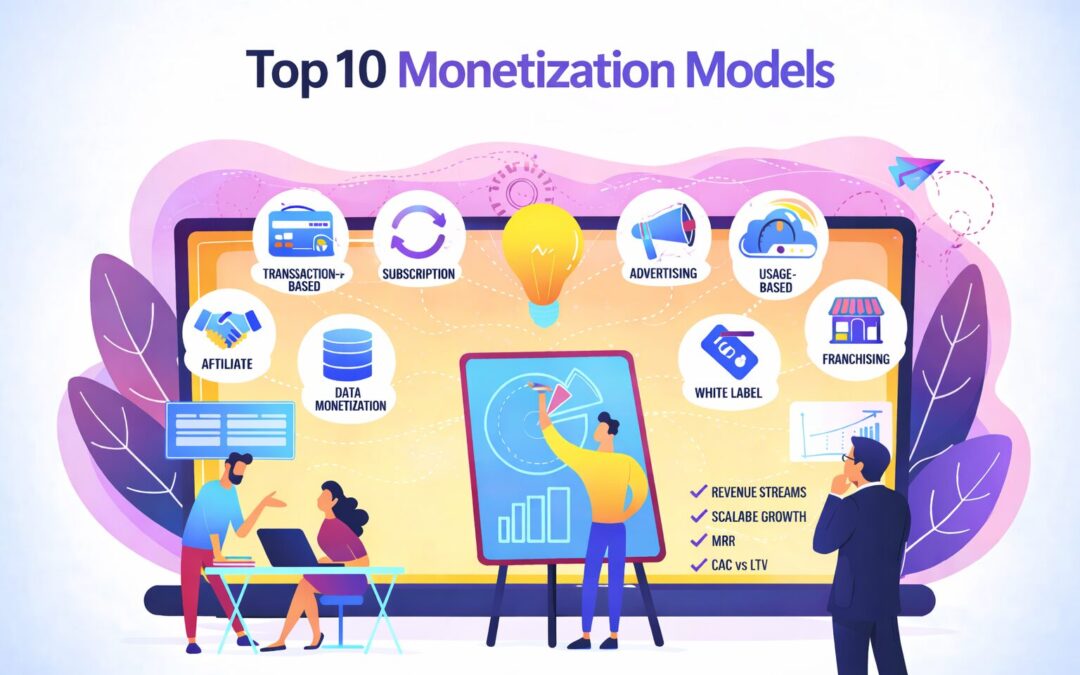
Top 10 Monetization Models for a Profitable Business
Transaction-Based Monetization
Transaction-based monetization models work well for an early-stage startup primarily because they lower the barrier to entry. Customers can make one-off purchases without committing to a recurring subscription. If they don’t sell, purchase, or use the platform, they needn’t pay.
This flexibility can prove to be an attractive value proposition and is ideal for helping you build an initial clientele. Transaction-based models are essentially commission-based revenue streams that align with sellers using the platform to market their products.
Your focus should be on delivering value to the entities using your platform. That’s how you can keep customer acquisition costs down. As you continually upgrade platform features and provide exceptional service, you’ll capture a larger share of the market.
Word-of-mouth advertising can quickly translate into high-volume, high-value transactions that ensure steady cash flow and revenue. Best examples include marketplace platforms, booking services, payment processors, and e-commerce platforms.
Subscription-Based Monetization
These monetization models are the most common approaches that digital services companies adopt. Think examples, such as streaming services like Netflix and Spotify, and content platforms like Adobe Creative Cloud. SaaS platforms like Slack and Zoom are also subscription-based.
Customers pay a recurring fee for continuously accessing the product or service. This fee can be monthly or annual, enabling startups to track their Monthly Recurring Revenue (MRR). MRR is a crucial metric in your financials slide that investors scrutinize carefully.
It tells them that your company is capable of generating predictable revenue streams. Most providers start off with a freemium service that lets users test the basic features before subscribing. More than 90% of mobile app profits are sourced from this model.
The underlying criteria for using this approach effectively are consistently upgrading the product with new features to minimize churn rates. You’ll also work to keep pace with the latest innovations in the space to ensure top-notch service for your customers.
Licensing Monetization Models
Licensing revenue streams center on the intellectual property (IP) your startup has developed. You’ll generate income streams by granting customers permission to use assets, such as software, patents, trademarks, or copyrighted content. In exchange, you’ll charge them a fee.
This monetization approach works well for early-stage startups as they can quickly start generating revenue from their assets. You need not incur additional production or distribution costs while simultaneously scaling your market reach.
Tech-heavy startups or creative agencies benefit from this model by leveraging their unique “secret sauce” or recognizable brand. Some excellent examples include Microsoft (Windows OS and Office Suite), Walt Disney Company, and Oracle enterprise software.
This monetization approach is highly effective. However, you’ll need to obtain robust legal protections to ensure the IP isn’t misused or diluted. Also, be mindful of constantly building on the product and improving its features to stay relevant in the market.
Advertising Monetization
This revenue-generating model is suitable for social media platforms, mobile gaming apps, and news outlets. Basically, any content-heavy site with a large reader base can earn revenue by displaying ads within the platform. These ads can be in the form of banners, native ads, and sponsored content.
Most advertisers earn revenue through “impressions” (views) or “clicks.” However, you’ll need to be cautious about the ads running on your platform and ensure that relevance to the audience. Also, maintain quality standards to avoid degrading the user experience.
Although early-stage startups can use this strategy to generate revenue with minimal effort, its success is tied to high-grade traffic. It is effective only if the traffic is substantial enough to generate significant income. To make that happen, you’ll publish top-quality and competitive content.
Usage-Based Monetization Models
The usage-based model is straightforward and appeals to customers for the flexibility it offers. Users can pay for a product or service according to their specific consumption levels. A form of “pay-as-you-go” revenue stream, it lowers the barrier to entry for new players in the sector.
Early-stage startups can scale their revenues as the customers’ needs grow. Because their costs are directly aligned with the value they receive, it is a “fair” pricing strategy many users prefer. That is, as against fixed subscriptions or high upfront fees, unsuitable for users with sporadic needs.
This revenue-generating model is primarily useful for data providers, utility companies, technical infrastructure providers, and cloud computing services. A great example is Amazon Web Services (AWS), which charges users only for the storage and processing power they consume.
The typical customer base includes enterprise-level companies that use cloud-based services on a per-seat basis for their employees.
An essential aspects of picking monetization models is figuring out the right marketing tactics to validate your business idea. You’ll align both strategies for maximum results. Not sure how to do that? Check out this video I’ve created.
Direct Sales Monetization Models
The direct-to-customer monetization approach is the most basic, involving selling a product or service directly to the customer. Once the manufacturer or producer accepts payment, the buyer gets full ownership and control over the product.
As the seller, you’ll have complete control over the pricing strategies and customer relationships. You’ll connect directly with the end user, eliminating the need for intermediaries and third parties to achieve full margin earnings. A key advantage is the regular feedback you’ll receive.
The D2C model is suitable for professional services, high-ticket items, physical products, and B2B solutions. You’ll need to build a robust sales infrastructure, including a well-maintained website and additional advertising, to connect with customers.
Customer acquisition costs are high, and you’ll constantly invest in strategies to attract new users and discourage churn rates. Revenue is generated only at the point of sale and largely relies on expert sales interactions with buyers.
Franchising Monetization Models
Franchising is similar to the licensing revenue model, but with a key difference. Instead of licensing only your intellectual property (IP), you’ll license the company’s entire business blueprint, along with its intangible assets. That includes the brand name, operating systems, and other defining features.
In return, the buyer pays fees and ongoing royalties. This model is suitable for early-stage companies that have developed a proven and replicable business model. Buyers can adopt this structure as-is to quickly expand into new geographic areas.
Because franchisees provide the capital for new locations, the startup can scale its brand presence much faster. It also does not need to incur large capital expenditures to achieve growth rates comparable to corporates.
Franchising works well for service-oriented businesses, such as global food and beverage chains, hospitality brands, retailers, and specialized service providers. However, issues like maintaining brand control and quality across a decentralized network, as well as legal documentation, can pose hurdles.
Affiliate Monetization Models
If you adopt the affiliate revenue model, you need not worry about maintaining a large inventory or handling customer service. It involves identifying specific products and promoting them to potential customers, earning a percentage of the profit or service.
This model is suitable for comparison platforms, influential content creators, review sites, and other niche communities. Startups that act as trusted intermediary agents leverage their audience’s trust to drive successful referrals.
The key advantage of adopting these monetization models is that your financial risk is limited to advertising and marketing programs. At the same time, for this approach to be successful, you’ll need a high-quality, relevant following on social media. Or, traffic with commercial intent on your website.
Before diving into affiliate models, you’ll need to build an extensive database of followers or website visitors. These users must purchase or complete a specific action via a unique referral link. These links and clicks translate into revenue. However, getting them can be highly challenging.
Data Monetization
Data is one of the most valuable commodities, and you can leverage self-generated data to create measurable economic benefits. Essentially, you’re converting raw information into a revenue stream. Early-stage startups can capture high-quality user insights, behavioral patterns, or market trends.
Next, you’ll leverage this data to optimize internal operations and marketing for your customers. Or, you can sell anonymized data sets to third-party researchers, advertisers, or partners. Scaling this business model is easily done once you’ve established the data collection infrastructure.
As for the costs, the marginal cost of “selling” the insight is almost negligible. You can use the data for your company’s operations and also sell it to third parties as a secondary revenue stream. This model is suitable for social media, market research firms, analytics providers, and IoT companies.
However, before you adopt this approach, be mindful of ethical considerations and data privacy, security, and compliance. You’ll ensure that you follow data governance policies and regulations and avoid compromising user privacy.
White Labeling
Manufacturers of highly customizable and reliable products that can be rebranded can sell to other sellers. Design agencies, service providers, SaaS companies, and software platforms are excellent examples of white-labeling to earn revenue.
You can build a steady stream of revenue through bulk sales or licensing fees. Customer acquisition costs are low, and you can scale quickly by serving multiple clients with the same core products. The only downside is that your startup remains unknown and invisible to the end users.
This can be a potential issue when raising further capital rounds. Keep in mind that storytelling is everything in fundraising. In this regard, for a winning pitch deck to help you here, take a look at the template created by Peter Thiel, Silicon Valley legend (see it here), that I recently covered. Thiel was the first angel investor in Facebook with a $500K check that turned into more than $1 billion in cash.
Remember to unlock the pitch deck template that founders worldwide are using to raise millions below.
In Conclusion – Adopt Hybrid Monetization Approaches
Adopting a single revenue-generating approach is never advisable. As a savvy startup founder, you’ll study the various monetization models and select a combination of two or more. You’ll diversify your cash inflow channels and de-risk the company.
Most importantly, you can deliver customized solutions to different customers and ensure consistent revenue streams. Demonstrating this approach can be a game-changer when you design your pitch deck for reaching out to investors for funding.
You’ll improve your chances of securing a capital infusion if they are convinced that your startup is insulated against changing market trends and customer behaviors.
You may also find our free library of business templates interesting. There, you will find every single template you need to build and scale your business completely, all for free. See it here.



Facebook Comments