


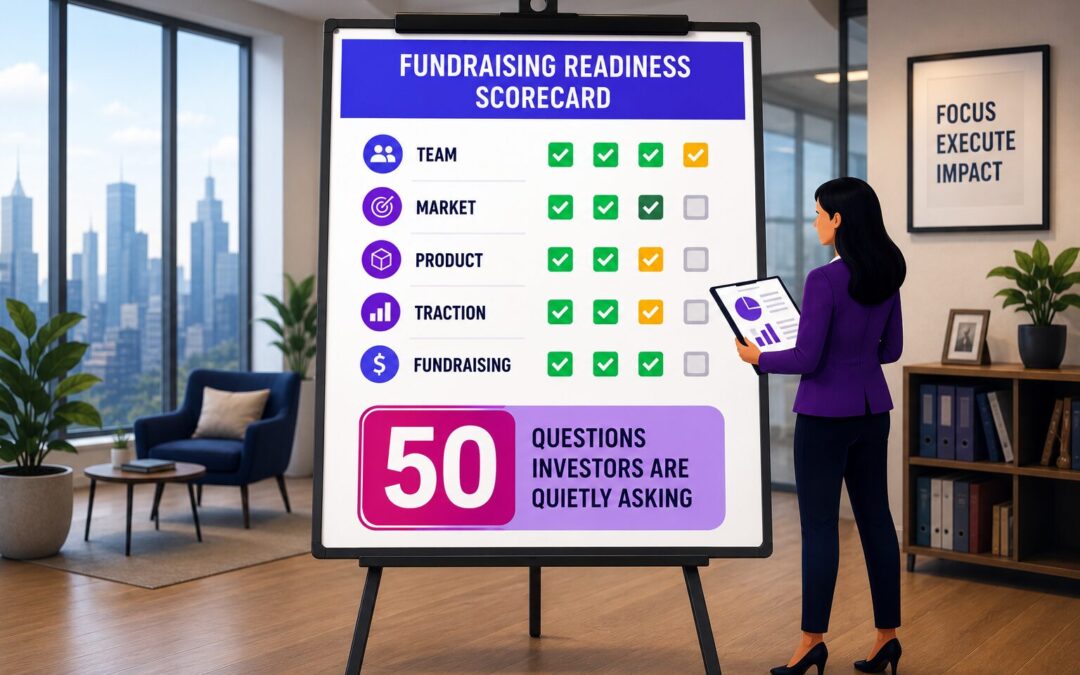
When drafting your pitch, you’ll focus on answering the core 50 questions investors are quietly asking. Experienced founders are well aware that the principal/investor reviewing the deck is well-trained in pattern recognition. All evaluations are driven by an informal checklist they maintain.
The pitch deck, the founder’s presentation skills, intros, and referrals influence fundraising success, but they are not deciding factors. Although you’ll welcome questions during the Q&A session, most investors have already completed their internal assessment by then.
This assessment centers on determining whether the opportunity is worth the risk and whether the team can execute. Above all, investors need to assess if the startup has the potential to generate venture-scale returns. Their checklist and scorecard are vital aspects of the evaluation framework.
However, the scoring criteria are never made public, and few founders know that they exist. Know that your pitch is earning points based on a series of critical questions. If you can understand these queries, you’ll identify the weaknesses in your pitch before entering the conference room.
More than addressing the gaps in the pitch, you’ll address the shortcomings in your startup before approaching investors. Read ahead for a breakdown of the startup fundraising readiness scorecard. Also, understand the 50 questions investors are quietly asking as they evaluate the pitch.
*FREE DOWNLOAD*
The Ultimate Guide To Pitch Decks
Category 1: Founder And Team Assessment
More than the startup, business idea, mission statement, and vision, investors back people, namely the founder and founding team. Markets are unpredictable and dynamic; products evolve to meet customer needs, and business models pivot as they chase success.
Only strong founders with robust leadership skills, resilience, adaptability, and a forward-thinking attitude survive. Here are the questions investors are asking:
- Is this founder uniquely qualified to solve this problem?
- Does the founder possess deep domain expertise?
- Have they demonstrated resilience through adversity?
- Can they recruit exceptional talent?
- Do they communicate clearly and persuasively?
- Are they coachable?
- Can they make difficult decisions?
- Is the leadership team complete?
- Do the founders complement one another’s skills?
- Would I personally want to work with this founder for the next decade?
What are Investors Looking for?
Keep in mind that a startup with an average product and exceptional founders often attracts more investor interest. That is, as compared to a startup with a great product and a weak team. Founders must demonstrate their ability to convert the product into sustained, predictable returns.
They must also exhibit domain expertise by having built and exited a company, or by having worked in a similar sector. A great example is Simon Bushell, the founder of Sympower. Simon and his co-founder developed the idea of transforming the way renewables are generated, stored, and used.
When Simon set out to raise funding, most of the investors who backed him were entities with whom he had existing relationships. They believed in his vision and mission statement and were willing to bank on a complex but disruptive idea. An idea that would set the tone for future renewables.
Interpersonal relationships and coordination between cofounders are also under careful scrutiny. The investor at your table is likely studying your interactions with cofounders.
Any misalignment is a red flag because it typically results in 65% of startups failing. Investors need to know whether the partners are competing with one another. Or if the disagreements are healthy and will propel the company forward.
Then again, investors want to understand if their expertise-driven suggestions and recommendations will be accepted or rejected. Don’t forget that they have a vested interest in your startup’s success.
They intend to support it with more than just capital. Think access to networks, additional resources, and assistance with entering into strategic partnerships. Moreover, they anticipate building long-term partnerships with the founder and potentially supporting their future ventures.

Raise Capital Smarter, Not Harder
- AI Investor Matching: Get instantly connected with the right investors
- Pitch & Financial Model Tools: Sharpen your story with battle-tested frameworks
- Proven Results: Founders are closing 3× faster using StartupFundraising.com
Category 2: Problem And Market Validation
Many startups are born when founders develop an exciting innovation that they think can disrupt the market. Actually, the reverse is true. Successful founders identify problems that need solving and then develop disruptive solutions to address them.
When investors review the pitch, they want to know if you can convert that solution into a marketable product. Customers have to want to purchase the solution you’re offering because it significantly improves how they work. Not just an improvement, but a drastic, money-saving transformation.
Among the 50 questions investors are quietly asking are queries centering on whether founders are tackling a real problem.
- Is the problem painful enough to matter?
- How frequently does the problem occur?
- Are customers actively seeking solutions?
- Is the problem growing over time?
- Can this become a billion-dollar opportunity?
- Is the market large enough to support venture-scale returns?
- Is there a clear market trend supporting growth?
- Are customers already spending money on alternatives?
- Does the startup address a critical need or a nice-to-have feature?
- Is timing working in the company’s favor?
What are Investors Looking for?
Investors understand that great startups often benefit from powerful market tailwinds that accelerate adoption. When customers purchase solutions, they’re not looking for nice-to-haves; they’re looking for can’t-do-withouts. Michael Mandel and his idea to build CompStak did just that.
CompStak is a crowdsourced commercial real estate data platform that streamlined how deals were done. Michael realized a critical gap in the market: information was shared through phone calls, informal networks, and Monday morning meetings. He decided to do something about it.
When Michael approached investors, they were skeptical because they didn’t understand the market. Then, he explained how real estate was the second-largest sector worldwide. He positioned himself as an authority on the subject and made a breakthrough that had never been attempted before.
Investors look for startups targeting customers who are actively seeking solutions to continually growing problems. Problems that result in loss of potential revenue and customers, and money left on the table. Most importantly, investors are seeking the next unicorn.
Category 3: Product And Product-Market Fit
Investors need evidence that customers genuinely want the solution and that the product delivers real value. They need to know if the founder has achieved real product-market fit. Here’s what they ask:
- Does the product solve the problem effectively?
- What makes the solution different?
- Is the value proposition immediately clear?
- Are customers using the product consistently?
- Is retention strong?
- Are customers expanding their usage?
- Would customers be disappointed if the product were to disappear?
- Is product-market fit beginning to emerge?
- Are customer testimonials compelling?
- Is the product difficult for competitors to replicate?
What are Investors Looking for?
Even if the product is an effective solution to the problem, it does not necessarily indicate an effective product-market fit. Among the 50 questions investors are quietly asking are queries centering on this fit. Customers should want to transition to the new solutions quickly—and not just for cost savings.
Further, the transition should be streamlined with the minimum of cost and disruption to their regular operations. Keep in mind that investors increasingly prioritize retention and engagement metrics over vanity growth metrics.
Customer acquisition is the easy part. The tougher question is whether users will continue to prefer your brand consistently over the competition. This is why you’ll include customer testimonials and reviews from early adopters. It tells investors if sales and revenue are likely to expand quickly.
Keep in mind that storytelling is everything in fundraising. In this regard, for a winning pitch deck to help you here, take a look at the template created by Peter Thiel, Silicon Valley legend (see it here), that I recently covered. Thiel was the first angel investor in Facebook with a $500K check that turned into more than $1 billion in cash.
Remember to unlock the pitch deck template that founders worldwide are using to raise millions below.
Category 4: Traction And Business Performance
At some point, opinions become less important than evidence. Here’s where metrics in the pitch come in—they demonstrate traction. Customers may leave rave reviews and share great things about the brand on social media. The real question is whether those reviews translate into actual sales.
- Is revenue growing consistently?
- Are customer acquisition costs sustainable?
- Is retention improving?
- Are unit economics moving in the right direction?
- Is growth accelerating?
- Is the company outperforming comparable startups at this stage?
- Are sales cycles becoming more efficient?
- Is demand coming from repeatable channels?
- Are customers referring new customers?
- Is there evidence of momentum?
What are Investors Looking for?
Investors are often looking less at current size and more at the direction and velocity of key metrics. You’ve proved that the product works and that you’ve achieved the ideal product-market fit. Now, investors are looking for evidence that you can sustain that momentum.
The focus shifts to where the company is likely to be in the next five years and what markers indicate accelerated growth. Your metrics will include numbers such as month-over-month revenue growth and lower customer acquisition costs.
You’ll show declining unit economic costs, signaling an increase in the company’s projected bottom line. Also, talk about word-of-mouth referrals and a rising number of repeat customers.
Category 5: Fundraising Readiness
Not all startups are ready for a capital infusion just yet. This is why many investors prefer to adopt the wait-and-watch approach. They may be looking for more attractive numbers and/or a reputable investor to serve as the startup’s lead investor. Here are the typical questions in this category:
- Is the fundraising story clear and compelling?
- Is the startup raising the right amount of capital?
- Is the valuation realistic?
- Does the company have a credible use-of-funds plan?
- Are key metrics investor-ready?
- Is the data room organized?
- Are legal and financial records in order?
- Does the founder understand the fundraising process?
- Can the startup achieve meaningful milestones with this round?
- Does this company look ready to absorb institutional capital?
What are Investors Looking for?
Questions in this category are designed to lead up to the term sheet. This is the initial evaluation investors conduct before the actual due diligence. If they have reached this section of questions, it typically means they see potential in the startup.
However, investors could be scanning the pitch for answers to these considerations. Not only should your narrative be compelling and concise, but you’ll also clearly indicate the exact amount of capital needed. Also specify the Use of Funds and Why Now to build urgency.
Now that you have an overview of what investors are thinking, you should also prepare for the questions they will ask after reviewing your pitch. Check out this video in which I have decoded the questions and the intent behind them.
How To Use The Startup Fundraising Readiness Scorecard
Now that you understand the 50 questions investors are quietly asking, let’s dive into how you can score the startup. Assign points to each question according to the chart below. Use your judgment and be honest.
0 = Major concern
1 = Needs improvement
2 = Acceptable
3 = Strong
4 = Exceptional
Next, you’ll add up the points to arrive at an aggregate. Here’s what you’ll see:
0–75: Significant preparation needed
76–125: Moderate investor readiness
126–175: Strong fundraising position
176–200: Highly fundable opportunity
When grading your scorecard, remember not to view each category as a stand-alone. Every one of these questions is closely interlinked, and a weakness in one category quickly impacts the others. For instance, a lack of product-market fit results in rising customer acquisition costs.
You can divert a large amount of resources toward marketing and advertising strategies like freemiums and discounted deals. But if the product does not solve a real problem, customer retention becomes a huge challenge.
Let’s try another example. Lack of leadership qualities and communication skills can spell disaster even before the startup launches. High employee turnover and difficulty in retaining talent can make it impossible for the company to succeed.
And investors are well aware of these signals that indicate the startup is not fundable. Fundraising approaches will have failed even as founders are delivering the pitch.
Conclusion: Investors Are Looking For Reasons To Believe
These 50 questions investors are quietly asking are not designed to reject the startup and pitch. They are searching for evidence that a company can achieve an extraordinary outcome.
Repeat founders who have raised capital for multiple startups understand how investors think. These entrepreneurs are trained in thinking from the other side of the table. They know the questions being asked long before the first pitch meeting occurs.
Before launching a fundraising process, you’ll step into the investor’s shoes and honestly evaluate your startup against these 50 questions. The answers will often reveal exactly where improvements are needed and what must happen before investors are ready to say yes.
You may also find our free library of business templates interesting. There, you will find every single template you need to build and scale your business completely, all for free. See it here.



Facebook Comments