


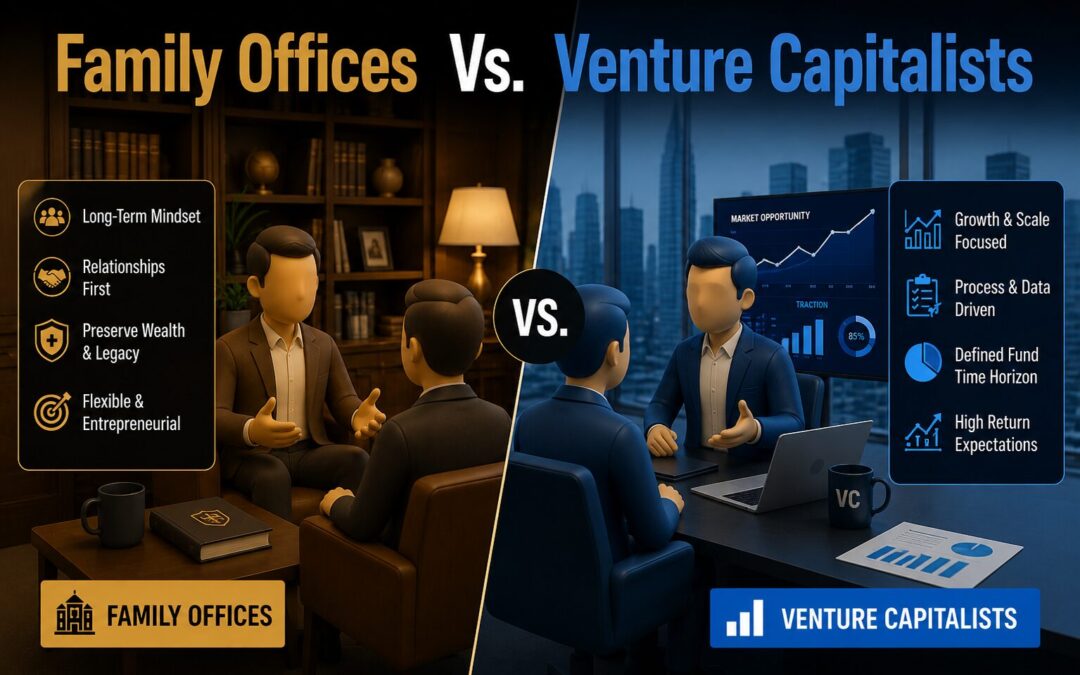
Startup fundraising from family offices vs. venture capitalists (VC) has several key differences. How you approach them and how the deal culminates in money in the bank involves distinct nuances that you must understand. Your strategizing depends on their individual organizational hierarchies.
How family offices and VCs evaluate, process, and accept applications also depends on the capital available and assets under management. Their investment thesis, sectors they prioritize, and the extent of their intended involvement in the portfolio’s operations also influence decisions.
The underlying principle in any fundraising framework is always to understand your target investors and how they operate. You’ll also draft the pitch and your approach according to the check sizes you need and where your startup is at. That is, the growth stage and the kind of assistance it needs.
Read ahead for detailed information about how to access startup fundraising from family offices (FO) and VCs. You’ll be better-positioned to draw up a list of potential investors suitable for your startup. Don’t forget that your target investors are also looking for opportunities that match their needs.
*FREE DOWNLOAD*
The Ultimate Guide To Pitch Decks
Startup Fundraising from Family Offices vs. Venture Capitalists – Key Differences
Institutional Framework
When researching any investor organization, your first question likely centers on who the ultimate decision-making entity is. You’ll also want an overview of the different layers of the hierarchy your application passes through before approval.
Know that the investment committee in the VC firm is the final decision-making body. Investment decisions are made during meetings where partners discuss the merits of each pitch before finalizing the quarter’s investments. Just two to three viable options pass the rigorous screening process.
Your initial point of contact is the principal, who serves as the VC firm’s representative. This is the entity that attends presentations and selects pitches to refer back to the firm. If they are convinced, you can expect they will champion your startup at the committee meetings.
The family office hierarchy is distinct. Here, the principal is the decision-making authority who evaluates and selects investment opportunities. They interview founders to ensure that the startup is a good fit and has the potential to earn returns for the office.
How Capital Gets Allocated
Family offices are typically flexible across all asset classes with no policy restrictions. At best, the FO could be innovation-driven with an investment thesis focused on disruptive or impact-driven startups. Some FOs may select projects to help them apply their expertise and additional resources.
Family office check sizes typically range from $1M to $50M, depending on the principal’s conviction and relationship with the founders. In contrast, VCs offer substantial check sizes, ranging from $25M to $500M. You’ll thus choose the investor to target according to the amount of capital you need.
Every venture capital firm works according to its charter, which defines its core investment approach, thesis, and operational structure. The charter also includes policy statements, regulating rules, and guidelines. It also lays down the minimum check size mandates that partners must follow.
Above all, this document specifies the sectors, geographical locations, and growth stages of the startups in which the firm can invest. Deviations from the clauses included in the charter are rare. If you’re looking for larger amounts of capital, reach out to VCs that support startups in your sector.

Raise Capital Smarter, Not Harder
- AI Investor Matching: Get instantly connected with the right investors
- Pitch & Financial Model Tools: Sharpen your story with battle-tested frameworks
- Proven Results: Founders are closing 3× faster using StartupFundraising.com
Prioritizing Relationships or Processes
One of the key differentiating factors in startup fundraising from family offices vs. venture capitalists is relationships. FOs prioritize prior relationships with founders. Trust and personal rapport drive almost every allocation, and they are more likely to select startups they previously know.
Family offices also encourage the younger family members to participate in investment decisions. If you can connect with them through networking channels, that could get you a foot in the door. After this initial introduction, the due diligence process begins, during which the FO analyzes the project.
However, if the meeting with the principal does not progress smoothly or a breach of confidence occurs at any point, the application is instantly rejected.
Although relationships with venture capital firms also matter, due process and compliance govern decisions more than introductions. More often than not, applications land on the desks of junior associates and analysts who form the first layer.
These professionals audit financials and conduct compliance checks before moving files to the principals’ offices. Even if your pitch receives the investment committee’s final approval, it will still go through due diligence. Any compliance red flags or policy misalignment can land proposals in the bin.
Investment Time Horizons and Core Objective
Family offices typically manage assets for families across multiple generations. This is why they don’t operate with fixed time horizons but are open to letting projects incubate over the long term. Startups developing time-consuming scientific innovations can thus approach them for backing.
Since FOs preserve capital, build legacy, and transfer wealth across generations, they invest in viable startups that can eventually deliver substantial returns. FOs also prefer to support innovation and development in sectors that generate wealth for their clients.
On the other hand, the typical venture capital firm has an investment horizon of 10 years. Though, it can extend this time frame to 12 years also. The firm must realize returns and deliver profits to its limited partners by the end of its lifecycle. Benchmark cycles also play a critical role.
This is why VCs prefer to invest in startups that can scale and be ready for an exit within their time horizon. Their objective is to make a profitable exit when the startup is acquired or goes public. When sourcing capital, you’ll need to ensure that your company’s lifecycle aligns with the fund’s.
Flexibility in the Investment Approach
Family offices adopt a more flexible approach when investing. They are open to backing almost all sectors, geographical locations, and growth stages. Their focus is on the founder, their track record with successful companies, and connections with client family members.
Thus, investment decisions are highly personal and conviction-driven per principal. Moreover, FOs have a strong appetite for direct deals and co-investment opportunities. They are known to jointly invest in projects with other FOs, VC and private equity firms, and other entities.
In contrast, VC firms are far less flexible. They operate in accordance with the charter’s guidelines and are accountable to their limited partners under the governance clauses. This is why smart founders do their research into the firm before approaching it for capital.
If you would like for additional information about the different types of investors you can approach besides family offices and venture capitalists, check out this video I have created. You’re sure to find it helpful.
What Credibility Looks Like
To reiterate, investment decisions revolve around the founder’s relationship with the family office. After the initial intro or referral, you’ll demonstrate consistency, personal integrity, and alignment of values over time.
A partnership with an FO is long-term, and you’ll also rely on them to back future projects. With VC firms, an audited track record, institutional pedigree, and verified performance carry more weight.
A great example of FO focus is Elon Musk, founder of SpaceX (Space Exploration Technologies Corp.). Several wealthy families and family-office-style investors participated alongside VC firms in Tesla and SpaceX.
These investors were willing to make long-term bets because they were investing in Elon’s vision rather than near-term financial metrics.
Take the case in point of Alex Haro, founder of Life360 and Hubble Network, who recently appeared on the Dealmakers Podcast. Alex successfully built his first company, taking it to a dual-IPO in 2019 and $500M in revenue in 2026.
When Alex set out to develop Hubble Network, VC investors were ready to back him regardless of how crazy his idea sounded. The incredible success of Life360 demonstrated his leadership and innovation skills, inspiring confidence and conviction among investors.
Accessing Capital
When startup fundraising from family offices vs. venture capitalists, you’ll use approaches most likely to succeed. For instance, if you’re targeting an FO, you’ll look for mutual connections within your network who can help you with warm intros. Also, use social media platforms to connect.
Attend networking events, conferences, seminars, and mixers, where you can interact with family members and principals to gain visibility. Always be ready with an elevator pitch. You could possibly meet a NextGen family member and get them interested in the concepts you’re developing.
Warm intros and relationships with VC partners and principals also work well before you send in proposals. However, you can tap other channels to access venture capital. For instance, connect with venture scouts, who facilitate deal flows between VC firms and early-stage startups.
You could also consider partnering with a venture studio, usually an arm of a well-known venture capital firm. These workshops operate much like incubators and accelerators, but getting accepted into them is a lot easier. You’ll get the seed capital needed to get your startup off the ground.
Keep in mind that storytelling is everything in fundraising. In this regard, for a winning pitch deck to help you here, take a look at the template created by Peter Thiel, Silicon Valley legend (see it here), that I recently covered. Thiel was the first angel investor in Facebook with a $500K check that turned into more than $1 billion in cash.
Remember to unlock the pitch deck template that founders worldwide are using to raise millions below.
Approaching Family Offices: What Founders Need to Know
Now that you understand the key differences in fundraising from family offices and venture capital firms, let’s dig some more. Many founders make some key mistakes in their approach to FOs.
- For starters, don’t rely on cold outreach; you need to build trust before pitching for capital.
- Refrain from using the same strategies that you would use for a VC firm—LinkedIn messages, cold emails, and pitch decks.
- The family office principal may receive hundreds of applications from new founders. However, their focus is always on the entity that introduced the founder. A warm introduction or referral from a trusted advisor, lawyer, accountant, founder, or existing portfolio company carries far more weight than a polished pitch deck. An intro from a client family member can also work.
- Before drafting the pitch, ensure you understand the family legacy and wealth preservation goals and address concerns. Further, analyze the family office’s asset allocation priorities. For instance, if the FO thesis is impact-driven, ensure your startup is a good fit before applying.
- Don’t focus entirely on financial metrics or inflate projections of the returns they can expect. Include only realistic and verifiable numbers. Loss of credibility kills your chances of securing capital quickly.
- Founders also assume that a quick “yes” from a principal means immediate funding. That’s only the first step. Proposals go through thorough due diligence before FOs approve and issue checks.
Approaching Venture Capital Firms: What Founders Need to Know
Similar to approaching family offices, you must begin by researching everything there is to know about the VC firm.
- Dig deep into its investment thesis, check sizes, and fund mandates. You’ll have a better chance of success if you ensure alignment and that your startup is a good fit. Pitching product ideas and sectors that their mandates don’t cover is a waste of time.
- Although using introductions and referrals can get you an appointment with the principal, don’t rely too much on such relationships. Your proposal will move to the next stage of evaluation only if it has real merit.
- Don’t make the mistake of assuming enthusiasm from a partner equals a firm-wide decision. That only means you have a champion who will speak for your proposal at the investment committee meeting. That’s where the final decisions and selections are made.
- Ensure you streamline the firm’s evaluation process by preparing thoroughly for due diligence and partner meetings. Never underestimate that diligence because every aspect of your company is under scrutiny. You’ll prepare and populate the data room and make every document and piece of paperwork available to analysts.
- Ensure that you send follow-up emails on schedule and promptly respond to requests for further information. Once VCs approve a proposal, they’ll move quickly to the next stage and send you the term sheet.
In Conclusion
Founders must understand that there are key differences in startup fundraising from family offices vs. venture capitalists. Capital is not just capital. What also counts is the entities providing that capital and the additional support they’ll provide.
This is why founders should align their fundraising strategy with the investor’s incentives, governance structure, and decision-making process. Keep in mind that the best fundraising outcomes happen when founders understand how investors think before they start pitching.
Do the necessary research and ensure alignment before you hit send on that proposal email.
You may also find our free library of business templates interesting. There, you will find every single template you need to build and scale your business completely, all for free. See it here.



Facebook Comments