


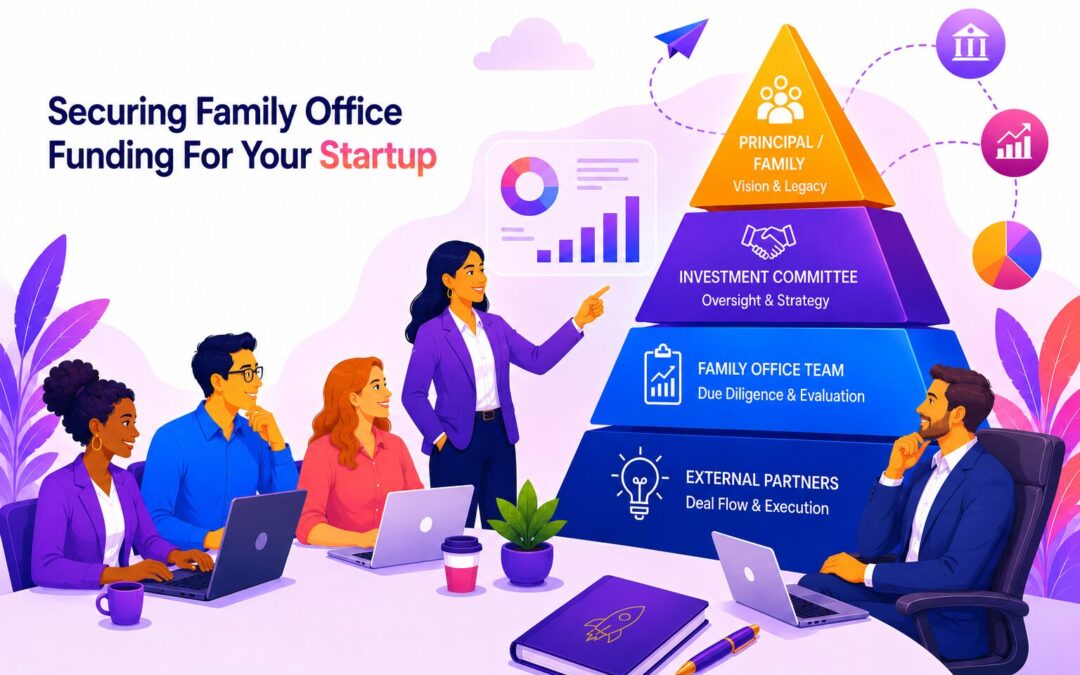
Securing family office funding for your startup could help propel it forward with more than capital. You can expect greater flexibility and longer exit horizons than with a typical venture capital (VC) firm. Thus, founders are increasingly turning to family offices to leverage their benefits.
Check Out These Statistics
Interestingly, family offices account for ~31% of all capital invested into startups globally. Despite fluctuations over the last few years, these investors have maintained their market share and status as one of the three largest investor types.
A significant shift over the last few years has occurred, with family offices increasingly opting for direct investment. Or, purchasing equity directly in startups. Over 70% of these entities now bypass traditional VC funds to lead their own investment rounds.
Reports suggest that the trend is rising, with investments increasing from 70% in 2023 to 82% in 2024. It continued through 2025 with a greater focus on technology (47%) and fintech (26%).
Further, note that 69% of family offices structure their investments as “club deals,” in which they pool capital with other families. This strategy enables them to mitigate individual risk. From the startup perspective, this factor translates into a large pool of capital you can tap into.
When compiling a list of investors to approach, you’ll include them alongside Venture Capital (VC) and Corporate Venture Capital (CVC). However, before drafting proposals, it’s crucial to understand how the family office hierarchy works.
You’ll dive into analyzing the key decision-makers who’ll view your proposal and the operational tiers. Learning more about their playbook and cultural nuances helps drive successful fundraising. Here’s what you should know about securing family office funding for your startup.

*FREE DOWNLOAD*
The Ultimate Guide To Pitch Decks
The Foundation: The Family Council
The family council sits at the apex of the entire family office hierarchy. This body defines the overall mission, long-term vision, values, and legacy goals. For instance, philanthropy, wealth preservation and management for multiple generations, or supporting impact-driven initiatives and innovation.
As the formal governing body, this council drafts the Family Constitution, which outlines the rules for the family members. It covers issues such as family office governance, members who can serve on the council, share ownership, and selling rights.
The family council serves as a structured platform where members can discuss sensitive issues and resolve conflicts. It prevents family disputes from spilling over into business or investment decisions.
Most importantly, it educates the next generation of members—the NextGen—about their rights and responsibilities as future shareholders. In this way, the council secures, manages, and grows the wealth that high-net-worth, multi-generational families own.
Members of the family council are elected representatives from the different branches or generations of the entire family. Their election is based on family values, legacy, and operating principles. When you apply to a family office for funding, this council makes the final decision to approve the proposal.
Accordingly, you’ll frame the application to align with its broader values and, more importantly, its risk appetite. Don’t forget to research their investment thesis before adding them to your list of investors.
Board of Directors or Advisory Board
The board of directors or advisory board is the execution arm of the family office, translating its vision and goals into action. This board oversees the organization’s assets and manages them as a professional business would. It invests in viable projects, manages risk, and realizes returns.
The board is also responsible for monitoring performance, approving budgets, and ensuring the office adheres to the investment thesis. Senior family members sit on the board to represent the family’s interests and values. It also comprises a team of independent directors and advisors in various roles.
These directors bring professional expertise to the board, such as legal, tax, investment, and financial expertise. Their job is to offer a neutral perspective that offsets emotion-driven decision-making or family bias. Directors have fiduciary responsibility and legal authority to make binding decisions.
When you pitch a family office for funding, the Board makes the final decision before the proposal reaches the council. Let’s assume your startup aligns with a specific board member’s expertise, like a director who was a former Fintech CEO. In that case, they can make recommendations.
When securing family office funding for your startup, remember that in this sphere, networking and professional contacts often matter more than the pitch deck itself. Many such organizations operate primarily through referral networks and trusted circles—a trend that has increased in 2025.

Raise Capital Smarter, Not Harder
- AI Investor Matching: Get instantly connected with the right investors
- Pitch & Financial Model Tools: Sharpen your story with battle-tested frameworks
- Proven Results: Founders are closing 3× faster using StartupFundraising.com
Investment Committee
The investment committee makes the key capital allocation decisions—the percentage of capital allocated to safe and risky bets. For instance, safe bets like bonds and real estate, and risky bets like early-stage startups.
The CEO manages the day-to-day operations of the family office and supervises other members, such as the CIO and CFO. The CIO is responsible for the investment strategy, risk management, and asset performance. And, the CFO handles reporting, tax alignment, and fiduciary duty.
The committee also has a risk officer on board who oversees compliance and regulatory controls. Former hedge fund managers, venture capitalists, or sector specialists also sit on the panel. Their job is to conduct an objective “stress testing” of potential deals.
As the founder submitting an application, you should know that the investment committee conducts due diligence on your startup. This diligence is as thorough as with any other investor, with teams diving into every aspect of your company. Think—vision, business model, product, and exit strategy.
Family offices, as a rule, have longer holding periods than typical VCs and PE firms. However, they do need to see a timeline within which they can realize returns.
Their due diligence has yet another concern—Does your startup complement or conflict with their existing holdings? For example, the family office owns a hospital chain. Thus, they are likely to be keenly interested in supporting a startup developing innovative AI-driven medical diagnostic devices.
Operations
The operations department is where the family office’s day-to-day management occurs, including the execution and administration. The investment committee relays capital allocation directives to this body, which undertakes the actual checks and balances.
The CFO manages financial reporting and oversight and is also responsible for tracking every dollar. This professional compiles the complex reports that the Family Council and tax authorities require.
Operations also has a compliance officer on board. Their job is to ensure the family office’s activities are compliant with regulations. If the office manages investments in global locations, compliance with those locations’ regulations is mandatory.
This officer manages insurance policies and conducts background checks. Their tasks also include supporting due diligence and gathering intel on projects the office might want to support.
The operations team is also responsible for the organization’s fintech stack and IT infrastructure. It ensures that every tech aspect is functioning smoothly, including communication, HR, financial, accounting, portfolio management software, and cybersecurity.
Many family offices also provide “Concierge” services to their members, and their management happens here. For instance, running the family’s real estate, shopping, private travel, and payroll for household staff.
External Expertise
In addition to in-house teams, family offices work with several third-party specialists and consultants. These professionals are hired specifically to fill knowledge gaps the internal team may not have. Their advisory expertise encompasses any support the organization needs for wealth management.
As more family offices shift toward direct investing, they need external certified consultants to vet complex startup investing opportunities. For instance:
- Private brokers provide access to banking and financing.
- Wealth managers provide expert guidance on portfolio diversification.
- Specialized legal firms handle the complex legal structures of direct equity investments. They cover issues like intellectual property (IP) ownership review and regulatory compliance.
- Tax and accounting advisors and external CPAs ensure that a startup investment won’t create unintended tax liabilities for the family’s estate.
- If a family office is considering investing in a “deep tech” or “biotech” startup, it will often hire sector-centric specialists. These external PhDs or industry veterans perform technical due diligence before finalizing investment decisions.
Depending on the family office’s size, operational structure, and assets under management, it may choose to outsource certain activities. For instance, it may hire independent consultants to manage areas such as due diligence, taxation and accounting, and IT infrastructure.
Keep in mind that storytelling is everything in fundraising. In this regard, for a winning pitch deck to help you here, take a look at the template created by Peter Thiel, Silicon Valley legend (see it here), that I recently covered. Thiel was the first angel investor in Facebook with a $500K check that turned into more than $1 billion in cash.
Remember to unlock the pitch deck template that founders worldwide are using to raise millions below.
Asset Allocation
This layer of the family office hierarchy is particularly relevant to you. Asset allocation is the master plan for diversifying family wealth into three buckets. When securing family office funding for your startup, gather information to determine whether your ideas align with its thesis and values.
- Investment in the Public Market accounts for approximately 42% of the firm’s portfolio. The objective is to achieve the highest yields by investing in top-performing stocks and bonds, which provide fixed income. This section represents secure investments that keep the office functional.
- Investment in alternative opportunities comprises another ~42% of the office’s holdings. The investment committee disperses capital in private equity (21%), real estate (11%), and hedge funds (6%). Startup investing is executed with funds available in this category—either through the PE firm or direct investment (~4%).
- Cash and commodities comprise the remaining ~13% to 16% of the assets under family office management. These assets are held in reserve to insulate the family office against inflation and unexpected situations.
Why Asset Allocation Decisions Impact Your Fundraising
Researching asset allocation when securing family office funding for your startup can determine the campaign’s outcome. Here’s why:
- Keep in mind that asset allocation is not set in stone at a family office. The board and council may move assets and holdings around in response to changing market conditions. Say, the standard investment model allocates not more than 40% of capital to the tech sector. However, rapid developments in the AI sector could prompt the council to raise that percentage to 50% or higher. They can leverage rising trends to maximize returns.
- The council focuses on risk mitigation strategies and may rebalance its portfolio accordingly. For instance, the current scenario with uncertain gas prices. Family offices may hesitate to back startups relying on oil imports for manufacturing. A sudden 20% spike in energy costs could wipe out annual profits.
- Asset allocation is fairly flexible. However, family offices may reject applications if they are “fully allocated” in a particular category. A proposal could be a perfect fit for their thesis, but the capital to fund it may not be available.
Next Gen Development
Family offices take on the crucial task of preparing younger family members to assume their responsibilities. Thus, they offer the NextGen education and mentoring to build financial literacy. Succession planning and preparing members for leadership transfer are part of the structure.
Younger generations participating in decision-making is one of the core reasons why family offices are now shifting toward direct investments. Statistics indicate a jump from 70% to 82% investment in non-traditional and disruptive startups.
Know that NextGen is typically tech-native and prefers to invest capital directly in innovation, real impact, AI, and sustainable energy rather than in passive funds. This factor could work well for startup founders.
As they are more accessible at networking events and tech conferences, you can interact with them for a quick intro–don’t forget to have an elevator pitch ready. NextGen members are also familiar with “startup language” such as SaaS, LTV, CAC, and runway—so communicating your ideas should be easy.
Most importantly, they have the emotional leverage to convince the Family Council to take a “risk” on a new technology. Older generations might not fully understand it, but young people do.
The Takeaway!
Understanding its hierarchy should make securing family office funding for your startup much more streamlined. Before approaching a particular organization, you’ll research its investment thesis and asset allocation models. You’ll target only those offices whose interests align with your startup idea.
Once you’ve identified the right organizations, tap into your network and look for contacts to get a foot in the door. An introduction or referrals will improve your chances of success. Also, reach out to the NextGen members and pitch your concepts to secure capital.
You may also find our free library of business templates interesting. There, you will find every single template you need to build and scale your business completely, all for free. See it here.



Facebook Comments