


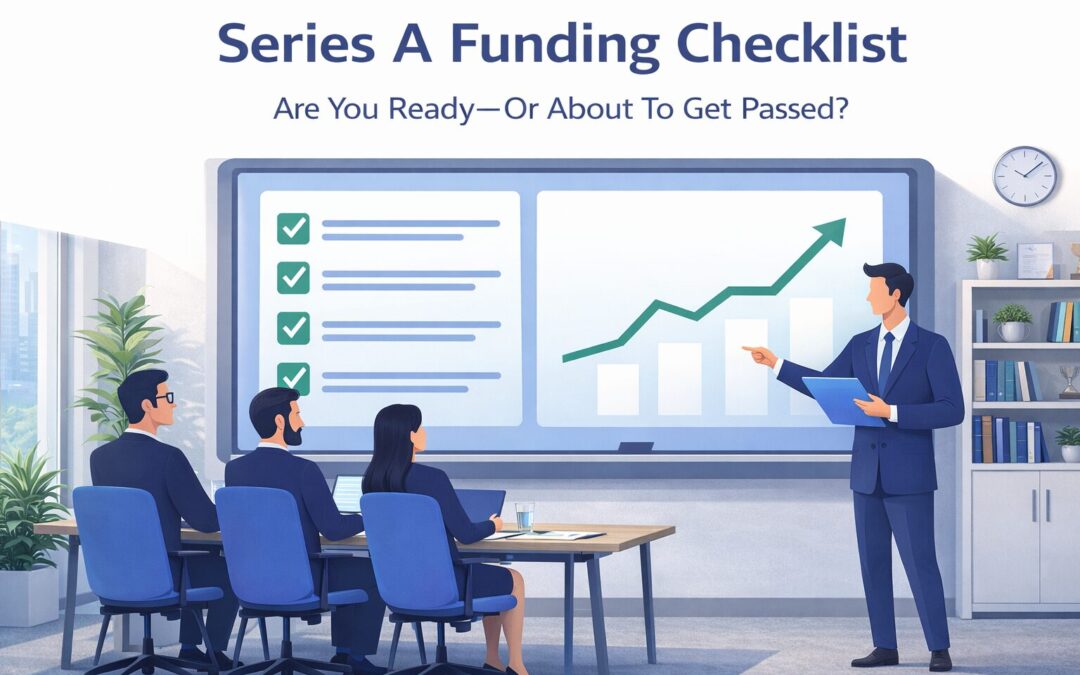
When putting together a Series A funding checklist, most founders think only about demonstrating growth. This is the underlying error they make, which results in investors passing up on the pitch.
Potential funders are instead looking to see if the startup has successfully eliminated the risks relevant to a Series A round. At the seed stage, you’re proving that the startup idea has potential. But when you move on to the next stage, it’s more about proving predictable numbers.
Founders think they are ready for the Series A round when they can demonstrate growth metrics. At their end, investors are looking for signals that you can sustain that growth and the risks you’ve covered. Further, they’re analyzing the moat you’ve built to stay ten steps ahead of the competition.
Read ahead for a detailed view of the Series A funding checklist investors will consider before writing that check. Make sure you have the numbers lined up before walking into the presentation room.

*FREE DOWNLOAD*
The Ultimate Guide To Pitch Decks
Understanding What a Series A Funding Round Is
Before we talk about the funding checklist, let’s do a quick recap of what a Series A round is. When you reach the Series A stage, you’ll have validated the product-market fit and built a robust customer base. Your objective is to raise $2M-$15M to accelerate operations and growth.
The capital raise should assist in scaling the facility by enabling the purchase of inventory, equipment, and tools. You’ll also invest in hiring top talent, refining existing product features, and adding to the current product portfolio.
Essentially, the money should be adequate for a 12 to 24-month runway before the Series B round. Your pitch will include a Use of Funds slide that tells investors how you intend to allocate the capital.
You’ll also talk about the milestones you hope to achieve, along with an approximate time frame. To do that, you’ll prove capital efficiency, low burn rates, unit economics, and effective barriers to entry.
The Series A Funding Checklist
As your fundraising consultant will advise, the strategy for a successful fundraiser is simple—think like an investor. Here’s a list of the signals they evaluate. Also, learn about the factors that prompt the venture capital investment committee to approve your application.
Traction
When investors review your pitch, they’re analyzing the metrics that demonstrate the growth you’ve achieved so far. They’re looking for de-risking numbers, such as $2M to $5M in Annual Recurring Revenue (ARR) and 7% to 15% consistent month-over-month (MoM) growth over the last 6 months.
Data like a 10% traction tells investors that the company has already started scaling effectively. Their capital will propel it forward quickly. Don’t forget to add numbers like higher LTV (Lifetime Value) to CAC (Customer Acquisition Cost) or LTV: CAC Ratios.

Raise Capital Smarter, Not Harder
- AI Investor Matching: Get instantly connected with the right investors
- Pitch & Financial Model Tools: Sharpen your story with battle-tested frameworks
- Proven Results: Founders are closing 3× faster using StartupFundraising.com
Product-Market Fit
Strong product-market fit is a crucial criterion for raising a Series A round. Investors want affirmation that the company has a robust customer retention rate with low churn. They also want to see lower customer acquisition costs (CAC) and advertising expenses, which indicate organic growth in sales.
Product-market fit shows that the startup idea effectively solves customer pain points better than existing products do. This factor translates into higher customer satisfaction, consistent demand, and long-term engagement and brand loyalty—the right ingredients for growth.
Growth Engine
Predictability and repeatability are the buzzwords here. Investors are looking for at least one of two repeatable acquisition channels. They want evidence that the startup’s growth isn’t driven by “founder push.” Or marketing strategies such as social media posts or public relations (PR) activities.
Instead, investors want “market pull” or organic traffic that you can convert into actual sales. That should feature on your Series A funding checklist. Your pitch should include reliable channels, such as search engine optimization (SEO) on the website. Or, maybe, paid search programs.
The objective here is to eliminate the risk that sales will taper off once the initial hype wears off. You also want to demonstrate demand outside of your network, including family, friends, colleagues, and acquaintances.
If investors suspect that you have “shallow growth,” that’s a red flag. They’ll view the series A funding round as premature.
Unit Economics
Unit economics can have different connotations on a Series A funding checklist. For one, investors want to see higher returns on investment in acquiring new customers. This means that once the advertising and marketing campaigns are set in motion, they should generate more leads and sales.
Your profit margins should also increase quickly relative to marketing costs. These numbers mean that customers are deriving higher lifetime value from your products. This, in turn, suggests lower churn rates and higher brand loyalty—effectively de-risking the investment.
Unit economics can also be about the manufacturing costs per product unit. As the company scales, production costs should decrease relative to the higher number of products you’re producing and distributing.
A company is ready for funding when it has robust unit economics. Without it, you can expect that investors will pass on the opportunity instantly.
Team
Ultimately, the team is one of the most crucial drivers of growth. Undoubtedly, the founder and their experience with building and exiting successful ventures are a huge draw on the Series A funding checklist. But investors also focus on their leadership skills and the team executing growth.
They’re examining the shipping cadence or the consistency, speed, and reliability with which a team releases new features and updates. Cost efficiency, or the ability to deliver more with fewer resources, also proves that the company is ready. A fresh infusion of capital will yield great returns.
Proof Ladder
Keep in mind that the company’s performance through its pre-seed and seed rounds is under scrutiny here. The investors’ Series A funding checklist traces the startup’s growth trajectory and how its metrics have improved with each stage. If you demonstrate steadily improving numbers, that’s a win.
Pitch Deck Narrative
Storytelling is always a crucial skill for an entrepreneur, just as your fundraising consultant will advise. When delivering the pitch—regardless of the growth/funding stage—you should be able to clearly explain its drivers. What are you trying to accomplish here, and what is the mission all about?
Use succinct and simple language to explain terms that investors can understand quickly. Don’t forget to trace a credible pathway to $100M+ outcome. Ultimately, they are concerned about exiting their investment with rich returns through an acquisition or an initial public offering (IPO).
If investors can see it happening within their fund’s lifecycle, your company is ready for capital. That’s one more tick on the Series A funding checklist.
Keep in mind that storytelling is everything in fundraising. In this regard, for a winning pitch deck to help you here, take a look at the template created by Peter Thiel, Silicon Valley legend (see it here), that I recently covered. Thiel was the first angel investor in Facebook with a $500K check that turned into more than $1 billion in cash.
Remember to unlock the pitch deck template that founders worldwide are using to raise millions below.
Social Proof
Regardless of the claims founders make or, at times, what the metrics say, nothing works better than customer feedback. Ensure that your pitch deck has verifiable testimonials and reviews from satisfied customers. Don’t forget to add feedback and buzz on social media platforms.
It comes down to—what are actual users saying about the company and its products? Are they happy with the performance and after-sales service Will they recommend the brand to friends and family? Are they likely to return for new launches? Or, do they prefer competing brands?
Don’t forget that before approving funding, investors do their due diligence. And, good reviews feature on their Series A funding checklist. Make sure you have them.
Investor Relationships
Convincing investors largely depends on building long-term relationships with them. And, successful entrepreneurs are well aware of the fact. Cold calling and outreach may not have great success rates, as your consultant will recommend. Warm intros will get you a foot in the door quickly.
You’ll begin outreach at least 6 months before your planned funding round. Tap into your network for references to top venture capitalist firms operating within your sector. Don’t lose sight of the fact that you need more than just capital. You also need industry-specific expertise and access to networks.
Build connections and visibility by delivering updates on your company’s performance and the various milestones it has achieved. Familiarity with the application is also on the investors’ Series A funding checklist. They are more likely to back founders they know.
A great case in point is Aneesh Reddy, a serial founder who recently appeared on the Dealmakers Podcast. Aneesh doesn’t believe in frantic fundraising and risking losing runway. Instead, he sends emails and meets with investors every few weeks, regardless of whether he’s actively raising funding.
What Happens at Venture Partner Investment Meetings
The investment committee (IC) at venture capital firms ultimately makes funding decisions. When the partners assess your application, their Series A funding checklist informs them whether a company is ready for funding.
Considering that they approve a few proposals per quarter, they’re looking for reasons to say, “no.” Keep in mind that a fundraising deal doesn’t fail when investors view the pitch. It fails when they start to doubt if the company is ready for a capital infusion.
When they start to think, ”This isn’t repeatable,” “Too early for Series A,” or”Looks like shallow growth,” the deal is lost.
What Founders Think vs What Investors See
Many founders tend to misread how the signals come across to investors. This lack of alignment between what founders think and what investors see leads to pitches failing. For instance:
- You could have all the robust, verifiable metrics to prove growth. Investors want to see whether it is sustainable.
- You could demonstrate that customers are interested in the brand and product portfolio. But investors want to see if you have returning customers. Is your product a “nice-to-have” or is it a “can’t-do-without”? Are customers interested in helping you further develop the product?
- You could demonstrate that you’ve achieved your milestones and targeted benchmarks. But, investors might consider that the targets weren’t ambitious enough. You set the bar too low.
Ensure that you present a deck that aligns with investor doubts and though processes. If you are looking for information about how to build the best pitch decks for Series A funding, check out this video I have created.
Do NOT Raise a Series A If…
Now that you understand how the Series A funding checklist works with investors, compare your startup’s metrics against their benchmarks. Don’t raise funding if the growth drivers are unclear and not sustainable. Delay the round if:
- You haven’t yet identified the Ideal Customer Profile (ICP). Or, a customer base that derives the maximum value from your products. These customers have specific, high-priority pain points that only your product can solve. Don’t confuse the ICP with the target audience, which can be too broad.
- You haven’t proven customer retention. And you’re not sure whether they’ll return for additional sales once the initial hype dies down. If you’re relying on a few customers who account for the entire sales, that’s a red flag. Losing them will mean that the company comes to a grinding halt.
- Your pitch narrative is unclear, leaving room for a pivot. Investors understand that pivoting is a practical option and even support it. But the founder has to be clear about the future pathways lined up for the company.
- You aren’t balancing growth and sustainability correctly. Don’t overlook the 40% rule, a basic benchmark where your growth rate + profit margin should be at least 40%.
- Your burn multiple is >1.5. If you are spending significantly more than $1.50 to generate $1.00 of new ARR, that’s a red flag. Investors view it as capital inefficiency. Wait until you bring down this metric to below 1.0.
- You haven’t covered the operational and legal basics. Don’t dive into fundraising until you’ve built a well-organized data room that is ready to share. Populate it with all the relevant data investors want to see. Also, be clear about intellectual property (IP) ownership rights and any other legal issues that investors might flag.
How do You Score?
Let’s go over the Series A funding checklist once more. You have a 9-point readiness score to match. Not sure how this works? Do you need more help with aligning the essentials when building a pitch deck? How would you ensure that the deck and slides can deliver the right impact?
You’ve come to the right place. Connect with an expert fundraising consultant who can help you evaluate your startup and build a robust pitch deck.
You may also find our free library of business templates interesting. There, you will find every single template you need to build and scale your business completely, all for free. See it here.



Facebook Comments