


Having delivered the pitch, correctly interpreting investor questions helps you respond with the right answers to win funding. As seasoned founders advise, most investors ask more or less similar questions during the Q&A session.
Your job is to decode them and understand where they’re coming from. Recognize that the audience is not just testing your responses; they’re evaluating your thought processes and reasoning. If you can demonstrate thinking on your feet, that’s a signal of resilience and adaptability.
When you prepare responses, they should resonate with the angels and venture capitalist (VC) reps assessing your company. Most VCs evaluate startups and allocate funds raised by their firms. Their objective is to minimize the limited partners’ risk while maximizing returns.
Read ahead to understand the framework of questions investors typically ask and the signals they’re looking for in the answers.

*FREE DOWNLOAD*
The Ultimate Guide To Pitch Decks
Questions Centering Around Market Credibility
The question you’ll likely hear is: Is this a real, scalable, and addressable market? Or, is this just a narrative?
Your responses should explain the “why now” of your business idea. You’ll define the inflection points that have resulted in significant market shifts so that the timing is perfect. These inflections could include a disruptive technology that transformed the sector entirely and favorable regulatory changes.
Changes in customer purchasing behavior, thought processes, and interests are other factors that influence demand. New research and scientific discoveries can also transform buying trends. For instance, a company develops an alternative fuel that significantly reduces carbon emissions.
Given the growing awareness of global warming and the need for solutions, consumers will be more inclined to adopt alternatives. Accordingly, you’ll include metrics such as monthly recurring revenue (MRR) on your financials slide. That’s how you’ll demonstrate that your idea is gaining traction.
From the investors’ perspective, an MRR of $10K to $50K signals rapidly increasing sales, de-risking the investment. Also, add statistics such as the Total Addressable Market (TAM) and Serviceable Obtainable Market (SOM) to demonstrate that the investment is secure.
When interpreting investor questions, keep in mind that they need proof of your ideal customer profile (ICP) and your competitors. For instance, what solutions have competing companies devised, and are they more likely to grab market share? What makes your products superior and economical?
They view not just your startup, but the startup as part of the entire market.

Raise Capital Smarter, Not Harder
- AI Investor Matching: Get instantly connected with the right investors
- Pitch & Financial Model Tools: Sharpen your story with battle-tested frameworks
- Proven Results: Founders are closing 3× faster using StartupFundraising.com
Questions Centering On Customer Economics
The question you’ll likely hear is: Do the unit economics work—and will the startup continue working at scale?
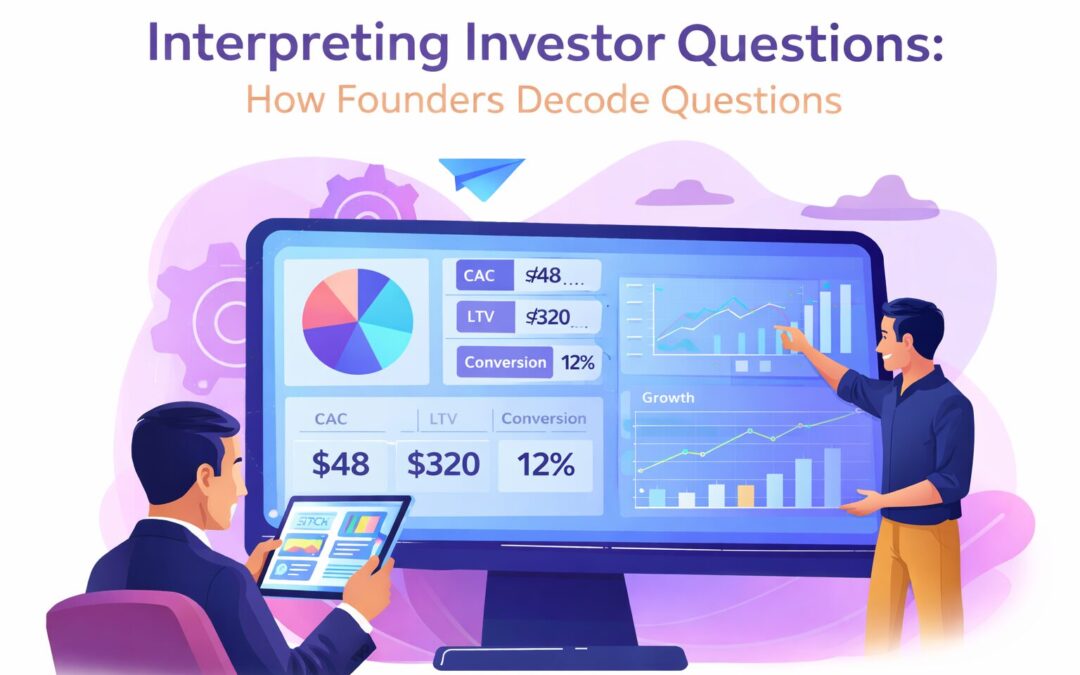
Your responses should explain how you’ll allocate funds to marketing and advertising to bring in more customers. In short, the total customer acquisition costs (CAC). Investors will compare this number with the lifetime value (LTV) you’ll generate from customers’ purchase cycles—3x is a good return.
When interpreting investor questions, understand that asking about LTV means they want to know your retention projections. Metrics such as a 90% retention rate indicate that churn is extremely low. And that a large section of your customers is staying.
A more impressive metric is retention, along with 110% Net Revenue Retention (NRR). This means that not only are customers stating but they are increasingly spending more on purchases. Keep in mind that recurring revenue indicates that value is compounded, which attracts investor attention.
When analyzing CAC, investors focus on the different channels you’ve deployed to attract buyers, such as organic and paid. They also need proof that the channels bring in an adequate number of paying customers to sustain the startup’s growth.
Yet another aspect is the timeline. Investors need to know how quickly you expect returns from your marketing programs. If advertising translates into quick customer acquisition, that ensures regular revenue and smooth cash flows within the company. That’a positive signal.
It indicates capital efficiency and the low reliance on external funding. Your startup demonstrates that it can continue scaling by rolling revenue back into operations. However, market saturation risk is a concern. Investors want to see whether you can continue to grow the target customer base.
Questions Centering on Capital Discipline
The question you’ll likely WON’T hear is: Will this founder turn capital into outcomes—or just burn it? But that’s what investors are thinking.
Aside from interpreting investor questions that they ask outright, you’ll focus on the questions they don’t ask. A savvy founder should understand and address their concerns. And, one of the foremost is whether you can use the money to generate and deliver profits and returns.
Accordingly, your audience will examine and analyze burn rates. This number should be less than 1.5 when dividing costs by the annual recurring revenue (ARR). It tells them the startup is disciplined with its expenses, and its costs align seamlessly with its growth.
You’ll also demonstrate how burn rates have evolved over time as you refined strategies. Investors want assurance that the startup adapts to changing market conditions and responds to results. For instance, leveraging cheaper inventory sources to improve the bottom line.
While the startup is still finding its feet, errors are part of the learning process. But investors need to see the founders’ takeaways from their mistakes. For instance, the steps they’re taking to lower costs and burn rates while improving revenue and extending the runway.
Delaying fundraising is always a positive signal; it shows that the founder can achieve more with less.
Keep in mind that storytelling is everything in fundraising. In this regard, for a winning pitch deck to help you here, take a look at the template created by Peter Thiel, Silicon Valley legend (see it here), that I recently covered. Thiel was the first angel investor in Facebook with a $500K check that turned into more than $1 billion in cash.
Remember to unlock the pitch deck template that founders worldwide are using to raise millions below.
Why This is Important
Investors understand that when you raise funding, the capital should fuel 18 to 24 months’ worth of runway. They might ask you about the runway you have left from the last funding round. As a rule, founders should plan their fundraising well in advance of running out of money.
Your audience wants to know whether you achieved the targeted milestones using the last capital raise. The numbers and responses you provide signal capital efficiency. Keep in mind that runway and burn rates are also indicative of the potential dilution.
Each time you raise funding, you’ll give up a portion of equity. At the seed stage, offering 10% to 20% equity is considered favorable. However, if you have high burn rates and lack runway, that signals you’ll need another cash infusion quickly. And that means more dilution for investors as well.
More importantly, the inability to meet milestones reflects poor performance and negatively impacts the startup’s valuation. Or worse, the need for a down round. In both scenarios, investors lose due to greater dilution.
Undoubtedly, returns and low risk are high on investors’ lists of priorities. But, they are also concerned about the share they can expect to get on exit—through a company sale or IPO. A higher dilution means that later-stage investors receive more equity, leaving a smaller share for seed-stage investors.
Questions Centering on Strategy and Control
The question you’ll likely hear is: Is there a clear, differentiated path to win—or just a collection of activities?
A company with a clear set of objectives and a well-structured pathway to achieve them is more likely to succeed. That’s what investors want to see when analyzing your pitch deck. Strategic focus on one or two priorities is sure to drive up scalability and valuation.
That’s because the company and its founders focus on these leverage points to streamline execution. At the same time, they also need flexibility to adapt and pivot if necessary. Investors are testing your responses on multiple fronts. For instance, if you have a clear roadmap for positioning as a market leader.
They also want to understand your brand’s edge over the competition and whether it will sustain the company to the finish line. For instance, disruptive technology can be replicated, and competitors can win over the customer base. But a robust moat and brand value will keep the company ahead.
Investors also want to know your entry point into the market and the growth path that traces repeated sales. They need assurance that the founders will not likely divert attention from the core mission and vision. When interpreting investor questions, understand their concerns related to strategy.
If you need more information about the questions investors will ask after reviewing your pitch deck, check out this video I have created. You’re sure to find it helpful.
Questions Centering on Founder Resilience
The questions you’ll likely hear are: Is there a cofounder’s agreement? Who’s in control? Who makes the decisions?
What are investors concerned about?: Will these founders hold up when things break—and still find a way to win? Cofounder disagreements and misalignments are among the core reasons why 65% of startups fail. This is why investors closely examine cofounder inter-relationships and dynamics.
Any history of unresolved conflicts is likely to quickly derail the company—particularly during crises. Thus, investors will analyze how the leadership structure works and if there are likely to be delays in decision-making. These delays can be costly when hiring talent or launching a new product portfolio.
Further, every company goes through downturns in response to market cycles—natural, recurring phases of economic expansion and contraction. When that happens, robust partnerships and resilience can see them through—particularly when downturns impact 40% of the revenue.
Investors ask: Do the cofounders have a mutual understanding that holds up in the face of disasters? For instance, regulatory changes that make the company’s core product redundant. The steps cofounders take collectively to develop new products can keep the company running.
Cofounders should be able to discuss options and arrive at solutions that stabilize the company for long-term growth. They should demonstrate strong leadership qualities that boost morale and motivate the entire team to move forward and overcome hurdles.
This is also where the founder’s prior experience comes into play. Entrepreneurs who have built and faced similar problems are likely to have a better handle on how to navigate them. They are also more adept at interpreting investor questions and answering them.
Questions Centering on Investor Communication
The question you’ll likely hear is: Will the founders communicate clearly, consistently, and transparently once we invest?
Investors expect regular updates from the founders regarding the company’s performance—even if the numbers aren’t so good. Maintaining open communication lines demonstrates transparency and builds trust among the people backing the company.
You’ll provide structured responses to any queries they might have, including metrics about the burn rates, runway, and expected margins. Most pitch decks include the Use of Funds slide, in which you’ll outline the milestones you intend to achieve.
Once the round closes and you get the money in the bank, investors want to see progress reports. They want to know about the headway you’re making in terms of actual numbers. For instance, the number of customers acquired and revenue earned within a quarter.
These data should align with the milestones you outlined. For instance, launching the product within six months. At the end of this period, you’ll deliver updates to investors that include testimonies from early adopters. You’ll add reviews—positive and negative—and feedback on possible improvements.
Next, your report will include information on how you intend to incorporate the feedback and upcoming improvements in new versions. Keep in mind that investors need more than just narratives and storytelling; they need to see actual numbers to prove it.
Investors are keen to see the company succeed and are open to offering you more than just capital. They’ll provide industry-relevant expertise, know-how, networking opportunities, and avenues for cross-selling and upselling opportunities.
Most importantly, VCs are looking for startups that prove viable for follow-on capital infusions. When interpreting investor questions, learn to recognize their offer of support. For instance, when they ask about your strategies for team expansion, they could be offering recommendations of top executives.
Interpreting Investor Questions – Leverage the Advantage
Founders should never be alarmed or nervous about the Q&A session at the end of the pitch. Instead, focus on the answers you can’t provide because they could uncover shortfalls in your business plan and idea. You’ll use this feedback to make the necessary improvements.
Enhance your pitch deck and business concepts and iron out the flaws. Each question you fumble at is an opportunity to nail the next session when you’re pitching to investors—whether these or the next ones you’re presenting to. Good luck!
You may also find our free library of business templates interesting. There, you will find every single template you need to build and scale your business completely, all for free. See it here.



Facebook Comments