


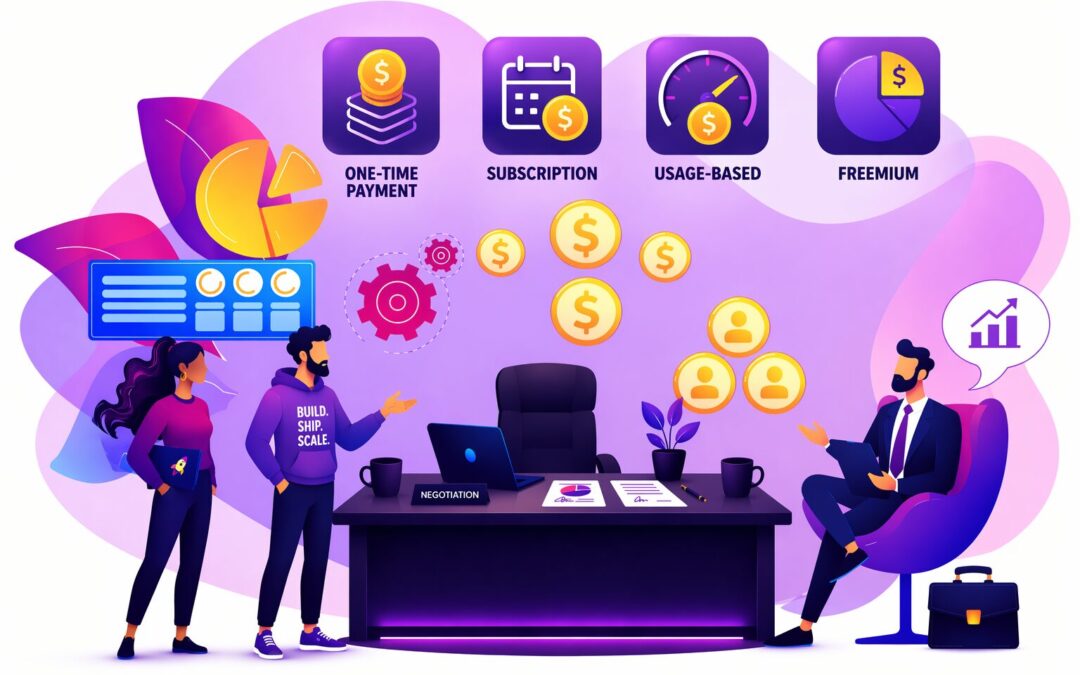
Choosing the right monetization strategy for your startup is a decision you’ll need to make alongside your product design. Many founders make the crucial mistake of focusing on transforming their ideas into products. But these products also need to be marketable and provide value to customers.
Underline “marketability” because building a successful business is about generating consistent and scalable revenue. To make that happen, you’ll need to work out the product’s price tag. This price has to make sense to buyers considering the value they hope to derive from their purchases.
When working out pricing, you’re calculating a monetary figure of that value or perceived value that buyers anticipate. Most importantly, you’ll select monetization models that streamline the way buyers pay for the product. It’s about speed, efficiency, and scalability. Read ahead to know more.

*FREE DOWNLOAD*
The Ultimate Guide To Pitch Decks
Let’s Start With Value: What Are You Really Charging For?
The right monetization strategy for your startup centers on the product’s core value metric, which has several components. For instance:
- The time customers save by leveraging the product to speed up their internal operations. You’ll calculate the value according to the additional revenue they can generate.
- You’ll estimate the additional earnings the customer’s organization can generate by directly deploying your product. Either by, say, improving user experience for its clients or growing its user base.
- Your price tag will assign a monetary value to the risk reduction your product can achieve.
Ultimately, monetization strategies are about aligning pricing with the outcomes customers get from the product and its features. For instance, you’ll assign $50 to a product with basic features and $75 to its advanced version. Customers can choose the versions that best serve their needs and pay.
Don’t forget to factor in the type of customer base you’re targeting and its general purchasing power. For instance, an enterprise customer is more likely to pay a premium price if the product meets their needs. But a smaller company may need competitive pricing to align with its limited budget.
Monetization Models to Choose From
You’ll pick the right monetization models based on the industry you work in, the product category, and usage type. The size of the customer’s organization and its workforce can also impact monetization pathways. Here are some of the typical models you can choose from.
- Transaction-based
- Subscription-based
- Direct to customer
- Usage-based
- Advertising
- Affiliate marketing
- Licensing
- Franchising
- Data monetization
- White labeling
Keep in mind that monetization approaches can evolve as the startup scales to later growth stages. Further, you can use a combination of two or more models, depending on your customers’ needs. You will want to make it easy for buyers to purchase products, accept delivery, and make payments.
Your monetization structure is likely to attract close scrutiny from investors. It tells them whether the startup is poised to generate revenue quickly and if the model has the potential to scale. This data influences their decisions to support your company with capital and other resources.
Keep in mind that storytelling is everything in fundraising. In this regard, for a winning pitch deck to help you here, take a look at the template created by Peter Thiel, Silicon Valley legend (see it here), that I recently covered. Thiel was the first angel investor in Facebook with a $500K check that turned into more than $1 billion in cash.
Remember to unlock the pitch deck template that founders worldwide are using to raise millions below.
Choosing the Right Monetization Strategy for Your Startup – Step 1: Research
The first phase of devising the ideal monetization strategy is extensive research, starting with surveys to understand the market. You’ll gather data on the customer base you intend to target, including their preferred payment methods and purchasing power. Speaking to early adopters is a good move.
You’ll also analyze your competitors’ pricing structures for similar products and services. At phase two, start analyzing the potential pricing for your minimum viable product (MVP). Check with early adopters about the price range they are open to for the basic, limited-feature version.
Test, iterate, and test again, going back to the drawing board multiple times until you’re ready with a functional model. In phase three, you’ll calculate the initial costs and unit economics to establish a pricing benchmark. This threshold should have achievable and realistic goals.
You are now ready to test the product on the first real paying customers. Gather as much data as possible while adjusting the pricing and features to align accurately. This is your seed stage, so you’ll use structures like usage-based and direct-to-customer models.
Step 2: Get a Realistic Overview of Your Costs
During the research phase, you were working with an overview of your expenses. But it’s time now to get a realistic view driven by actual numbers. Accordingly, you’ll begin adding your fixed costs, such as rent, salaries, utilities, and infrastructure costs.
Also, add the variable costs that depend on production, including inventory, shipping, packaging, wages to temporary workers, and payment processing. Next, include development costs in the list, such as product research and development (R&D), customer acquisition, advertising, and more.
Once you have the costs added, divide them by the number of products manufactured to arrive at the per-unit cost. This is the minimum pricing you need to break even—without factoring in the profits you intend to earn. It will help you pick the right monetization strategy for your startup.
For instance, in a white-labeling model, your cost per unit becomes the pricing baseline. By layering in your desired margin, you can arrive at a customer price that reflects both cost structure and profitability. Also factor in the cost of customizing the product to align with buyer branding.
Step 3: Learn More About the Market and Competition
Remember that monetization approaches will evolve as your startup matures and reaches the next growth stage. Before you start scaling, you’ll need more detailed information about the market and competing brands, including their pricing structures. Next, you’ll align that price with your USP.
What does your product offer that sets it apart from the competition? Why would customers pick your brand over others—not just once, but consistently? What is the unique value proposition you offer? Is it scalable? Regardless of how innovative the product design is, it must compare with market trends.
Many founders make the mistake of overpricing disruptive products. But customers need time to test and understand the benefits before committing to premium pricing. Accordingly, you’ll use models like freemiums and limited-period discounted rates to enable testing without purchases.
When choosing the right monetization strategy for your startup, you’ll do a deep dive into competitor approaches. In particular, you’ll analyze how industry leaders price their products and the strategies that work well for them.
There are several benefits to this move, and the objective here is not just to mimic successful ideas. For starters, you’ll get an overview of customer expectations and how the industry operates. Further, you’ll identify gaps in the ongoing monetizing structures that you can leverage.
Look for alternative approaches that can serve customers more efficiently. Next, you’ll transform them into differentiating factors that help your brand stand out from the crowd.

Raise Capital Smarter, Not Harder
- AI Investor Matching: Get instantly connected with the right investors
- Pitch & Financial Model Tools: Sharpen your story with battle-tested frameworks
- Proven Results: Founders are closing 3× faster using StartupFundraising.com
Step 4: Understand Your Customers’ Needs
When choosing the right monetization strategy for your startup, understanding customer needs is crucial. You’ll create customized models tailored to align with different segments. For instance, a software company can offer multiple tiers or plans for enterprise, small, and medium-sized users.
Individual users and startups with limited requirements can go for Tier 1, the basic plan. On the other hand, the business plan is better suited to small- and medium-sized companies with more users or seats. You can offer them Tier 2 plans with better features.
Larger organizations are best served through Tier 3 monetization models, as they have more users or seats. These customers may also need dedicated support reps and customized solutions with the best features. Monetization strategies here combine usage-based and subscription-based models.
Step 5: Evolve Models According to Your Company’s Growth Stage
When building the company, you’ll start working with one or two monetization models to test which delivers adequate value to customers. But, at the same time, generates attractive profits.
As the company scales and becomes an established, trustworthy brand that customers know and trust, you’ll add other monetization models. This strategy helps you diversify your revenue streams and include more sources to supplement product sales.
For instance, advertising and affiliate marketing monetization. You’ll offer ad spaces on the website that third parties can purchase to reach your customer base. You can also start programs in which you recommend third-party products to your customers.
Yet another strategy is to leverage franchising and licensing opportunities. Here, other companies can use your business model, product portfolio, and intellectual property (IP) to start businesses. You can charge premium pricing and royalties as additional revenue sources.
Data monetization is another approach you can adopt, allowing you to capitalize on data users have voluntarily shared with you. Third parties operating within your sector are open to paying for this data. That is, instead of investing time, capital, and other resources in gathering the data on their own.
Whatever the monetization strategies you choose, the pricing structure will depend on market trends and consumer behavior. You’ll rely on algorithms to adjust pricing based on buyer purchasing trends, such as seasonality, demand, and the availability of alternatives.
Key Errors Founders Make When Selecting the Right Monetization Strategy
When choosing the right monetization strategy for your startup, be watchful of the key errors most founders make. Here are some of the pitfalls to look out for:
- In the early days, founders focus on achieving the product-market fit and building a broad user base. Aggressive pricing will effectively deter early adopters, who will likely hesitate to pay premium prices for untested products. On the other hand, pricing too low indicates a lack of confidence in the product’s value. Further, investors may not want to back a startup that cannot demonstrate clear revenue-generating pathways.
- Founders also tend to price products lower than market value to attract customers. However, if this strategy results in losses and an inability to break even, the startup may find it challenging to remain in business. Ensure that your monetization approaches generate fair value for your products.
- Whatever the monetization strategy you adopt, don’t overlook customer acquisition costs. The amount spent on advertising and marketing programs must exceed the lifetime value (LTV) per customer. Or, the earnings you expect to generate from the customer through their relationship with your brand.
- Monetization models should match your product’s unique value proposition. Don’t make the mistake of blindly following industry trends and prevalent strategies. Instead, ensure that they align with your business goals and long-term objectives.
- Always remember that monetization is a dynamic process that evolves through the company’s lifetime. Be flexible and open to pivoting as the business scales, and you add more features, product versions, and additional offerings to the portfolio. Also, be open to discarding methods that aren’t working well. Listen to customer feedback and their needs and adapt accordingly. Customizing monetization and adopting hybrid models are better strategies.
- The most effective indicators of success are data and metrics such as customer LTV, churn rate, and conversion rate. Don’t let vanity metrics deflect attention.
Leveraging AI to Refine Monetization Strategies
Don’t hesitate to use automation and artificial intelligence (AI) tools to help in refining monetization models. Here’s how:
- Use AI to categorize customers based on behavior and value. You can then tailor pricing plans, offers, and upsells to maximize LTV.
- Leverage AI to A/B test pricing tiers, packaging, and discounts in real time. You can then optimize models for conversion, long-term retention, and increasing revenue.
- Use AI to understand customer behavior regarding responses to pricing and willingness to pay. AI can help you analyze usage patterns, the features they prefer most, and the triggers that lead to churn. You can then identify the categories that derive maximum value and target them accordingly.
- AI can help you estimate how price changes will affect churn rates, customer acquisition costs, and customer LTV. Any decisions you make will be driven by real data and accurate metrics.
Before We Sign Out!
Choosing the right monetization strategy for your startup isn’t a one-time exercise. It is dynamic and evolves throughout the company’s lifecycle in response to market trends, competitor activities, and customer needs.
Your objective is to identify and deploy a blend of ideal monetization models that enable customers to make payments seamlessly. At the same time, they are extracting maximum value from your products, which ensures long-term retention and satisfaction levels.
Keep an open mind as you refine and pivot your approaches to maximize revenue. This, in turn, maximizes profits and the company’s potential to scale over the long term.
You may also find our free library of business templates interesting. There, you will find every single template you need to build and scale your business completely, all for free. See it here.



Facebook Comments