



What does the timeline for closing a startup financing round look like? How would you strategize your fundraising to avoid running out of money when building the company? Planning a funding round from start to finish–when you finally receive the money in your account is time-consuming.
Moreover, estimating an accurate timeline is exceedingly tricky. Most entrepreneurs consider a good rule of thumb to be six months before they run out of cash. Let’s see now. For starters, you’ll engage the services of an expert fundraising consultant to assist you with compiling a list of targets.
You’ll follow that step by preparing the necessary paperwork, like financials and a business plan. Next, you’ll add them along with other documents to the virtual data room. Negotiating the term sheet with investors and completing the due diligence will also take time.
By that estimate, you’ll need at least five months to close the funding round. That leaves you with a narrow leeway of just one month, which is cutting it too close in case something goes wrong. Can you take that risk of losing runway? Can you risk the company operations screeching to a standstill?
Statistics indicate that at least 38% of startups fail because they fail to raise funding in time. Don’t let that happen. Here’s how to estimate a realistic timeline for closing a startup financing round. But before we dive in, understand that several factors can influence this timeline.
These factors include the growth stage and the cash reserves you have available. For instance, a seed-stage company can close a funding round in 6 to 12 months. But a series A round can take anywhere from 9 to 18 months to reach the finish line. Ready to learn more?

*FREE DOWNLOAD*
The Ultimate Guide To Pitch Decks
Building a List of Targeted Investors: Estimated Time Frame – 2 to 4 Weeks
Building a list of potential investors takes time, but it helps you narrow down your options. It makes sense to reach out to people who are most likely to invest in the company. Most founders may connect with hundreds of investors during the course of their fundraising outreach.
Particularly, if you’re raising a seed round, you’ll connect with at least 100 to 200 investors before closing. As you progress to later funding stages, around 50 conversations can land you the check. To speed up this process, you’ll do your homework and gather as much information as possible before the outreach.
Gather information about their typical screening criteria, such as the specific sector, growth stage, and estimated check sizes. Doing the necessary due diligence at this stage can ensure you run a lean campaign. You’ll cut back on some of the guesswork and approach investors most likely to say yes.
Expect the outreach process to include cold emails and calls initially. You can speed up the process by searching for contacts within your network to help with warm intros. The objective here is to connect with one of the key decision-makers within the investment firm.
You could converse directly with the general partner in a venture capital (VC) firm or a venture scout. Even after the initial introduction, you’ll engage in some back-and-forth during coffee chats and Zoom calls. A few follow-ups later, you can get invited to deliver the pitch.
If you’re raising funding as a new founder, expect to take around 30% longer to get that first check. As your fundraising consultant will advise, you’ll want to categorize investors according to priority.
Try to line up a few meetings with people lower down on your list initially. This strategy will help you hone your pitching skills.
Getting a Positive Response: Estimated Time Frame – 2 to 4 Weeks
When estimating the timeline for closing a startup funding round, it’s crucial to understand how VCs and other investors work. A typical partner in a venture capitalist firm may engage in 15 or more introductory calls every week. In addition, they may view multiple pitch decks every day.
It is not unusual for VCs to meet with between 3 and 5 company founders each week. During the peak fundraising months, this number could be even higher. You can safely assume that a VC firm may finalize a single investment deal per quarter. This works out to 3 or 4 deals each year.
Considering the incredible volume of calls and pitches they assess, investors don’t spend much time on a single pitch. At best, they might dedicate two to three minutes or up to five minutes to evaluate a company. Within this time, they decide whether or not the opportunity is worth pursuing.
If your pitch has made the first cut, and you’ve been called in for a follow-up meeting, that’s a win. At this presentation, you’ll answer questions to address any gaps in the information in the deck. You’ll answer queries about the market size, competition, cash flow projections, business model, and team.
Most VCs have finalized their decision after this presentation and may give you their answer within 24 hours. Others may hold off responding until 2 to 6 weeks later. But even if you don’t hear back from them after two follow-up emails, don’t give up. You could get a call 9 to 12 months later for updates.
Investors are known to put interesting projects on the back burner and revisit the option months later. They may choose to give your company time to demonstrate results and progress before investing.

Raise Capital Smarter, Not Harder
- AI Investor Matching: Get instantly connected with the right investors
- Pitch & Financial Model Tools: Sharpen your story with battle-tested frameworks
- Proven Results: Founders are closing 3× faster using StartupFundraising.com
Creating the Pitch Deck: Estimated Time Frame – 1 Hour to 6 Months or More
With the assistance of your funding consultant and a selection of templates, you can put together a compelling pitch quickly. As long as you have the data readily available, you can create the deck in 60 minutes or less.
Make sure you include lots of visuals and leverage color psychology to make a lasting impression. However, it’s crucial to understand that the pitch is dynamic and undergoes multiple changes and transformations. You’ll refine it before and after every presentation.
Before delivering the pitch, you’ll tweak it according to the audience you’re targeting at the time. You’ll include relevant numbers and other information that the particular investor is likely to focus on. After delivering the pitch, you’ll refine it according to the response and feedback you received.
Making consistent iterations and changes is how you’ll deliver the perfect presentation when it matters. Circling back to our earlier point–meeting with investors who are not on top of your priority list initially helps. You’ll learn from your mistakes and understand how to deliver with perfection.
You’ll practice the pitch to a point when you can quote the numbers on cue. That’s how you’ll develop the confidence and understand how to read the room when interacting with the audience. A special emphasis on “interacting.” Remember that you’re not just “presenting,” you’re having a conversation.
Keep in mind that storytelling is everything in fundraising. In this regard, for a winning pitch deck to help you here, take a look at the template created by Peter Thiel, Silicon Valley legend (see it here) that I recently covered. Thiel was the first angel investor in Facebook with a $500K check that turned into more than $1 billion in cash.
Remember to unlock the pitch deck template that founders worldwide are using to raise millions below.
Gauging the Investment Fund’s Interest: Estimated 1 to 4 Weeks of Wait Time
Making an impression on the initial point of contact is just the first step. But it’s how you get a toe in the doorway. Once the partner sees potential in the startup, they may refer the opportunity back to the investment panel or committee.
Many venture capitalist (VC) funds and angel investors have associates who act as the initial point of contact. You could meet with this individual when you first interact with the investor. If your pitch covers their screening criteria, you’ll move on to the next round.
At this stage in the timeline for closing a startup financing round, you’ll present projected financial data. For instance, the annual recurring revenue (ARR), profits, cash flows, and more. Expect that a representative will go over the numbers with you, requesting an analysis and their origin.
You’ll also talk about the objectives and milestones you hope to achieve with the funding. Doing a competitive analysis to understand market trends and comparable brands is also part of this step. You’ll demonstrate your brand’s unique selling proposition (USP) and your competitive edge.
The investment panel may comprise representatives of the limited partners (LP), external advisors, and other decision-makers. Meetings typically run for a couple of hours, and you’ll answer questions explaining what the company is all about.
Since the panel screens multiple candidates and meets with several founders, responses may take a few weeks. Once the VC gets back to you, they may be ready to proceed to the due diligence phase. Alternatively, they may have more questions or ask you to rework a potential milestone that has flaws.
Negotiating the Term Sheet: Estimated Time Frame – A Week to 10 Days
If the investment panel approves your pitch, you’ll receive the term sheet–a document that contains the standard terms and conditions. Most term sheets are boilerplate and entrepreneur-friendly. You shouldn’t have much trouble understanding what the investors expect in exchange for capital.
Term sheets typically have components like the valuation, liquidation preferences, board seats, voting rights, ratchet clauses, and tag-along provisions. However, it’s crucial to have an expert legal counsel examine the term sheet to flag any toxic clauses. Be wary of “dirty term sheets.”
These sheets may include specific provisions that assign unfair rights and privileges to the investors. You might find it hard to honor them or risk the company’s stability and long-term success. Also, look out for clauses that enable hostile takeovers or allow investors to oust you from the company.
Though if you’re negotiating for capital through convertible notes or SAFEs, the process is much more streamlined. Requesting changes and getting responses from the investors’ legal team can involve some back-and-forth. But, conservatively speaking, you should finalize the term sheet in 10 days.
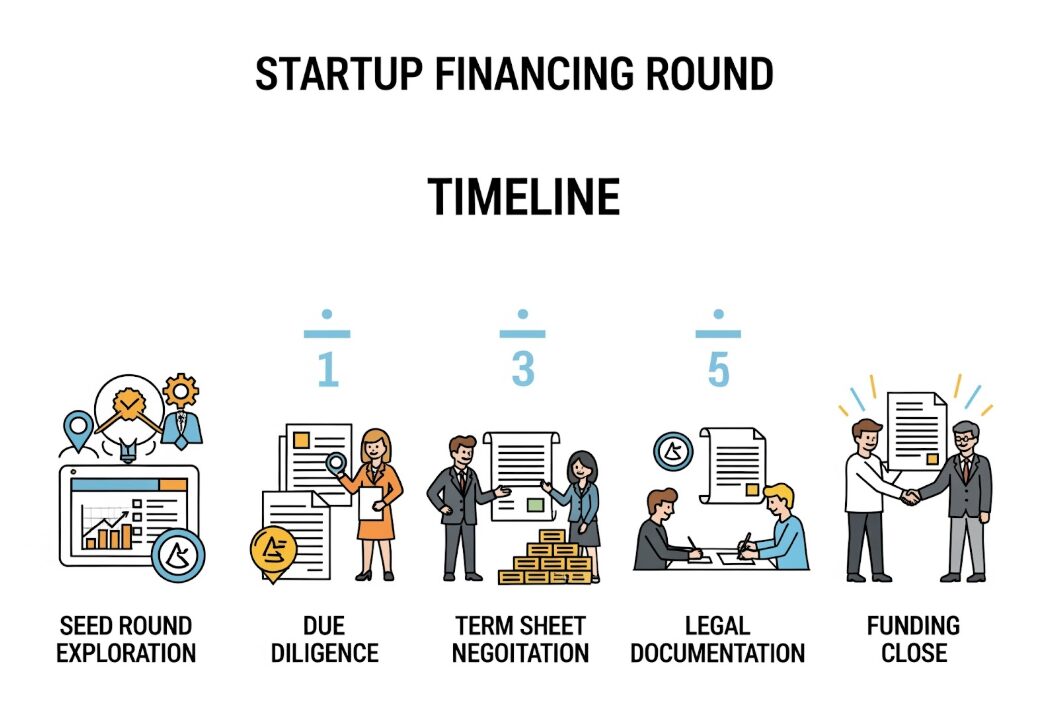
Conducting Due Diligence: Estimated Time Frame – 2 to 4 Weeks
This step is, undoubtedly, the most crucial in your timeline for closing a startup financing round. The ultimate success or failure of your endeavors depends on what investors uncover when conducting due diligence. This process is like an audit of your company to find all its risks and weaknesses.
Most top investment firms now work with experienced and independent third-party agencies to delve into the company’s financials. They also explore other aspects such as its intellectual property (IP), patents, ownership rights, regulatory compliance, licensing, permits, and more.
If you’re running a tech company, investors may hire tech specialists to verify the products and their value. Similarly, if you work in, say, the pharmaceutical sector, expect independent contractors to go over the company’s assets. They’ll also examine the team, facility, equipment, and legals.
Aside from this due diligence, investors engage in extensive background checks on the founder, the team, and top clients. They may request references and call up around 10 of them to verify against reputational and money-laundering risks.
Calling up customers to learn about their experiences is also a strategy investors use. As for the timeline, third-party agencies may take around 2 weeks to deliver a detailed report. Factor in another 2 weeks for investors to cover all their bases before moving on to the next step.
Unexpected delays are commonplace, though leveraging AI tools to speed up the process can help reduce time lags.
Timeline for Closing a Startup Financing Round: The Final Stage – 1 to 2 Weeks
Although navigating the due diligence is a significant hurdle, you’re not quite there yet. Many investors may begin drafting the investment contract and other documentation while the due diligence is in progress. Others may prefer to delay until the final reports are in.
The clauses are typically an extension of the term sheet, but you can expect additional provisions. The legal team may add more conditions to cover any contingencies identified during the checks. Also, expect more negotiations until all the concerned parties are satisfied with the agreement.
Thus, the signing could take another 2 weeks. All that remains now is getting the checks in and confirming that the money is in the bank. Although wire transfers can be executed within hours, be prepared for unexpected delays.
Sometimes, investment firms don’t have the funds available. They may have to call in capital from their limited partners before sending you the funds. In that case, you can expect another 2 weeks of delays before you can start using the funds.
In Conclusion
If you add up the estimated time, the tally comes to around 20 weeks before you receive checks or wire transfers, and the funds are available for use. That is, if your campaign is successful. At any time, during this process, negotiations could fall through, and you might have to go back to the drawing board.
That being said, you can always rely on the expertise of your fundraising consultant to ensure that your campaign is a success. At the same time, this timeline should give you an estimate of the runway you should have available. Ensure your company has the reserves to continue operating until you raise money.
You may also find our free library of business templates interesting. There, you will find every single template you need to build and scale your business completely, all for free. See it here.



Facebook Comments