


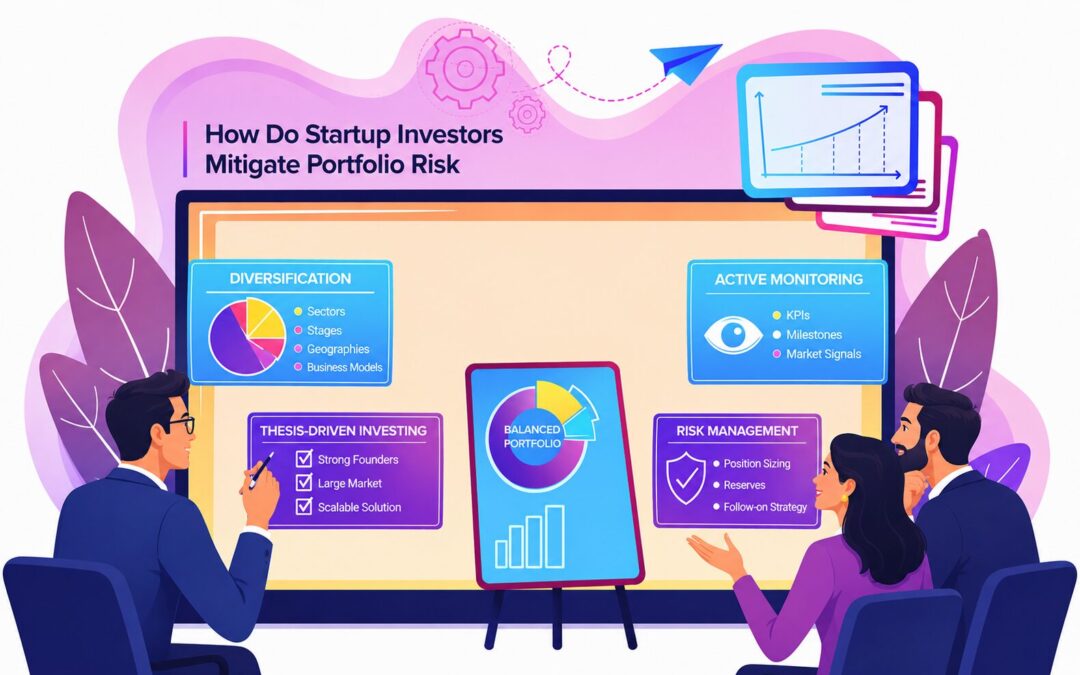
How do startup investors mitigate portfolio risk is a question every savvy founder should ask. Be aware that investing in an early-stage startup carries the highest percentage of risk. Typically, venture capitalists lose ~75% of their capital when investing in startups.
This is why they are wary of backing early-stage companies and leverage several strategies to lower their risk. When pitching your ideas and negotiating for favorable terms, you’ll learn to think from the other end of the table. Understand their perspectives and how they view your pitch.
Anticipating and addressing their concerns will help you design a compelling deck and maximize your chances of securing funding. Also, remember that every growth stage carries a different kind of risk. Investing in an early-stage startup is primarily about existential risks.
On the other hand, the risks associated with a later-stage company are mainly about successfully executing the idea. When compiling a list of investors to approach, don’t overlook factoring in their risk appetite. Focus on their strategies for mitigating portfolio risk when answering their questions.
Your pitch should also reflect the overall market conditions and investor sentiment about backing opportunities on the high end of the risk spectrum. If the sentiment is upbeat, risk appetite is higher, and investors are open to backing disruptive ideas.
However, if the sentiment is cautious, investors seek more guardrails and stringent terms in the term sheet. Accordingly, you’ll prepare the pitch by asking—How do startup investors mitigate portfolio risk at this time? What are they expecting to see when evaluating the pitch?

*FREE DOWNLOAD*
The Ultimate Guide To Pitch Decks
Unpacking How Startup Investors Mitigate Portfolio Risk
Before approaching venture capital firms, you should understand their decision-making timelines for selecting viable opportunities to back. Typically, they pick a few startups each quarter to invest in. Here are the risk mitigation strategies they deploy.
Portfolio Diversification
Know that the partners viewing your pitch rarely pick startups based on the initial meeting. They view hundreds of pitches per week and later assess them carefully. Although lucrative returns are high on the list of priorities, risk mitigation is not far behind.
Investors are well aware that 90% of startups fail within the first five years. Their objective is to spot that rare unicorn or power winner that will deliver the returns limited partners (LPs) expect. These top-tier 3% to 5% companies deliver 3x to 10x the returns that venture capital funds actually earn.
That’s how they hope to offset their losses. When reviewing a pitch, VC partners are trying to discern which startup is among the 3% or the 90%. They’ll also allocate capital among 10 to 20 of the most promising startups. That’s their strategy to diversify the impact of losses from a single company failure.
Accordingly, investors select ventures from different sectors with a range of business models and growth stages. Geographic, regulatory, and tech innovation-driven diversification add further layers of protection. The check sizes you’re expecting can also influence their decisions at the time.
As your expert fundraising consultant will advise, VC investment decisions vary quarter to quarter. A “no” in this quarter can mean that your proposal has been placed on the back burner for review later.
Active Support & Mentorship
Once investors provide capital, they naturally have a vested interest in the startup’s success. This is why they’ll offer you all the extra support you need to reach the finish line. Expect access to industry-specific expertise, networks, and resources that help overcome operational challenges.
Essentially, investors are strategic partners who open avenues for collaboration with other companies on cost-effective marketing, distribution, and inventory purchasing. They’ll help with recommending top-notch talent when you’re ready to expand the team.
Most investors require a board seat and/voting rights as part of the investor agreement. They’ll send a representative who may act as an observer or an active participant, guiding decision-making and offering valuable advice.
That’s how startup investors mitigate portfolio risk—by helping founders navigate the intricacies of company building and thus, ensuring success. At the same time, know that it is not mandatory for you to accept every piece of advice. Reserving the right to reject ideas contrary to your vision is crucial.
When drafting the investor agreement, include clauses that prevent board reps from overriding your decisions. Or worse, remove you from the company if your decisions don’t align with investor interests and exit timelines. That’s also how you’ll avoid the risk of founder-investor misalignment.

Raise Capital Smarter, Not Harder
- AI Investor Matching: Get instantly connected with the right investors
- Pitch & Financial Model Tools: Sharpen your story with battle-tested frameworks
- Proven Results: Founders are closing 3× faster using StartupFundraising.com
Leveraging Domain Expertise
A critical factor about venture capital firms that you must understand is that their investment model is thesis-driven. This means that at the time of their establishment, General Partners are clear about the specific sectors/themes they’ll support. For instance: fintech, impact, or climate tech.
When accepting funding applications, partners select proposals that align with this fundamental thesis—others are rejected outright. This is one of the key reasons why seed-funding strategies fail. Founders don’t do the necessary research before approaching a venture capital firm.
The objective here is to zero in on startups operating in sectors in which investors have deep insights and expertise. This strategy enables them to identify high-potential opportunities and support them with experience-driven knowledge that benefits the startup.
VCs are finely attuned to the initial market trends that signal major economic upheavals. They are thus well-positioned to insulate their portfolio companies against unexpected downturns by warning and preparing them in advance. Novice founders may not have the expertise to detect such signals.
This support can sometimes make the ultimate difference between success and failure.
Checking Founder’s Prior Experience with Building Companies
Founders with prior experience building companies have a higher chance of securing funding. VCs understand that passion, vision, enthusiasm, and a disruptive product idea don’t always guarantee success. Ultimately, it comes down to execution. And that comes from experience.
Entrepreneurs who have faced failure (or success, for that matter) take away important lessons from their first ventures. It changes their approach toward execution, thanks to valuable insights. However, this trend could be changing in recent years.
Statistics indicate that 24% of entrepreneurs are between the ages of 18 and 24 years. Younger cohorts are making great strides in emerging tech sectors like Web3, Generative AI, and Climate Tech.
Investors recognize their talent and potential and are open to supporting their ideas. The trick is to offset the lack of execution experience by hiring a strong founding team that offsets the shortfalls. If you can demonstrate that your team has the necessary talent—that could indicate risk mitigation.
On their part, investors are open to helping you build the necessary infrastructure for the next unicorn. That lack of legacy thinking could translate into a competitive advantage.
Conducting Extensive Due Diligence
Rigorous due diligence is how startup investors mitigate portfolio risk. Investors typically have a broad team of expert market analysts, financial modelers, and legal counselors on board. Their job is to assess the opportunity thoroughly and uncover any red flags.
Due diligence covers every aspect of the startup’s structure, ranging from its intellectual property (IP) to its unique selling proposition (USP). Analysts study market potential, customer data, competitive position, the business model, market timing, and overall conditions vis-à-vis product launch.
The financials are under close scrutiny. As a rule, financial modelers study the numbers from the last three years. However, most early-stage startups lack these metrics and must rely on projections and comparative analyses.
Accordingly, the focus is on cash flow projections, financial plans, burn rates, budget, and profitability. Instead of year-over-year analysis, month-over-month analysis and quarterly evaluation carry more weightage. As mentioned earlier, the team’s track records and achievements are also under review.
These numbers tell investors whether the startup has the financial discipline to meet its milestones. If it can progress to the next funding round without losing runway, that’s a signal for low risk. This startup is worth capital support.
Keep in mind that storytelling is everything in fundraising. In this regard, for a winning pitch deck to help you here, take a look at the template created by Peter Thiel, Silicon Valley legend (see it here), that I recently covered. Thiel was the first angel investor in Facebook with a $500K check that turned into more than $1 billion in cash.
Remember to unlock the pitch deck template that founders worldwide are using to raise millions below.
Selective Follow-on Investing
Yet another risk mitigation strategy investors deploy is to be selective about follow-on investing. They are likely to scrutinize your performance after the last fundraising round and whether you’ve achieved the projected milestones. Good numbers indicate stability and potential for returns.
Many investors also prefer to set terms like small, staged checks. According to this strategy, capital is provided in predetermined tranches rather than as a single large payment. Each check is subject to the company demonstrating a successful milestone or a key performance indicator (KPI).
This strategy could work in your favor as it enforces financial discipline and a lean approach. You’ll adopt capital-efficiency tactics and be watchful with every dollar spent unless the cost yields a return.
Working with Syndicates and Networks
Top venture capital firms never operate in a vacuum—they work as part of a syndicate and in close collaboration. Their networks comprise other VC funds, private equity firms, angel investors, and top family offices. The objective is to share data, due diligence, and intelligence about high-quality deals.
This information sharing enables investors to lower risk and make more sound investment decisions. For instance, one tech-centric firm may excel at technical product audits, while another (like a family office with deep roots in logistics) might better understand the startup’s supply chain risks.
By cross-referencing “intelligence,” investors can uncover red flags in a founder’s data room that a single firm might overlook. Working with networks has an added advantage—access to a larger pool of capital to invest in exceptional opportunities.
The investor networks are closely intertwined. If a lead investor chooses to participate in a follow-on funding round, other firms see it as a positive signal. They are encouraged to support the company through further funding rounds. This factor could work as an advantage for your company.
Active Exit Planning
Exit planning is possibly one of the most crucial factors investors consider when picking startups. Their objective is to determine whether its maturity will align with their fund’s lifecycle. As a rule, venture capital firms have a 7- to 10-year lifecycle within which they must realize returns.
That’s the time frame for which limited partners (LPs) remain vested in the fund. Thus, timing is high on their list of priorities. Further, investors need to see clear exit pathways that they can bake into the investor agreement. For instance:
- An acquihire to recover their investment through talent acquisition. This option is typically used if the startup shows clear signs of failing entirely.
- A secondary stock sale where the lead investor can liquidate their holdings by selling them to a later-stage VC.
- Selling shares in secondary markets to third parties.
- Selling shares back to the founders.
- The startup maturing to a growth stage where it can enter into a merger or acquisition (M&A) deal.
- The company going public with an Initial Public Offering (IPO).
Each of these options can deliver great returns. But investors also include exit channels so they can pull out of the holding in case the company fails. That’s their failsafe strategy for recovering at least a part of their capital and minimizing losses.
Many agreements include clauses restricting investors from selling their holdings to third parties. These clauses protect the founder from the threat of hostile takeovers and the loss of ownership and control of their company.
When negotiating the terms and conditions, you’ll arrive at a middle ground that offers investors some amount of assurance. The best way to go is to build a strong relationship with your investors, aligned on shared goals and protecting mutual interests.
In Conclusion
When analyzing how startup investors mitigate portfolio risk, you should consider how to translate their strategies into securing your company. Ultimately, the end goal is closely aligned. You’re looking to raise funding for the company’s long-term growth, success, and profitability.
Investors are thinking along similar lines. They’re looking to invest in lucrative opportunities that will grow their capital and yield rich returns. They are also open to offering you the necessary non-capital support to achieve that exceptional growth.
Risk mitigation approaches are not just crucial for successful fundraising and to attract investors—it’s how you’ll take the startup to the finish line. Either through a lucrative acquisition deal or by going public with an initial public offering (IPO). Investors’ goals are the same as yours—a profitable exit.
You may also find our free library of business templates interesting. There, you will find every single template you need to build and scale your business completely, all for free. See it here.



Facebook Comments