

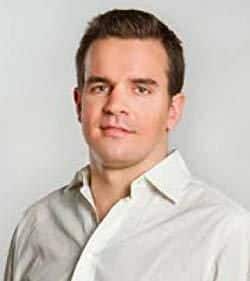
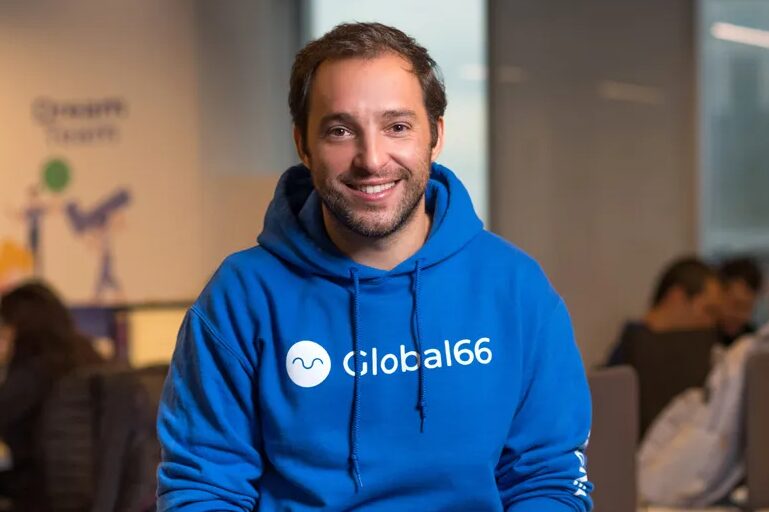
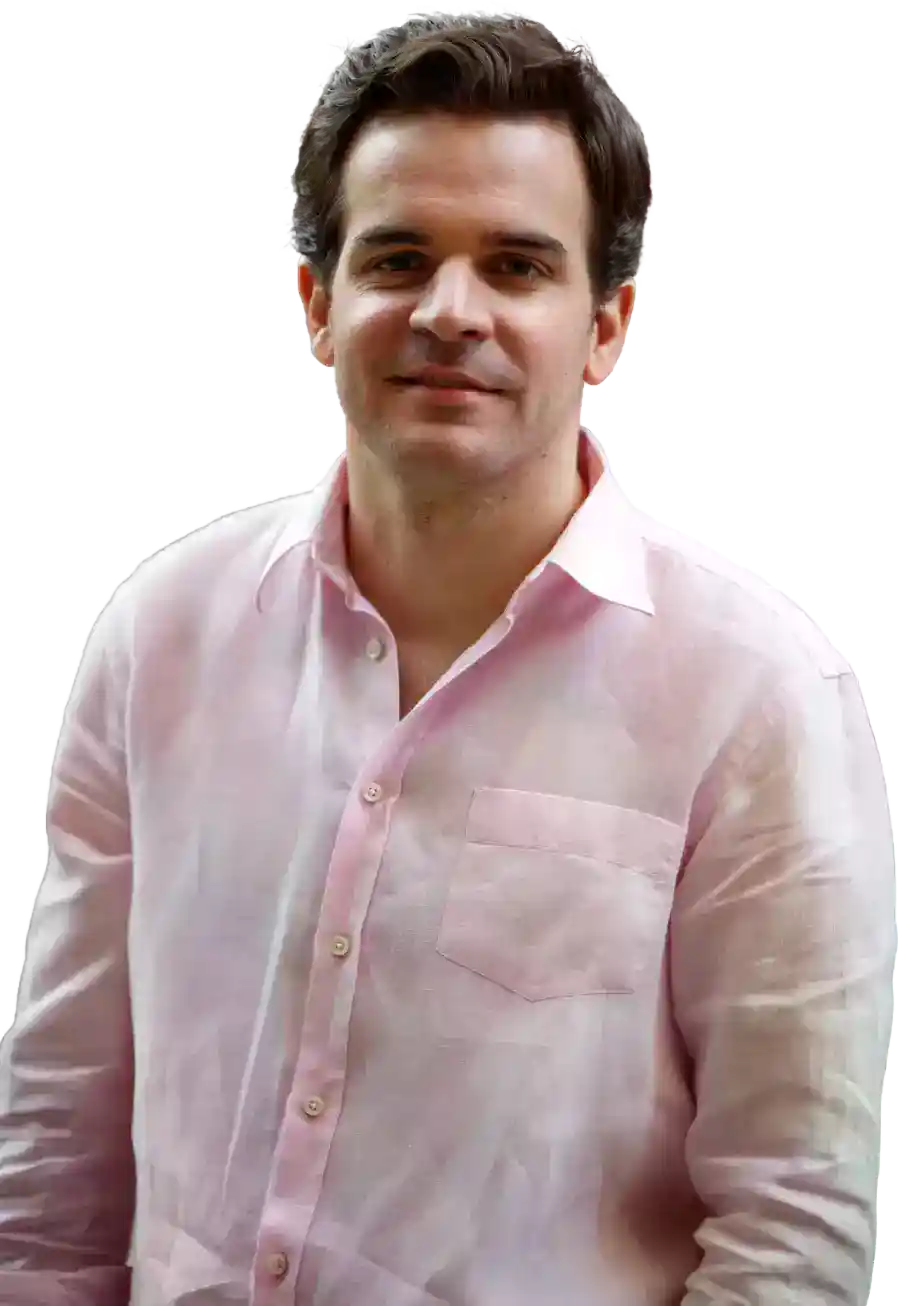
Tomas Bercovich’s entrepreneurship path was never a straight line. All through, it has been a sequence of experiments, pivots, hard decisions, and compounding lessons; each one sharpening his instincts for what truly matters when building enduring companies.
Born and raised in Chile, Tomas has founded four startups across very different industries, from cinema revenue management to e-commerce, IT services, and now fintech.
Today, he is the co-founder and CEO of Global66, a fast-growing financial platform rethinking cross-border money movement for individuals and businesses across Latin America.
In this engrossing interview, Tomas reveals how a founder from “the bottom of the world” developed a global mindset, learned when to let go, and built one of the most capital-efficient fintech companies in the region.
Listen to the full podcast episode and review the transcript here.
*FREE DOWNLOAD*
The Ultimate Guide To Pitch Decks
Roots: Immigration, Entrepreneurship, and Early Hustle
Chile may be a long, narrow country at the edge of the world, but for Tomas, it was the perfect place to develop a founder’s mindset early on. His grandparents were immigrants who fled Europe—what is today Ukraine—and arrived in Chile with nothing.
With no safety net, entrepreneurship wasn’t a choice; it was a necessity. That reality shaped the family culture Tomas grew up in: building, hustling, and creating value from scratch. A mentality that showed up early.
By age 10, Tomas was already working retail. Soon after, he became a waiter, then a DJ at 13. Entrepreneurship, for him, wasn’t an abstract ambition; it was simply how things were done.
Learning to Think Global by Living Global
While Chile grounded Tomas, the world expanded him. He studied abroad for a semester in the UK, later lived in New York, and completed his MBA at Columbia University alongside entrepreneurs from across Latin America.
These experiences did more than add credentials; they rewired Tomas’s worldview. Living and traveling abroad taught him a simple truth: If you want to build global companies, you need to live globally. He learned what it is to build companies and teams to impact people’s lives.
Across borders and cultures, Tomas saw the same entrepreneurial challenges repeat themselves, such as capital constraints, operational complexity, talent, and execution. The industries and regulations changed, but the fundamentals remained the same.
That realization would later become critical when Tomas began thinking about businesses that could scale far beyond national borders. When he graduated from university, his lack of experience held him back from getting a job. So, he moved to the US to gain hands-on working experience in a company.
Doing basic tasks at this first job gave Tomas a perspective on how businesses are run. He started his first company in parallel, working nights and weekends. When a strategic opportunity arose, he quit his job and started working full-time on his startup.
Raise Capital Smarter, Not Harder
- AI Investor Matching: Get instantly connected with the right investors
- Pitch & Financial Model Tools: Sharpen your story with battle-tested frameworks
- Proven Results: Founders are closing 3× faster using StartupFundraising.com
First Startup: Learning the Hard Way in Cinema Tech
Tomas’s first startup operated in the cinema industry, offering advanced revenue management solutions, including pricing optimization, capacity management, and analytics. The product worked, but the problem was timing. Eventually, he had to wind down operations.
Cinemas were just learning how to sell tickets online. Tomas was effectively trying to sell the “cherry on top” before the cake itself was finished. The lessons he took away were painful but invaluable. Firstly, don’t sell advanced optimization before the core problem is solved.
Tomas’s clients were facing several issues, including how to increase revenue and profits. Revenue management wasn’t on their list of priorities. Tomas also learned that founders should choose industries that are large enough to sustain real scale.
Solving problems that are painful, urgent, and unavoidable for people or businesses increases the likelihood of success. As Tomas puts it, you either succeed or you learn.
Cuponatic Latam: Competing Lean Against Giants
The next venture, Cuponatic Latam, looked very different on the surface. It was a Groupon-style marketplace operating across Latin America. But strategically, it shares the same DNA, helping businesses optimize underutilized capacity and generate more revenue.
Cuponatic optimized infrastructures and increased sales not only for cinemas but also for spas, beauty centers, entertainment centers, and other businesses. While Groupon was a SaaS company, Cuponatic was an e-commerce company. Both had a relative impact.
This time, Tomas’s challenge wasn’t product-market fit; it was competition. A major Mexican client copied the Cuponatic system and bought the biggest cinema company, which was Cuponatic’s biggest customer.
Global players entered Latin America armed with tens or hundreds of millions of dollars. Cuponatic Latam raised just $1M, and its survival required extreme discipline. Tomas’s strategy was to ensure extremely lean and efficient operations.
This approach paid off because most players in the industry had very high fixed costs without a business model to support them. Many of the players went bankrupt or closed, and Cuponatic acquired three or four companies in the region.
When the pandemic happened, the players with fixed costs failed, including Groupon in Latin America. Although Cuponatic had its share of challenges, the company survived. After the pandemic ended, Tomas made it profitable again.
Today, Cuponatic Latam operates profitably across four Latin American countries and remains one of the strongest players in its category, growing quickly. The experience reinforced a core belief: Lean companies bend. Bloated ones break.
EasyTech: Knowing When to Step Aside
EasyTech was different. It emerged from an incubation model, with partners who ran the company day to day. Over time, it became clear that the people building the business should also own it.
Instead of forcing alignment, Tomas and his partners chose a clean, respectful outcome: they sold their stake to the operating founders. Not every entrepreneurial chapter ends with a dramatic exit. Sometimes, the right move is simply recognizing when your role is complete, Tomas says.
Why Fintech—and Why Now
By the time Tomas co-founded Global66, he had seen enough patterns to know when something truly mattered. He had built three startups and worked in different spaces, industries, apps, and environments.
Global66 happened because the pain in the Latin American financial infrastructure was impossible to ignore. Tomas strongly believed that through technology, they could help millions of people and businesses manage their financial lives much more easily, economically, and globally.
As Tomas realized, there were stark imbalances. In the US, around 330 million people are served by more than 5,000 banks. In contrast, in Latin America, 660 million people have fewer than 300 banks. The US has 35 more banks per person than Latin America.
Tomas points out that if you do the same exercise in Europe, you would get the same results. Banks in LATAM are the most profitable in the world and have limited competition. Return on Equity (ROE) in the US is 8% to 10%; in Europe, it’s around 5%; and in Latin America, it’s 18% to 20% and higher.
Add to that a world where people and businesses are increasingly global. They have the opportunity to travel, live, and study in different global locations as freelancers, importers, and SaaS subscribers, with international customers. The mismatch becomes glaring.
Banks, Tomas observed, are simply bad at cross-border financial products. As he points out, when his entrepreneur grandparents moved to Chile, it didn’t occur to them to conduct business overseas in countries like Colombia, Argentina, Mexico, or the US. They build local businesses, focusing on them.
However, entrepreneurs today envision expanding their companies cross-border, if not globally. They pay to hire freelance talent from global locations, source imports, and subscribe to software. They also receive payments from global customers.
The bottom line is that businesses have cross-border needs, and existing banks and incumbents haven’t delivered. They operate at extremely high banking margins and offer expensive, friction-filled, cross-border services. Global66 was built to fix that.
Global66: A Truly Global Account
Tomas was convinced that with technology, they could build a global account for individuals and businesses. At its core, Global66 offers local accounts across multiple regions, including US and European accounts for Latin American users.
As a result, users can avail of low-cost cross-border payments, multi-currency functionality, and a frictionless experience for individuals and businesses. The company earns revenue primarily through currency exchange spreads, which are significantly lower than those of traditional banks.
The mission is ambitious but clear: Make global finance simple, affordable, and accessible for Latin America.
The Hardest Call: Cutting Deep, Once
In 2022, like many growth companies, Global66 faced a reckoning. The team had grown from 40 to 300 people post-pandemic. Burn reached $700K per month. Decision-making slowed, and bureaucracy crept in.
After reading a memo that emphasized decisive leadership during downturns, Tomas made the hardest call of his career. He called his cofounder, Cristóbal Forno, and they decided to downsize. Ninety people were laid off, once, deeply, and decisively. The approach was intentional.
As Tomas recalls, they laid off people in a single, not multiple rounds. They stressed transparent communication and explained their reasons to the team. Tomas and Cristóbal also made a clear commitment to the remaining team.
The result was counterintuitive but powerful. Within months, the company was performing better, moving faster, and growing more efficiently with fewer people. Tomas’s takeaway: sometimes, leadership isn’t about avoiding pain; it’s about preventing prolonged uncertainty.
Capital Discipline as a Competitive Advantage
Global66 has raised just over $20M and still has roughly 40% of that capital on the balance sheet. The company has been profitable for the last two years and hasn’t raised further capital since 2021.
Tomas’ philosophy is simple. He believes in raising only what the company needs. He also stresses spending as little time fundraising as possible. However, he is dedicated to operational efficiency, culture, and execution.
Storytelling is everything that Tomas Bercovich was able to master. The key is capturing the essence of what you are doing in 15 to 20 slides. For a winning deck, take a look at the pitch deck template created by Peter Thiel, Silicon Valley legend (see it here), where the most critical slides are highlighted.
Remember to unlock the pitch deck template that founders worldwide are using to raise millions below.
The Long-Term Vision and Advice to Younger Self
If Global66 succeeds fully, Tomas envisions it as the default global financial account for Latin American people and businesses. It should be a platform serving millions of users, acting as a bridge that removes borders from everyday financial life, regardless of the activity or currency.
It’s a massive ambition, but it sits squarely at the intersection of a huge market and a deeply painful problem. Tomas often returns to a piece of advice given by a former boss. He advised that starting a company is only 50% of the job; the other 50% is keeping your eyes open to know when to pivot.
Tomas’s own addition is even sharper. He learned to choose big industries, and Global66 is in the world’s largest industry, the financial sector. He also learned to solve real pain — not nice-to-have problems — and his words: “Don’t sell the cherry; sell the cake.”
That mindset is what led Tomas from cinema pricing to cross-border finance and why he believes Global66 can become truly transformative. He invites people to download the Global66 app, which enables onboarding from 60 different countries.
Users can fund their accounts with stablecoins and even directly via an ACA transaction, as is common in many Latin American countries. Tomas talks about many new products in the pipeline that will streamline banking services for users.
Final Thought
Tomas Bercovich’s journey is not about overnight success. It’s about compounding learning, disciplined execution, and the courage to make hard decisions early.
From Chile to the global stage, his story is a reminder that world-class companies don’t only come from traditional hubs; they come from founders who think globally, act decisively, and stay relentlessly focused on real problems. Sometimes, the biggest ideas really do come from the bottom of the world.
Listen to the full podcast episode to know more, including:
- Entrepreneurship compounds through experimentation, failure, and hard decisions—not linear success.
- A global mindset is built by living globally, not by thinking locally with international ambitions.
- Startups fail when they sell the “cherry on top” instead of solving a core, painful, and urgent problem.
- Lean operations are a strategic advantage—especially when competing against well-funded incumbents.
- Knowing when to step aside can be as important as knowing when to double down.
- Decisive leadership in downturns means acting once, acting fast, and communicating transparently.
- The biggest companies are built by tackling massive industries with structural pain, not incremental convenience.
SUBSCRIBE ON:
 iTunes
 Google Play
 Stitcher
 TuneIn
 RSS
RSS SoundCloud
 Spotify
Keep in mind that storytelling is everything in fundraising. In this regard, for a winning pitch deck to help you, take a look at the template created by Peter Thiel, the Silicon Valley legend (see it here), which I recently covered. Thiel was the first angel investor in Facebook with a $500K check that turned into more than $1 billion in cash.
*FREE DOWNLOAD*
The Ultimate Guide To Pitch Decks
Remember to unlock for free the pitch deck template that founders worldwide are using to raise millions below.
Podcast: Play in new window | Download
Subscribe: Apple Podcasts | Spotify | TuneIn | RSS | More
Facebook Comments