


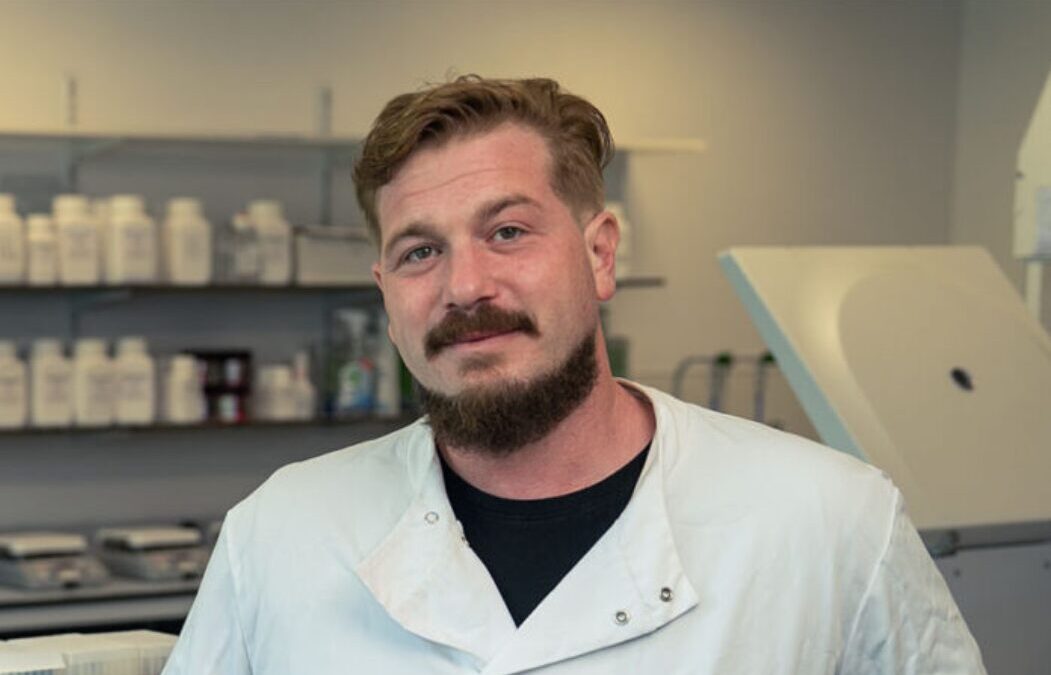
Some founders enter entrepreneurship gradually. Others leap from one world into another. Orr Yarkoni’s path started in academic research and went on to building Colorifix, one of the world’s most ambitious biotech-textile companies that radically reframed how biology can power industry.
From his early fascination with living systems to raising $46M and building a breakthrough technology now used in global supply chains, Orr’s journey reflects what happens when deep science aligns with hard-earned entrepreneurial instinct.
This is the story of how a molecular biologist turned a scientific insight into a company that reshaped one of the world’s most polluting industries. In this engrossing interview, Orr talks about navigating barriers to entry, scaling up versus numbering up, and raising funding from VCs and strategics.
Listen to the full podcast episode and review the transcript here.

*FREE DOWNLOAD*
The Ultimate Guide To Pitch Decks
Roots in Nature: Understanding Life Through DNA
Orr was born in Israel before his family relocated to Portugal when he was just two. By the time he reached his teens, his obsession with living things, animals, ecosystems, and biological processes had crystallized into a professional calling.
“I wanted to understand nature better, and particularly nature’s language, which is DNA.” That drive led Orr to the UK at 18, where he completed an undergraduate degree, a PhD at Newcastle, and eventually a postdoc at Cambridge.
Orr was keenly interested in molecular biology, synthetic biology, and understanding how to work with nature’s own processes to make things. He worked on interfacing cells in the environment via biosensors for several years.
Then, Orr met his future co-founder, Jim Ajioka, while working on biosensors that detect the impact of the textile industry on environmental contaminants in the water. The duo came up with the idea of using SynBio to develop colors for fabrics, rather than to measure water pollution.
This research—engineering microorganisms to communicate with their environment—sparked two important realizations:
- Synthetic biology could be used not just to measure pollution, but to prevent it.
- To create real change, the science needed a business model.
That second insight triggered a career-altering shift, from researching to starting a business, which Orr recalls wasn’t an easy decision.
From Academia to Entrepreneurship: Doing Good by Doing Well
Orr’s biosensor work was academically successful but commercially doomed. The product was good and a perfect fit for its purpose, but the market didn’t exist. There was just no financial incentive to move forward with it.
Orr quickly realized that, although they were making low-cost sensors to help people monitor water quality, no one would make money selling the product. “To do good, you must also do well. For something to be sustainable, it has to be financially sustainable, not just environmentally viable.”
That belief pushed Orr away from the security of academia and into the uncharted waters of startup building. But first came the humbling realization that he needed to learn how companies actually work.
Orr realized that building a company was a step-by-step process, requiring different levels of commitment from not just himself, but also the people around him. There was only so much he could achieve by himself. He needed to surround himself with the right people.
Orr credits his co-founder with helping and guiding him through the process, enabling him to become the company’s CEO. He read the UK Companies Act 2006 cover to cover and studied the obligations of directors.
Orr approached entrepreneurship with the same rigor and perspective he once applied to molecular biology. “In my mind, I was still doing research, just not into science anymore.” The process wasn’t smooth sailing, and he concedes they made mistakes along the way.

Raise Capital Smarter, Not Harder
- AI Investor Matching: Get instantly connected with the right investors
- Pitch & Financial Model Tools: Sharpen your story with battle-tested frameworks
- Proven Results: Founders are closing 3× faster using StartupFundraising.com
Early Missteps: The Patent Trap That Delays Founders
Once they had the technology ready, Orr and Jim started by filing for the patent and acquired the search examiner’s report. Next, they began looking for investors, when they should have developed a minimum value proposition and tested it on customers.
It took Orr and Jim time to secure the first customer willing to test the solution, and even longer to convert that into investor traction. Thus, Colorifix materialized in 2016. But those early learnings became foundational pillars:
- Validate with customers early.
- Don’t over-rotate on technology.
- Build slowly, but deliberately.
- Surround yourself with the right people.
The Birth of Colorifix: Letting Biology Make the Colors
The idea behind Colorifix is elegantly radical. It involves modifying microorganisms to produce colorants and dyes for use in textiles. The key difference is in the technique that uses nature’s way, rather than manufacturing chemicals that destroy ecosystems.
Orr explains the essence of the process:
- Borrow color from nature: If you take the vibrant blue from a parrot’s feathers, you can identify the DNA sequences responsible for that hue.
- Transfer that DNA message into microorganisms: The microbes become tiny biological dye factories. They make the same color the parrot makes, similar to how the parrot makes it, starting with sugar and nitrogen and building the chemistry.
- Ferment microbes like beer: Except that, instead of alcohol, the output is pigment.
- Apply the fermentation biomass mixture directly to the fabric: The microbes naturally bind and fix the dye into the textile—eliminating the need for toxic chemical baths.
At Colorifix, they change how dyes are applied to fabrics, thus rewriting the rules of how color enters supply chains. As a result, this cuts:
- 77% of water consumption
- Significant CO₂ emissions
- Energy usage across the board
The Barriers to Entry: Regulation, Scale, and Standardization
Colorifix’s technology is a GMO process that produces a non-GM output, a regulatory complexity that almost no one in the textile industry had dealt with before.
- Regulatory Bottlenecks: To operate in any region, Colorifix must acquire local GMO licenses. And every new customer means a new regulatory cycle. For instance, in the EU, it’s ~45 days, while in Turkey, it’s up to 270 days. Each time a new customer is onboarded using the process, Colorifix must engage the entire regulatory process. Navigating administrative procedures and successfully submitting applications is highly challenging the first time around, because few applications for distributed SynBio exist.
- On-Site Standardization: Dye houses are operated by machine technicians, not fermentation scientists. Colorifix had to make the cutting-edge biological process simple enough for a non-technical, machine operator to replicate with precision and achieve consistent, reproducible results. The company had to get the processes to take place in the customer’s dye house using the existing labor, infrastructure, and processes.
- Proving the Full Spectrum: It wasn’t enough to produce one good blue. Textile customers demanded dozens of colors, all of which met strict safety and performance tests and specifications.
Navigating the Proof of Concept
Each stage of growth and breakthrough unlocked a new milestone:
- The first reasonable piece of fabric dyed soaked up the color with perfectly clear spent liquid
- Passing all industry metrics, including quality and safety
- Scaling from grams → kilos → hundreds of kilos → tons
That climb, Orr notes, was steep. Colorifix had to build a product portfolio that met customer needs and could be tested at a meaningful scale. After the first commercial production pilot trial, the customer would have to have the capital expenditure (CapEx) in place.
If they didn’t, the process involved time lapses, extensive planning, and handholding to get things right. Having provided the proof of concept, Orr and Jim had to raise more money to progress to the next step in scale.
The Fundraising Journey: From Seed Struggles to $46M Raised
As Orr recalls, their first funding round enabled them to develop a product that passed all the metrics to enter the market. They also convinced customers to do on-site trials. The next fundraise helped install equipment so customers could work with the technology and provide feedback.
The next funding round took Colorifix to the next level of scale, enabling industrial-scale production of tons per batch rather than tens to hundreds of kilos. Colorifix raised a combined $46M, moving from small angels and early VCs to major strategic players like H&M and IKEA.
Storytelling is everything that Orr Yarkoni was able to master. The key is capturing the essence of what you are doing in 15 to 20 slides. For a winning deck, take a look at the pitch deck template created by Peter Thiel, Silicon Valley legend (see it here), where the most critical slides are highlighted.
Remember to unlock the pitch deck template that founders worldwide are using to raise millions below.
But landing the first lead investor—the one who anchors a round—was the hardest part. Colorifix’s first funding round was led by Sagana, an impact venture capitalist (VC). Interestingly, the folks at Sagana convinced Orr and Jin to revisit H&M’s proposal to work together.
Working with Strategics vs. Venture Capitalists (VC)
Initially, the duo was hesitant to align closely with a big brand at an early stage. Orr and Jim had concerns about being siloed and the potential exclusivity. However, H&M convinced them that there would be no commercial tie-in.
Thus, H&M became one of Colorifix’s strongest allies, introducing them to manufacturers, customers, and global fashion leaders. It’s now one of their most valuable relationships. As Orr reveals, H&M has helped them understand the product-market fit and promoted their technology to other brands.
This experience taught Orr the value of working with strategics, as long as their interests aligned with your own company in the deal. He points out that strategics take a different approach than other financial players, such as VCs and private equity firms. But it makes sense to partner with a blend.
Strategics have a higher level of scrutiny and focus on technology and product performance rather than projections and the total addressable market (TAM). They envision how the technology will fit into their systems and how it can also work for competitors.
Strategics ensure that the product’s quality, specs, and scalability match their needs. They regularly come across several great solutions that don’t work at scale or at the price/cost point vis-à-vis the market they’re targeting. Their job is to separate the viable ideas from the duds.
Unlike VCs, strategics focus on the revenues in the initial three to five years. In contrast, VCs are more focused on revenue projections. This is why Orr prefers to work with both sides on every funding round.
Participation from VCs and strategics, and then partnering with H&M and IKEA, brought validation by checking the numbers and the product, and ensuring alignment with Colorofix’s products and market potential.
The Vision for Colorifix
Orr imagines a future where:
- Nature—not petrochemicals—produces the colors on our clothes. Petrochemicals can perform specific functions that natural molecules cannot, which is why they are advantageous. But they should be used only where their value is exclusive, Orr opines.
- Biological dyes replace a significant source of water pollution
- Manufacturing shifts toward local, low-energy, low-carbon models
“If all industrial color were biological, that would be a great start,” Orr says.
Scaling Up vs. Numbering Up: A Core Strategic Decision
Colorifix faced one of the most fascinating strategic dilemmas. As Orr weighed their options, “Do we centralize and make a big fermentation center where we make huge vats of dyes and ship them all over the world? Or do we send fermenters all over the globe and ferment things locally?”
The first approach would entail shipping and downstream processing costs, as well as environmental impacts, in terms of CO2 emissions and water use, not to mention other unexpected overheads. The unit economics would also have to make sense.
Considering the value chain and market trends, which included greater vertical integration in the industry, the pressure shifted toward positioning the dying process as another step. Customers could produce the color they needed in-house rather than wait for shipping and handle other delays.
Orr and Jim factored in water savings and carbon footprint reductions and concluded there would be a positive impact on costs. Thus, they opted for the distributed approach. The next challenge focused on estimating optimal batch sizes for producing dyes for customers on-site.
Each customer has different dye houses, some handling 10 tons of fabric a day and others 600 tons. A modular approach was needed that could accommodate small, medium, and, particularly, large customers.
Colorifix needed to standardize and modularize the process to enable its tech support team to serve every customer. This factor underscored Orr’s vision of scaling their processes.
Overcoming Challenges on a Global Scale
Orr talks about the key challenges they faced, particularly from the tech and regulatory perspectives. The challenge of obtaining licenses across the geographies where Colorifix operates still stands. Not all countries adopt GM processes or integrate them into their targeted industries.
Colorifix is seeking to penetrate geographical markets where brands already have supply chains. As Orr points out, it can take a large brand up to 2 years to onboard a new supplier and walk them through all the steps and accreditation before they can start supplying at volume.
Colorifix must onboard players into the supply chain rather than trying to change it to work with its existing partners. Choosing the right partners and betting on the right players in the supply chain were key to determining the next steps.
The Hidden Realities of Fashion: What Everyone Gets Wrong
Orr is blunt, “There’s too much that we think is right that is wrong.” From sustainability impact numbers to assumptions about production, the industry suffers from misinformation. His most important point: Sustainability is driven by consumers, not brands.
Brands can influence choice by offering better products, but consumers ultimately dictate what gets made, worn, and disposed of. Orr hopes for stronger anti-greenwashing regulations to create more honest consumer decision-making. “We consume too much,” he says.
A Founder’s Mindset: Patience, Long-Term Vision, and Color
When asked what color is most underrated in nature and in fashion, Orr doesn’t hesitate: “Yellow. I love yellow. It brings things to life.” Green and blue are colors that signify nature, but they are also the hardest to achieve with natural dyes. Yellow is a delightful summer-to-early-autumn color.
Orr’s advice to young founders? “You’re going to have to be a lot more patient—with everything, including yourself. It’s a marathon, not a sprint.”
Colorifix is proving that synthetic biology isn’t just a lab tool—it’s an industrial force. And if Orr Yarkoni has his way, the colors of the future won’t come from chemistry, but from life itself.
Listen to the full podcast episode to know more, including:
- Orr Yarkoni transitioned from academia to entrepreneurship after realizing that environmental impact must be paired with financial sustainability to endure.
- Colorifix uses engineered microorganisms to produce natural dyes, dramatically reducing water, energy, and emissions in the textile dyeing process.
- Early on, the team made the classic mistake of chasing investors after a patent, rather than validating with customers and proving a real market need.
- Regulatory hurdles around GMO processes and the need to simplify biotech for non-scientist dye-house operators created major barriers to entry—and a strong moat.
- Colorifix chose “numbering up” (distributed, on-site fermentation at dye houses) instead of “scaling up” in a central plant, aligning unit economics with sustainability and supply-chain resilience.
- Blending VCs with strategic investors like H&M and IKEA gave Colorifix both financial backing and deep market validation without sacrificing independence.
- Orr reminds founders that building climate-scale solutions is a marathon, not a sprint, and that patience—with the market and with yourself—is essential.
SUBSCRIBE ON:
 iTunes
 Google Play
 Stitcher
 TuneIn
 RSS
RSS SoundCloud
 Spotify
Keep in mind that storytelling is everything in fundraising. In this regard, for a winning pitch deck to help you, take a look at the template created by Peter Thiel, the Silicon Valley legend (see it here), which I recently covered. Thiel was the first angel investor in Facebook with a $500K check that turned into more than $1 billion in cash.
*FREE DOWNLOAD*
The Ultimate Guide To Pitch Decks
Remember to unlock for free the pitch deck template that founders worldwide are using to raise millions below.
Podcast: Play in new window | Download
Subscribe: Apple Podcasts | Spotify | TuneIn | RSS | More



Facebook Comments