

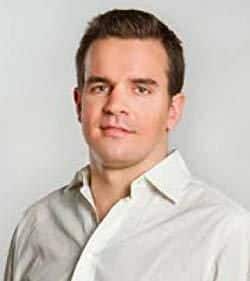
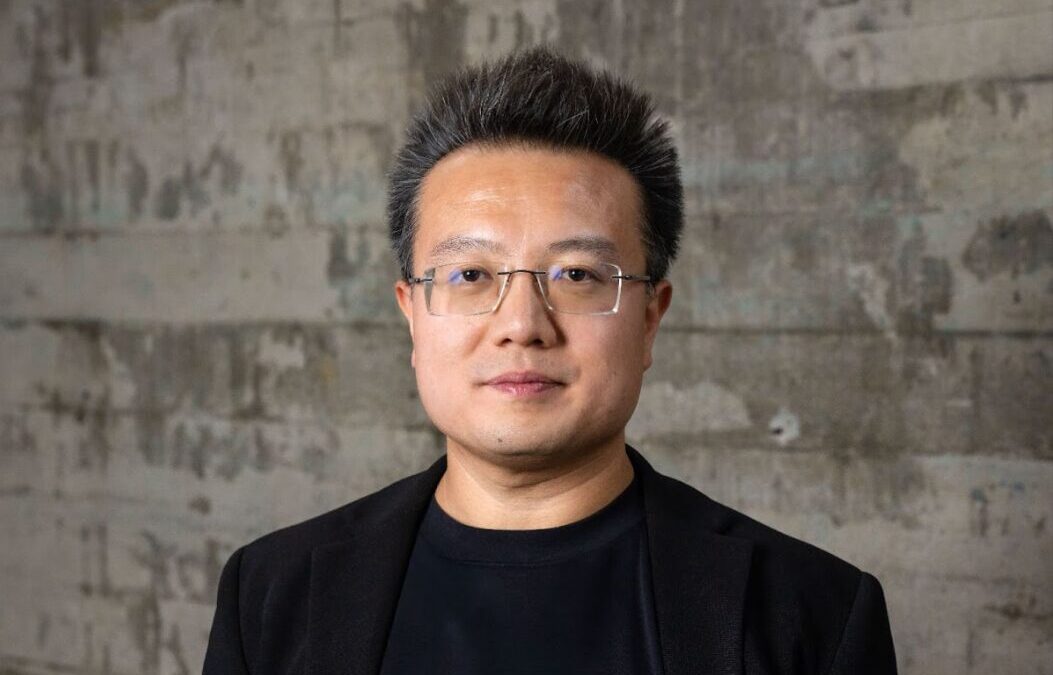
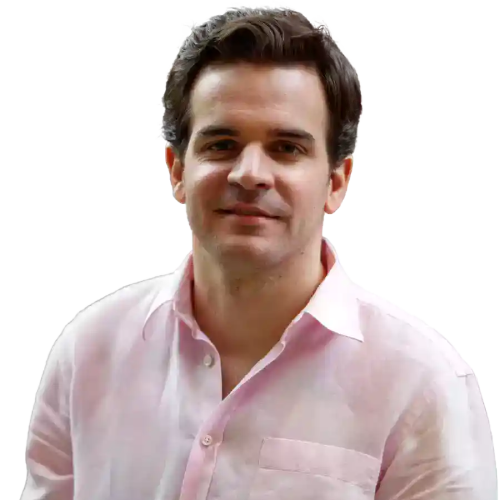
Most startup stories follow a familiar arc—an idea, early traction, a grind toward product-market fit, and eventually, scale. Wen Sang’s journey breaks that pattern. After building, scaling, and exiting his first company, he went on to start another startup, Genspark.ai.
With Genspark.ai, Wen helped build one of the fastest-growing AI companies in recent memory. A phenomenal unicorn, Genspark went from zero to $155M ARR in just 10 months. This is the story behind that trajectory and the lessons that every founder can take from it.
Listen to the full podcast episode and review the transcript here.
*FREE DOWNLOAD*
The Ultimate Guide To Pitch Decks
From the Mountains of Shanxi to MIT
Wen’s story starts far from Silicon Valley. Born and raised in Shanxi, China, a mountainous region south of Beijing, his early life was grounded in discipline, problem-solving, and a culture that valued technical rigor. Like many engineers of his generation, he gravitated toward automotive engineering.
That path took Wen to the United States, where he pursued a PhD at MIT Sloan Automotive Lab. Here, he worked on improving engine efficiency, literally burning fuel to optimize performance. But MIT gave him something more valuable than technical training; it gave him exposure to entrepreneurship.
“MIT brought in successful entrepreneurs. I remember Drew Houston coming back to speak. That’s when I realized there was another way to make an impact,” says Wen. That moment planted the seed.
The First Company: Rejection, Grit, and an Unlikely First Investor
Smarking, Wen’s first startup, was an enterprise SaaS company focused on digitizing parking infrastructure. It sold software to municipalities, commercial real estate owners, and other organizations.
However, Smarking didn’t start with venture backing; it started with rejection. Trying to raise capital in Boston, Wen encountered a very different investor mindset. The investors he approached asked for 5-year financial projections.
Wen also faced the typical skepticism toward first-time founders and realized they had a limited appetite for early-stage risk. With no traction and no track record, funding was nearly impossible.
So, Wen’s first investor was his wife. “She wrote the first check. My wife, then girlfriend, was my first angel investor,” he recalls. That moment captures a truth most founders don’t talk about: a leap of faith often starts before validation.
Applying to the Y Combinator Program
Looking back on his journey, Wen remarks that he was a young immigrant and naive enough to take risks. To work in the US, he needed a specific type of visa or green card, which he could have obtained by getting a job, as other immigrants do.
However, Wen was on a student internship visa. That meant success or returning home. Initially, he secured a job as a mechanical engineer near Boston, but after 4 months, he quit. He couldn’t see himself in the same place 10 years down the line.
That’s when Wen learned that Y Combinator had sent one of its partners to scout projects or companies in Cambridge. He connected with them through one of his mutual contacts at MIT. At the initial meeting at Harvard Square, Wen presented his sales proposal for Boston Logan Airport.
The partner was so impressed that he suggested Wen apply to the Y Combinator program. This led to an intense interview in Mountain View, which he aced with numerous rounds of practice thanks to his MIT/YC alum connections.
Wen intended to move to California for three months and then move back to Boston. The second never happened.
Raise Capital Smarter, Not Harder
- AI Investor Matching: Get instantly connected with the right investors
- Pitch & Financial Model Tools: Sharpen your story with battle-tested frameworks
- Proven Results: Founders are closing 3× faster using StartupFundraising.com
From Engineer to Operator: The Hardest Transition
For Wen, the engineer in him made it difficult to transition to door-to-door sales to government officials, real estate folks, and property owners. This phase was about interacting with the human world and understanding the dynamics
Wen had to learn to motivate his team and manage the human component of running the business. “As an engineer, you solve problems. But business is about people. That transition was painful.” This is one of the most underestimated founder transitions.
Wen realized that technical excellence does not translate directly into leadership capability. It must be learned—often the hard way.
Surviving Near-Death—and COVID
By the fifth year of building Smarking, Wen began receiving acquisition offers from private equity (PE) firms and other companies in the industry. However, he and his cofounder anticipated bigger opportunities and wanted to continue working on the company.
Wen was convinced about Smarking’s mission—a worthy problem that enabled people to find the time for more meaningful things rather than wasting it on finding parking. However, like many startups, the company faced multiple existential threats.
Smarking had a near-death experience in 2018. But Wen came back up by releasing a second product, which proved successful. Then came the complete industry shutdown during COVID. “By April, the entire industry disappeared,” Wen recalls.
But one decision made all the difference. They were cash-flow positive, which allowed them to survive the downturn. Wen cut credit for clients to help them survive and continued rebuilding Smarking alongside the market.
The Exit: A Strategic and Personal Decision
By 2022, acquisition offers continued coming in, but Wen and his co-founder faced a classic founder’s dilemma. They could continue scaling for another 5 to 6 years or exit and reclaim their personal lives. After nearly a decade of building—and with a young family—the decision became personal.
They sold the company to ParkHub/JustPark in October 2022 after scaling Smarking to2500+ parking properties across North America.
The Second Act: Why “Who” Matters More Than “What”
After the exit, Wen didn’t immediately jump into another company. Instead, a chance connection changed everything.
Wen met Eric, a former Microsoft veteran, at a Starbucks in Santa Clara through a mutual friend. Eric had built a company from scratch to a $5.5B valuation by leveraging deep learning technologies earlier. He had just moved back to Silicon Valley and was taking time off to be with family.
“It’s not just about the what… the who is equally important,” is a lesson Wen says he learned over the past 10 years. This is one of the strongest signals of success in startups. Great companies are built by great teams—not just great ideas.
In Wen’s perspective, a great team has ambition, competence, and a great work ethic, but is also humble. These are the kind of people he wants to work with, and Eric was the ideal cofounder.
What Genspark.ai Actually Does
Wen explains that Genspark.ai is a Palo Alto-based technology company that builds AI agents for the over one billion knowledge workers worldwide. However, Genspark.ai is not just another AI tool; it’s an all-in-one super agent to redefine how work gets done.
Humans have been the production engines that execute tasks manually, such as building a financial model, writing an email, crafting a document, and creating a presentation for decades. Until now, humans have worked hands-on, word by word, and pixel by pixel. All that has changed with AI.
With Genspark.ai, humans no longer need to learn suites of tools from Microsoft, Google, Slack, Notion, Salesforce, or more. Instead, they can command Genspark.ai super agents to perform end-to-end workflows, including multi-step processes (research, modeling, presentation, media) and the parallel execution of tasks.
A user can ask Genspark.ai superagents to build a financial projection and discounted cash flow analysis for Nvidia’s stock price and, at the same time, to build a full investment memo for a $10M purchase. Users can spin up five to ten agents at a time, assigning them different tasks that run side by side—in minutes.
The goal is clear—eliminate busy work and unleash full human potential. Wen concedes that the work is not necessarily perfect from the get-go. But with 80% to 90% accomplished, humans can regain much of that time and spend time on creative and strategic work.
Wen believes that the right way to work and tap your human potential is to leverage AI to do most of the heavy lifting and mundane tasks, such as copying-pasting the same business context from meeting notes to an email, a calendar invite, then to Slack, or a Google Doc
The Growth: $155M ARR in 10 Months
The growth of Genspark.ai wasn’t planned. Wen retraces the sequence of events that led to a $155M annual run rate (ARR) in just 10 months. As he explains, they launched Genspark.ai in April 2025 with no major expectations.
At the outset, they surmised that the wave of AI breakthroughs would enable users to access personalized information and get real work done. Their target audience was people like themselves, the knowledge workers.
However, within 45 days, Genspark.ai had 2 million users—a great signal. This encouraging metric prompted the team to continue releasing new AI agents every one or two weeks. Eventually, they had over 20 agents doing different optimized functions for users, including customized agents.
Most importantly, Wen and Eric were committed to high-quality, enterprise-grade output, ensuring users didn’t have to struggle with prompts. The growth was like wildfire, as Wen puts it. Within five months, they crossed $50M in ARR, and within nine months, they crossed $100M in ARR.
All driven primarily by word of mouth. “We didn’t do much marketing. People just told each other.” Wen reveals that they released the new products only on their X platform, YouTube channels, and LinkedIn. The incredible response prompted them to experiment with SEO.
At one point, Eric considered running a Super Bowl commercial. However, by the end of January, their ARR had reached $155M even before the commercial went live.
Genspark.ai Success Stories
Wen has several success stories to relate about AI power users who leveraged Genspark.ai to cut costs and accelerate their businesses. He discusses users building websites on platforms such as Shopify or custom-built sites in the style they need. Or, running a market analysis for a restaurant.
Genspark.ai superagents can build financial models, including historical P&Ls and balance sheets, or models to raise a bank loan for a restaurant. AI agents can also build a basic pitch that users can refine to specifications and present to investors.
Genspark.ai also assists consulting firms catering to manufacturing businesses with hundreds of billions of dollars in market cap. It also builds a selection of prototypes for clients to choose from, enabling a handful of analysts and consultants in remote locations to serve clients worldwide.
As Wen sees it, in a short time, it’s like the whole economy has changed—not just the production aspect, but also the coordination aspect.
Raising Capital with Intent: Avoiding “Tourist Investors”
Wen Sang framed Genspark’s fundraising as “not the first rodeo” for the team. Having already built, scaled, raised capital for, and exited a prior company, he emphasized that experience changes how founders evaluate investors.
In Wen’s view, many investors claim they “add value,” but founders quickly learn to distinguish true partners from what he calls “tourist capital.” For Genspark.ai, the goal was never just to raise money; it was to fund growth with capital from people who could genuinely support the company.
Storytelling is everything that Wen Sang was able to master. The key is capturing the essence of what you are doing in 15 to 20 slides. For a winning deck, take a look at the pitch deck template created by Peter Thiel, Silicon Valley legend (see it here), where the most critical slides are highlighted.
Remember to unlock the pitch deck template that founders worldwide are using to raise millions below.
Wen explains that, despite the diligence and process, fundraising is ultimately a trust-based decision. Genspark’s seed round, he noted, was raised by Eric, his co-founder and CEO, who had previously taken a company from zero to a $5.5B valuation.
That track record built deep credibility with investors who trusted Eric’s ability to build again, even as the product evolved. Wen described it as investors backing the builder, not just the initial plan.
Series A and Series B – Raising a Total of $460M
For the Series A, Wen pointed to continuity and long-term relationships. The round was led by an investor in Silicon Valley that had been among the earliest backers of his previous company.
For Wen, that relationship reinforced the same theme: capital formation accelerates once trust is established, and both sides understand how the other operates through the highs and lows of building.
Genspark’s Series B attracted a different class of investor aligned with a larger thesis about the future of work. The round included Emergence Capital, a firm backed generational enterprise companies like Salesforce, Box, and Zoom since the first checks.
Wen highlighted that this wasn’t a situation where the founders needed to “sell conviction.” Instead, it felt like a rapid mutual recognition—two sides discovering they shared the same worldview about where the world is heading and what software must become in an AI-native economy.
Wen extended the same logic to other investors in Genspark’s ecosystem—SBI from Japan, LG, and several venture groups—describing the common thread as “human trust” built on shared values, shared worldview, and a history of productive collaboration.
Over time, that trust-based approach helped Genspark.ai raise a total of $460M, and Wen notes that the company quickly crossed the unicorn threshold within 20 months of its launch.
What “Value-Add” Really Means
When discussing what “value-add” actually means, Wen was blunt. The first and most important value investors provide is capital—ensuring the company is sufficiently resourced to reach the next stage of growth without constantly operating from scarcity.
Wen cites firms like Emergence as examples of investors whose track records are themselves a form of leverage. They’ve capitalized and supported category-defining companies repeatedly, and that experience tends to translate into better partnerships, better pattern recognition, and faster alignment when scale arrives.
A Shared Belief in the Future of AI
Wen also emphasized that Genspark’s fundraising partnerships were shaped by a shared belief in what AI means for society. While some narratives focus on AI replacing jobs, he described Genspark’s—and key investors’—view as fundamentally optimistic.
They believe that when productivity rises, total output increases, and technology becomes a driver of human expansion rather than displacement. In that frame, Genspark’s mission is to help knowledge workers capitalize on the shift and become “superhuman” in their ability to execute, decide, and create.
That worldview also translated into practical strategic advantages, especially internationally. Wen explains that Genspark’s user base was global from day one, with top markets including the U.S., France, Japan, Korea, and India.
Partners like LG and SBI weren’t just financial backers; they helped the company operate more effectively in key regions, navigate local priorities, and accelerate execution.
Wen cites examples like leveraging SBI’s infrastructure to simplify setup and operations in Japan and using these relationships to support launches, including the opening of an office in Tokyo.
When One Introduction Becomes Multiple Outcomes
Wen described investor value as most real when it compounds into multiple outcomes from a single relationship. For example, he shares how investor networks helped Genspark.ai quickly identify customer support solutions through introductions to BPO operators.
Those introductions didn’t just solve a hiring bottleneck—they also opened up potential pathways to enterprise adoption, turning one connection into multiple mutually beneficial opportunities. The BPOs, in turn, purchased Genspark enterprise business solutions for their companies.
Wen framed this as the difference between investors who merely provide money and investors who can activate ecosystems around the company.
A World Without Busy Work – Wen’s Vision for Genspark
Looking ahead, Wen describes a future in which Genspark’s vision is fully realized, with AI agents “autopiloting” busy work. In that world, knowledge workers are no longer trapped in repetitive copying, pasting, formatting, and coordination.
Instead, they focus on creativity, strategy, and problem selection—work that expands the scope of what each role can accomplish. Wen envisions output per person increasing by orders of magnitude, while communication and coordination overhead become simpler and faster.
Wen pushed that idea beyond business productivity into a broader human ambition. He argued that much of humanity’s capacity is currently constrained by the need to grind through mundane tasks simply to sustain daily life.
If AI can absorb more of that baseline work and create greater abundance, then society can redirect more human intelligence toward frontier problems—scientific discovery, deeper understanding of how the universe works, and even space exploration.
Wen’s view was that people already carry “supercomputers” in their brains, but only use a fraction of that potential because time and cognitive bandwidth are consumed by survival-driven work. Humans can do more, accomplish more, and move on to bigger and more amazing things.
Advice to His Younger Self: Focus on Humans, Not Just Problems
When asked what advice he would give his younger self before launching a business, Wen returned to a theme that shaped his own transition from engineer to operator: the world centers on people, not just problems.
Wen says that it’s not enough to understand what the problem is—you must understand why it exists, how different stakeholders think and feel, what they value, and what constraints govern adoption.
In many cases, he suggests, the highest-leverage solution isn’t the most direct engineering fix, but the approach that accounts for human incentives and human behavior.
When it comes to different stakeholders and different parties of a problem, it’s possible there are highly efficient, highly effective, and highly leveraged solutions that are pure or a blunt kind of engineering solution.
Reflecting on his prior company, Wen says that the problem they tackled was meaningful, but the path they chose was harder than it needed to be. With the same time and energy, he believes a different path could have produced even larger outcomes—not only financially, but also in impact and adoption.
Wen’s takeaway is to stay open, be mindful of human factors, remain curious about alternative pathways, and build solutions around what people want rather than what the builder wants.
An Open Invitation to Builders
Wen closes with an open invitation to the community. He emphasizes that Genspark.ai actively seeks honest product feedback, grounded in a shared belief that people deserve more freedom and time for more meaningful things.
Wen also notes that the company is hiring globally and encourages those aligned with the mission to reach out and get involved.
Final Thoughts
Wen Sang has experienced both sides of entrepreneurship—the slow grind of building infrastructure software and the explosive growth of an AI-native company. The contrast is striking.
“The speed at which things are happening now… It’s unbelievable,” Wen says. “We are entering a world where execution is automated, creativity is the differentiator, and the best founders build leverage—not just products.”
Genspark.ai is not just another startup; it’s a glimpse into that future.
Listen to the full podcast episode to know more, including:
- Wen Sang’s journey shows that the leap of faith often starts before validation, with his wife being his first investor when no one else would.
- Transitioning from engineer to founder reinforced that building companies is about people, not just solving technical problems.
- Surviving near-death moments and COVID-19 highlighted that cash-flow positivity builds resilience and flexibility in crises.
- Genspark’s explosive growth demonstrates that product quality and real value drive word-of-mouth faster than paid marketing.
- Wen’s fundraising philosophy underscores that great investors are defined by trust, shared worldview, and long-term alignment—not just capital.
- His long-term vision reveals that AI’s true potential is to free humans from busy work, unlocking creativity, strategy, and frontier innovation.
SUBSCRIBE ON:
 iTunes
 Google Play
 Stitcher
 TuneIn
 RSS
RSS SoundCloud
 Spotify
Keep in mind that storytelling is everything in fundraising. In this regard, for a winning pitch deck to help you, take a look at the template created by Peter Thiel, the Silicon Valley legend (see it here), which I recently covered. Thiel was the first angel investor in Facebook with a $500K check that turned into more than $1 billion in cash.
*FREE DOWNLOAD*
The Ultimate Guide To Pitch Decks
Remember to unlock for free the pitch deck template that founders worldwide are using to raise millions below.
Podcast: Play in new window | Download
Subscribe: Apple Podcasts | Spotify | TuneIn | RSS | More


Facebook Comments