

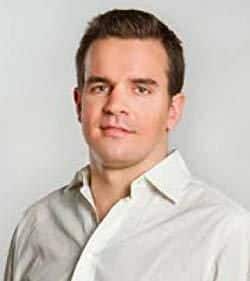
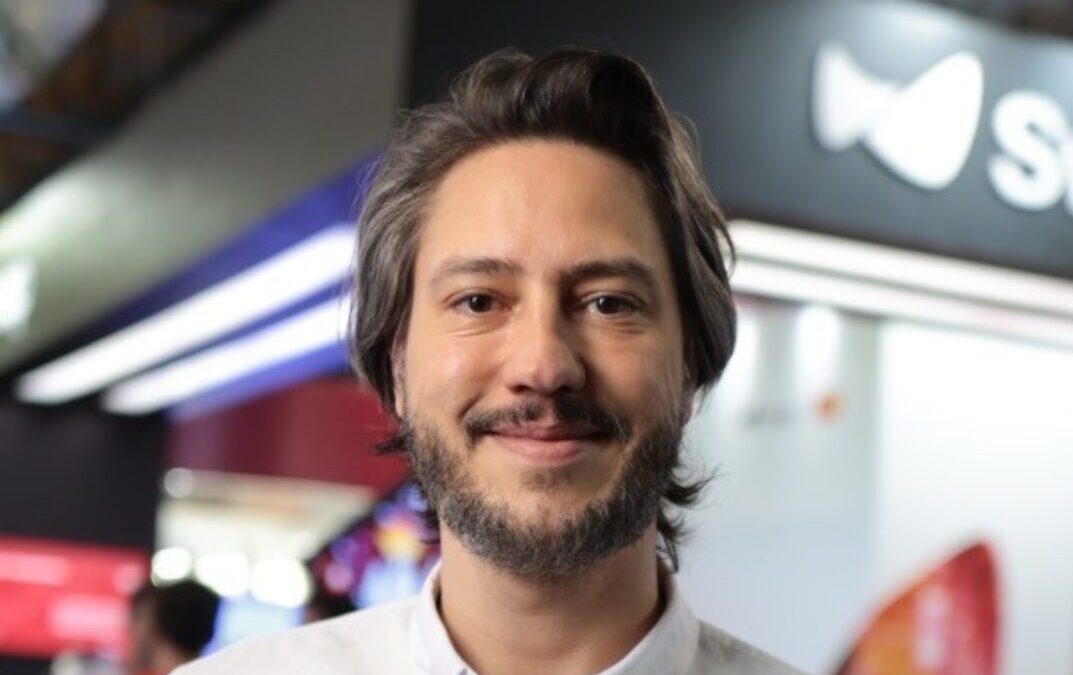
Doug Storf’s entrepreneurial story is not a linear ascent fueled by perfect timing and flawless execution. It is a story shaped by contrasts between consulting and operating, between theory and reality, and between abundance and scarcity.
Doug’s story also captures what it truly takes to build financial infrastructure in an emerging market: resilience, humility, and a deep respect for capital. In this engrossing interview, he discusses the challenges he faced in building, scaling, and raising funding for SWAP.
Listen to the full podcast episode and review the transcript here..
*FREE DOWNLOAD*
The Ultimate Guide To Pitch Decks
Childhood and Early Years in São Paulo
Born and raised in São Paulo, Doug grew up navigating vastly different environments every day. His school was an hour away from his neighborhood, exposing him to a range of socioeconomic realities early.
Evenings with his grandmother, weekends playing in the streets, and long commutes across one of the world’s largest cities shaped Doug’s worldview long before he ever touched a pitch deck. That exposure planted the seed for something that would define his career: an instinct for problem-solving.
A Problem Solver Before He Knew the Word
Doug’s problem-solving mindset surfaced early. At just 15 years old, he took a summer job to manually fix thousands of corrupted zip codes after a software update broke a company’s database. Within days, he realized the issue was simple—the system had dropped leading zeros.
Using Excel, Doug fixed the problem in two days. With nothing left to do, he noticed another inefficiency. Employees were lining up to use a shared HP 12C financial calculator to compute payments.
Doug built a simple Excel template, installed it on every computer, and eliminated the bottleneck entirely. That moment foreshadowed a lifelong pattern.
Whether studying engineering, working in consulting, or later building companies, Doug learned to break complex problems into their simplest components, solve them with the tools available, and then recombine those solutions into something scalable.
Raise Capital Smarter, Not Harder
- AI Investor Matching: Get instantly connected with the right investors
- Pitch & Financial Model Tools: Sharpen your story with battle-tested frameworks
- Proven Results: Founders are closing 3× faster using StartupFundraising.com
Engineering vs. Consulting: Two Ways of Thinking
Doug’s training as an engineer taught him to test multiple solutions methodically. Consulting refined that mindset further, but in a different direction. At firms like McKinsey, he learned to operate in a hypothesis-driven way: form a belief, assume it is correct, and work backward to disprove it.
As Doug points out, as an engineer, you tend to think more like a scientist testing alternatives to find the right one. But as a consultant, you tend to work more on hypothesis-driven scenarios. This shift from exploration to conviction would later prove critical when navigating ambiguity as a founder.
During his MBA at the University of Michigan, Doug moved through roles at Google and AWS, and after earning it, continued on the consulting track before stepping into a defining chapter: joining Brazilian mobility giant 99 as Head of Corporate Strategy.
The Shock of Becoming an Operator
On paper, the move made perfect sense. A former consultant stepping into a strategic role at a fast-growing tech company should have been a seamless transition. But, it wasn’t. Doug quickly realized that 99 didn’t need more PowerPoint decks. It needed execution.
The consultant toolkit — analysis, frameworks, polished narratives — wasn’t enough. The company needed someone to own problems end-to-end and deliver outcomes. For nearly six months, Doug spun his wheels. He worked harder than ever and produced less than ever.
Everything changed after DiDi acquired 99. Instead of remaining in strategy, Doug decided to build something tangible. He took ownership of launching 99Pay, a digital wallet for the ecosystem.
Suddenly, Doug was selling ideas, working with limited resources, and pushing initiatives forward without institutional backing. For the first time, he truly felt what it meant to operate.
Seeing the Market Gap Before the Market Named It
While building 99Pay, Doug began to see a broader pattern. The friction he faced within DiDi included regulatory complexity, infrastructure gaps, and a lack of reliable partners. It was the same friction his peers across Brazil’s fintech ecosystem faced.
Doug felt like he was hitting a wall and not getting any real traction. He was exposed to the market and recognized that the pain points he experienced were similar across the board.
Demand was rising, but supply was not, and the opportunity felt too large to ignore. In October 2018, Doug founded SWAP alongside Ury Rappaport, with whom he had been working at 99. The timing helped. DiDi’s acquisition of 99 had energized Brazil’s venture market, and Doug’s background gave him credibility.
SWAP raised its first pre-seed check in December 2018 on a PowerPoint deck. But the real breakthrough came almost accidentally.
Rewriting Employee Benefits in Brazil
A former McKinsey colleague was launching a company in employee benefits, an industry historically built on closed-loop card systems. These models required building card schemes and acceptance networks from scratch — a massive barrier.
Convincing restaurants to adopt the new payment method and convincing card companies that restaurants were open to it was expensive. Doug was well aware of how tough it can be to stimulate two sides of the marketplace.
Doug proposed something different: open-loop cards using Visa and Mastercard rails. By leveraging existing payment infrastructure, SWAP eliminated the hardest part of the equation overnight. Restaurants already accepted the cards, so employers could onboard faster.
A new paradigm was born. SWAP didn’t just find product-market fit — it redefined the market.
Building Banking-as-a-Service, the Brazilian Way
SWAP evolved into a full banking-as-a-service platform, but not in the lightweight sense common elsewhere. In Brazil, BaaS providers build their own infrastructure, and it is more than just a distribution layer between fintechs and banks.
SWAP developed direct connections to the central bank, card networks, internal ledgers, card-issuing processor, and regulatory licenses. In short, all the infrastructure needed for users to have a fully functional, transactional wallet, along with the licenses.
Under the hood, SWAP became a full financial operating system. The business model was simple: take a percentage of transaction volume. Over time, SWAP raised $30M. But the journey was anything but smooth. At the onset, the going was really good, as Doug recalls.
Storytelling is everything that Doug Storf was able to master. The key is capturing the essence of what you are doing in 15 to 20 slides. For a winning deck, take a look at the pitch deck template created by Peter Thiel, Silicon Valley legend (see it here), where the most critical slides are highlighted.
Remember to unlock the pitch deck template that founders worldwide are using to raise millions below.
SWAP had great traction and a large potential client base. However, the market flipped.
Running Out of Money—and Firing Everyone
The hardest chapter came in early 2020. As the pandemic hit, SWAP was in the middle of a seed funding round, with the product not yet fully deployed or having strong metrics. Capital froze, the world shut down, and cash evaporated.
Within 10 days of lockdown, Doug had to fire the entire team over Zoom. It was devastating because employees who believed in the mission were let go during one of the most uncertain moments in modern history. Some stayed, though.
As Doug looks back, it was the most delicate period of our generation in terms of human existence and survival. Half the team accepted equity instead of paychecks and committed to rebuilding a broken company with no guarantees.
That moment permanently changed Doug’s relationship with capital. In startups, everything compounds, including cash burn. In December 2019, SWAP had 50% of its capital in the bank. By March, it had zero. The lesson was clear: growth may be exponential, but so are costs.
Client acquisition, revenue, and traction — everything is exponential.
Partnering With Regulators, Not Fighting Them
Operating in financial infrastructure meant navigating regulation head-on. Doug adopted a philosophy he once heard from Condoleezza Rice — regulators exist to regulate. It’s the industry’s responsibility to engage them with high-quality information, so they can make informed decisions.
Instead of merely following the rules, SWAP helped shape them. The company worked closely with regulators, participating in debates and co-founding a banking-as-a-service association in Brazil, which influenced regulations released in late 2024, and got more representatives in the market.
For Doug, mature industries require dialogue among competitors and between operators and regulators. In his perspective, top players in a regulated industry need to be able to influence rule making not because they want the rules to favor them.
Instead, it’s because regulators don’t always have the full picture. They are not exposed to day-to-day workings and don’t understand the realities and complexities of the market.
It is up to the top players to assist regulators in setting the right boundaries to create a regulatory framework that not only stabilizes the market but also promotes competition and a healthy industry.
The World Doug Is Building Toward
Doug’s vision for SWAP is not about becoming a bank. It’s about enabling trusted ecosystems, including employers, platforms, communities, to deliver tailored financial services efficiently to the people closest to them.
In that world, financial services flow through relationships with the companies that users interact with and the employers that employ them — not institutions. Products and solutions are developed and deployed specifically to serve the people.
Doug envisions local ecosystems being built around players who have the legitimacy to build those ecosystems. Capital is allocated more efficiently. Prosperity becomes circular.
One Piece of Advice: Trust Your Instincts
If Doug could go back and speak to his younger self, the message would be simple: believe your instincts. Humans process more data than they can consciously explain. Those subtle signals matter. Ignoring them in favor of external validation often leads founders astray.
Doug’s journey — from São Paulo streets to financial infrastructure — was never about certainty. It was about listening closely, acting decisively, and staying committed when the data ran out. And sometimes, that’s what building something that lasts really looks like.
Listen to the full podcast episode to know more, including:
- Building financial infrastructure in emerging markets demands resilience, humility, and an uncompromising respect for capital.
- True founders move from thinking like consultants to acting like operators who own problems end to end.
- The biggest opportunities often appear when demand is obvious but the supply side is fundamentally broken.
- SWAP succeeded by removing structural friction, not by incremental improvement, rewriting how employee benefits worked in Brazil.
- In startups, everything scales exponentially, including cash burn, which makes capital discipline a survival skill.
- Regulated industries reward founders who partner with regulators to shape healthy, competitive ecosystems rather than fight the rules.
- When data runs out and certainty disappears, trusting your instincts becomes one of the founder’s most valuable advantages.
SUBSCRIBE ON:
 iTunes
 Google Play
 Stitcher
 TuneIn
 RSS
RSS SoundCloud
 Spotify
Keep in mind that storytelling is everything in fundraising. In this regard, for a winning pitch deck to help you, take a look at the template created by Peter Thiel, the Silicon Valley legend (see it here), which I recently covered. Thiel was the first angel investor in Facebook with a $500K check that turned into more than $1 billion in cash.
*FREE DOWNLOAD*
The Ultimate Guide To Pitch Decks
Remember to unlock for free the pitch deck template that founders worldwide are using to raise millions below.
Podcast: Play in new window | Download
Subscribe: Apple Podcasts | Spotify | TuneIn | RSS | More
Facebook Comments