


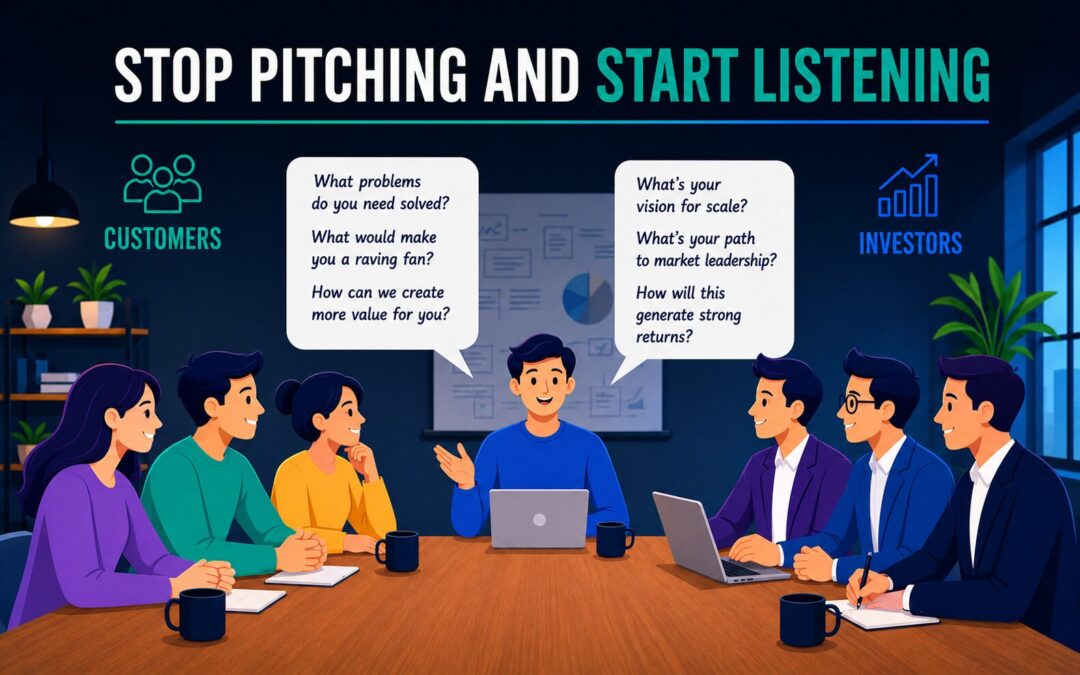
Successful founders understand that the overall framework for selling their startups to customers and investors is essentially the same. Selling is often misunderstood. Most people assume that great salespeople are persuasive talkers who can convince anyone to buy anything.
In reality, the best founders and sales professionals spend much more time listening to buyers rather than talking. Whether you’re selling a product, a service, a vision, or even a startup to investors, the process follows a surprisingly consistent framework.
You’ll start by asking questions to identify the buyer’s key pain points and to design a narrative that projects an outcome. Next, you’ll demonstrate the contrast—before and after they buy and deploy your product. The underlying selling point is to stay honest when defining the solution.
Why does this framework work? People don’t buy products; they buy solutions to their problems and upgrades to their existing processes for a better future. Most importantly, they want assurance that their purchase will deliver a better outcome. Let’s explore this ideal sales strategy in detail.

*FREE DOWNLOAD*
The Ultimate Guide To Pitch Decks
1. Ask Questions Before Offering Solutions
Most founders quickly dive into pitching the product, its features, benefits, and capabilities. That’s a key mistake. The problem is that they haven’t understood their audience or what it cares about. At this point, customers don’t want to hear about solutions.
Even if you’ve developed an incredible innovation, it has value only if you can convert it into a usable product. A product that solves a real problem and is compelling enough that customers want to purchase it. Your solution should also outperform existing options and be cost-effective to deploy.
Before you pitch a solution, you’ll ask questions to encourage buyers to express their problems. Start with open-ended questions that elicit discussions that go beyond yes/no answers. For instance:
- What are you currently struggling with?
- What prompted you to explore solutions now?
- What’s working well today?
- What’s not working?
The objective is curiosity, not qualification. Keep in mind that the initial responses may not explain the real problem. You’ll dig deeper to understand its importance and the impact of failing to get optimal solutions. For instance, money left on the table, customer dissatisfaction, or higher logistics costs.
Top founders who are successful in selling to customers and investors are primarily active listeners. They pay close attention to unspoken concerns, hidden frustrations, and repetitive phrases. If you listen carefully enough, your prospect will often tell you exactly how to sell to them.
Resist the urge to talk about solutions right away or push your products. Let the prospects talk and share detailed information with you. The more information you gather, the more relevant your solution becomes. You’ll draft the pitch narrative accordingly and maybe also offer customized products.
2. Find the Real Pain Behind the Problem
Expert sales personnel understand that pain points trigger purchasing decisions—people are looking for relief. The greater the pain, the faster the decision—that’s what you’re targeting. Here’s how your conversation flows:
Ask Questions → Identify The Problem → Uncover The Pain → Present The Solution
Once your questions identify the problem, you’ll move on to uncovering the pain and actual impact. It can be financial, operational, emotional, strategic, or have future consequences. That’s usually where buying decisions are made. Most importantly, learn to differentiate between the problem and pain.
Let’s try an example:
- Prospect problem: Our sales team spends too much time manually entering data into the CRM.
- Prospect pain point: Our reps spend 10 hours a week on admin work, which means fewer customer meetings and missed revenue targets.
- Actual problem: Time-consuming and inefficient data entry processes.
- Actual pain point: Lost revenue, poor productivity, and frustrated salespeople.
- Solution needed: An efficient CRM software package that streamlines data compilation.
The right questions can help you spot the gaps between the current and desired realities. Most prospects will have accepted the existing status—it’s just the way things are. Your pitch will center on actual metrics, such as revenue lost, employee attrition, and higher customer acquisition costs.
You’ll also acknowledge the emotional component when selling your startups to customers and investors. Remember that great salespeople address both the financial and emotional costs to the customer.

Raise Capital Smarter, Not Harder
- AI Investor Matching: Get instantly connected with the right investors
- Pitch & Financial Model Tools: Sharpen your story with battle-tested frameworks
- Proven Results: Founders are closing 3× faster using StartupFundraising.com
3. Paint the Outcome They Want
Now that you’ve understood the problem and pain point, you’ll move on to visualizing the possibilities and successful outcomes. How would the prospect define a win? Remember, the discussion is still not about the product you’re selling, but the larger ambitions beyond the immediate problem.
To go with the earlier example, ultimately, the prospect is looking to increase revenue, save time, and build market leadership. They are also seeking to lower customer acquisition costs and improve employee productivity—basically by providing them with the tools they need to do their jobs better.
You’ll weave your narrative to include those larger goals by demonstrating how the barriers to these goals can be eliminated. The prospect needs to believe that progress is achievable. You’ll help them visualize an efficient CRM that lowers employee frustration and streamlines data entry and accuracy.
Workers connect with more customers, generate more sales and revenue, and are more confident, thereby accelerating growth. That’s a future outcome that is tangible, desirable, and achievable.
4. Show the Cost of Doing Nothing
Experienced sales experts have an interesting observation. The primary barrier to a successful sale is almost never the competition—it’s the status quo that prospects maintain. Either they are unaware of the solutions available in the market or unsure how to deploy them. That inaction is your target.
You must demonstrate how that inaction is costing them through operational inefficiencies, missed opportunities, and lost revenue. Also, highlight the competitive disadvantages and long-term results of not addressing the problem and pain points. Discuss how the problem can compound over time.
For instance, sluggish growth or the competition taking over their customer base. At this point, you’ll underscore the “Why Now?” part of the pitch. Why is addressing the pain point crucial right now? What will it cost to deploy solutions now versus, say, six months later?
You’ll leverage quantifiable metrics to calibrate the value of the opportunities currently being missed. These costs invariably exceed the direct costs of purchasing the solutions. For instance, captured market share, broader customer base, team expansion, and improved manufacturing.
Your strategy for selling your startup to customers and investors should be about positioning the decision as a smart bet. Frame the solution as a calculated, intelligent move rather than a risky gamble by building their confidence and certainty.
5. Stay Honest Throughout the Process
The most critical aspect of a successful pitch is building trust with the prospect. This trust is built through transparency. Your objective here is to build a long-term relationship with them, whether or not they are ready to place orders.
Don’t make the mistake of manipulation because anyone can see through the tactic. Instead, you’ll establish yourself as an authority in your sector, offering credible advice and guidance—not just products. Be honest and acknowledge the product’s limitations—what it can and cannot do.
Prospects appreciate transparency because it eliminates uncertainty. They will know exactly what to expect from the purchase and their relationship with your brand. Once they believe in your advice and recommendations, they become long-term customers, referral sources, and valuable advocates.
You’ll transform that credibility into a competitive edge. At the same time, you’ll become a reliable source of information about anything customers need within the sector. This is the bedrock of more than just a sale—you’re laying the foundation of a partnership.
6. Bridge Your Solution to Their Desired Outcome
Having built trust with the prospect, you can now present your product as a possible solution. Link the solution to their pain points and desired outcomes in a narrative that seems logical and organic. Reiterate their words, using their phrases to underscore the problem, outcome, and key stressors.
Your goal here is to align the problem and solution for a smooth transition to closing the deal. Don’t push for a quick sale. Customers are wary of pushy sales personnel. Instead, give them time to consider their options so that their choices are clarity-filled.
Allow the prospect to evaluate where they are today and what they intend to achieve. And next, how the solution can help them achieve those outcomes. When that bridge is obvious, decisions become easier. You can, however, make it easier for them to reach a decision.
Talk about how you’ll work with them to deploy the solution and minimize friction. Customers may have concerns about possible disruptions to their operations during the transition. Or, the costs of the transition, above the expense of adopting a new product.
Here’s where your skills as a partner come in. Take this as a case in point of David Dorfman, a recent guest on the Dealmakers Podcast. When David offered dental clinics the YAPI software that could streamline patient intake and processing, they were hesitant.
YAPI came preloaded into iPads, and clinics relied on Topaz signature pads. David offered to buy their Topaz pads and replace them with iPads. The response was tremendous. Customer acquisition grew quickly, resulting in a viable acquisition for YAPI.
Whether selling products or fundraising, ultimately, it comes down to listening effectively. If you’re looking for more information about how listening helps during fundraising, check out this video I created.
Selling Your Startup to Customers and Investors – Using the Same Framework to Raise Funding
Selling to customers and selling to investors are more similar than most founders realize. Investors are also buyers. The key difference is that they are buying equity rather than a product. Here’s how the framework plays out.
Identifying the Problem
Founders who are successful in capital raising start by asking questions—researching. They spend time understanding everything they can about their target investor, including the check sizes offered.
Founders also dig into their firm’s investment thesis, risk appetite, existing portfolio, preferred sectors, geographic locations, and exit horizons. Answers to these questions define the investors’ problem—where to invest to earn excellent returns. But also with assurance that the money is safe.
They’re also looking for prospects who will benefit from the assistance they can provide in building their companies and accelerating growth. Most importantly, they need to see returns within a specific time frame.
Isolating the Pain Point
Venture capital firms are accountable to the limited partners (LPs) who invest in them. Their pain points include identifying venture-scale opportunities and generating substantial returns for their partners. They must access proprietary deal flows and avoid missing viable opportunities.
Of course, VCs’ primary concern is the risk they’ll carry. Statistics indicate that ~75% of startups fail to return capital to their investors. Of these, around 30% to 40% liquidate their assets, resulting in a 100% loss for their investors. Just 6% of venture deals generate 60% of their returns.
Furthermore, only the top 15% to 20% of venture capitalists consistently generate strong returns. The potential for losses is much higher than the potential for returns. These are the pain points you’re addressing.
Painting the Outcome
Investors’ outcomes center on achieving a profitable exit, either through an acquisition or through the startup going public via an IPO. Thus, their focus is on the metrics and signals that indicate the company’s success. You’ll help with the visualization by presenting metrics and other data.
Smart founders demonstrate the potential for category creation, market leadership, and revenue growth. You’ll also define profitable exit pathways investors can count on. Remember, the most compelling pitches make investors imagine future success.
Your pitch should include all the ingredients that a successful startup needs. For instance, a top-notch team, proprietary intellectual property, or a game-changing innovation, founder experience with successful companies, and emerging sectors.
Keep in mind that storytelling is everything in fundraising. In this regard, for a winning pitch deck to help you here, take a look at the template created by Peter Thiel, Silicon Valley legend (see it here), that I recently covered. Thiel was the first angel investor in Facebook with a $500K check that turned into more than $1 billion in cash.
Remember to unlock the pitch deck template that founders worldwide are using to raise millions below.
Show the Cost of Passing
As a founder, you’ll understand the struggle of raising capital—hearing countless “no’s” before that elusive “yes.” But things are equally complex on the other side of the table. Sifting through hundreds of applications to identify viable projects isn’t easy.
Regardless of how well investors are trained in pattern recognition, they regrettably pass on incredible opportunities. Salesforce, Uber, Airbnb, and Zynga are a few of the best-known examples. Your goal is to create Fear of Missing Out (FOMO) and underscore why now is the right time to invest.
You’ll leverage market timing, competitive advantage, social media presence, and momentum signals to catch and hold their attention.
Stay Honest
A key piece of advice every fundraising consultant will give you is to never risk inflating metrics or overvaluing your startup. Making unfounded claims can have a disastrous impact on your credibility. Overvaluation invariably results in down rounds.
Keep in mind that sophisticated investors detect exaggeration quickly. Further, the real numbers will certainly emerge during the thorough due diligence they conduct. Be transparent about the risks, challenges, weaknesses, and competing products within the niche.
Credibility often matters more than perfection, and glossing over your startup’s shortcomings won’t get you anywhere. Highlighting them indicates that you’re aware of them and working to correct them. Here again, you’re building long-term relationships.
You need these investors not only to participate in follow-on funding rounds, but also to support you in future ventures.
Bridge the Investment Opportunity
Now that you’ve laid the groundwork, it’s time for the culmination of your strategies for selling your startup to customers and investors. You’ll connect your pitch with market opportunity, team skills, product differentiation, traction, and growth potential.
Investors should clearly see why your company is uniquely positioned to win. That will prompt them to revisit your proposal when making the final investment decisions.
Your Takeaway
Selling your startup to customers and investors—the underlying concept is to analyze what they want, not to pitch. The same framework that closes customers can also help founders raise capital from investors.
Your job as the founder is to present a solution well-positioned as a bridge to help them achieve their ultimate goals. Work on building trust with them and laying the groundwork for a long-term relationship/partnership.
Helping buyers and investors visualize profits/returns is the key to a successful pitch.
You may also find our free library of business templates interesting. There, you will find every single template you need to build and scale your business completely, all for free. See it here.



Facebook Comments