


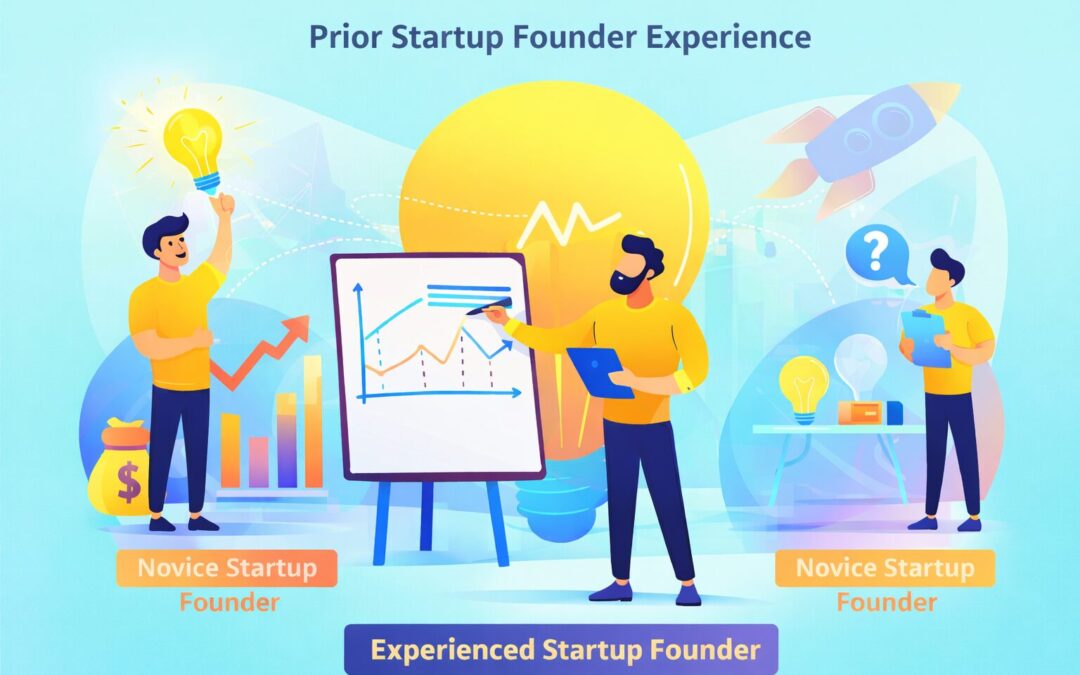
How do investors view prior founder experience? Do they consider it an advantage or a deal breaker? Does a founder’s success track record influence how they raise funding?
If you’ve established and exited a highly successful venture or worked in a corporate setting, that experience gives you an edge. The adage—once an entrepreneur, always an entrepreneur—holds true. And, statistics prove the point.
The Multiplier Effect
Close to 49% of unicorn startup founders in the US have built at least one company earlier in their careers. Experts also talk about the “Multiplier Effect,” in which successful entrepreneurs nurture and support budding entrepreneurs, thereby amplifying their efforts. That’s not all.
Employees of top companies typically go on to build successful companies of their own, a phenomenon observed worldwide. In Europe, around 65% of unicorn builders have prior experience.
This figure is particularly notable because venture capitalists in Europe follow a far more disciplined approach when evaluating investment opportunities. However, startups with prior founder experience are more likely to complete the approval process faster.
These founders can also expect more favorable terms and conditions thanks to their relationships with investors. Venture capitalists view them as “safe bets” and are inclined to offer them capital. On the other hand, first-time founders have also demonstrated similar success.
Top examples include Mark Zuckerberg, Jeff Bezos, and the founders of Airbnb: Brian Chesky, Joe Gebbia, and Nathan Blecharczyk. The bottom line is that investors cannot discount the outliers and upcoming entrepreneurs pursuing their life’s work. So, does prior founder experience count?
You would be surprised. Interestingly, investors value experience, team strength, education, and social capital. They are willing to back founders even if their first venture failed. Resilience, domain expertise, and learning from failure signal a higher likelihood of future success to investors.
*FREE DOWNLOAD*
The Ultimate Guide To Pitch Decks
Prior Founder Experience: Advantages
Founder experience is an advantage in the startup ecosystem across all sectors. Building a startup in an industry where they have previously worked gives them a distinct advantage. This edge is not just about raising funding or long-term survival. And, investors know that.
Launching a future multinational corporate giant doesn’t just start with a groundbreaking business concept. Research indicates that the founder’s track record with similar companies or startups in the same industry is a factor. Here’s why:
- Founders bring knowledge, skills, and insights from what works and what doesn’t.
- Whether building relationships with vendors, distributors, or complementary businesses for horizontal and vertical mergers and acquisitions, pre-entry experience matters. Seasoned founders can quickly recognize the potential pitfalls that lead to integration failures.
- Attracting an exceptional team is also easier. Skilled professionals are interested in working with management that demonstrates proven leadership, which creates opportunities for career advancement. Higher salaries and option pools are added incentives. On their part, seasoned founders know how to identify the right talent necessary to drive success.
- Experience helps understand volatile market trends, economic cycles, customer requirements, and competitor dynamics. Pattern recognition skills enable founders to differentiate between “nice-to-have,” “must-have,” and “can’t-do-without” products that drive repeat sales. They can identify changing trends well before they occur, as well as toxic deals and dirty term sheets.
- Having launched successful companies or worked in them, seasoned founders are more likely to avoid the key fatal mistakes that kill startups.
- Founders with pre-experience are adept at understanding the problems customers face and at finding targeted, potentially more cost-effective solutions. Finding the ideal product-market fit is easily done.
- Customers who have long-standing relationships with a particular founder always welcome the opportunity to partner with them on future ventures. Trust goes a long way.

Raise Capital Smarter, Not Harder
- AI Investor Matching: Get instantly connected with the right investors
- Pitch & Financial Model Tools: Sharpen your story with battle-tested frameworks
- Proven Results: Founders are closing 3× faster using StartupFundraising.com
Prior Founder Experience: Disadvantages
Interestingly, founder experience can sometimes be a disadvantage. Prior success can fast-track a seasoned founder’s next venture, but can also limit long-term outcomes. Particularly when they are inclined to take fewer risks in challenging the industry’s existing frameworks. Here’s what happens.
- Prior founder experience can get in the way of agility and the ability to adapt to unexpected market conditions. Rigidity can hinder rapid decision-making and risk-taking that involves experimenting with new ideas, leading to breakthroughs and success.
- Seasoned founders typically feel the pressure to measure up to the benchmarks of their past success stories. Fear of failure and loss of reputation leads to a more cautious approach. This can be a downside when exploring new ideas and building startups.
- Experience can be a double-edged sword when founders rely on misconceptions that past strategies will work again. However, every startup is unique and needs to build its pathways to success. Prior experience helps refine execution strategies, but it doesn’t guarantee adaptability or the ability to align that experience in a new setting.
- After reaching the corporate level, going back to step one can present a major challenge. Having tasted success and the ability to work with more funding and resources can be a downside. Founders must adapt to working within the constraints of a small organization.
- Most repeat founders invest some of the profits they made when exiting their previous companies. These exit strategies can occur through an acquisition, an initial public offering (IPO), or a recapitalization. Failure can mean losing hard-earned money, making them more risk-averse.
- Overconfidence in tried-and-tested frameworks and an unwillingness to adapt can kill the startup.
- Building a highly successful venture takes a lot out of the founder, and many experience burnout and fatigue. Navigating the high pressures of startup building might not work for them.
Beginner Founder Advantages
Novice founders testing the waters have many advantages over their more seasoned counterparts. Here’s why:
- Beginner founders tackle challenges with a fresh perspective, free from preconceptions and stereotypes. This factor enables them to develop disruptive ideas that can potentially transform the industry. They take more risks, diving deeper into problems to find solutions.
- The lack of experience in corporate structures quickly becomes an advantage, as novices can think outside the box. They also pivot quickly, changing their decisions when the data doesn’t align with their convictions.
- The lack of “scar tissue” and fear of failure enables new founders to take more risks.
- Several industries, such as technology and customer-focused sectors like gaming, social media, apps, and e-commerce, require an innovative mindset. Younger entrepreneurs are better at understanding the needs of the next generation because they can connect with their thought processes. Their age gives them that elusive edge.
Prior founder experience is just one of the many factors that investors look for in founding teams. If you’re looking for a more comprehensive list of the boxes they tick, check out this video I have created.
A Balanced Approach Raises Chances of Success
Prior founder experience can prove to be a game-changer if you adapt it to a new setting. If you’ve worked in a corporate setting, you’ll pick up skills like strategic thinking, business acumen, and running operations.
You’ll also learn how large companies manage risk and navigate financial, legal, and regulatory compliance concerns. Most importantly, you’ll understand how to build a robust foundation that can sustain future growth and success.
At the same time, you should be open to challenging existing industry frameworks. Also, know when to let go of redundant operational norms and experiment with new technology. For instance, artificial intelligence (AI) can streamline and accelerate operations across the company.
If you’ve worked in a company at the startup stage, you’ll take away critical lessons about the typical pitfalls. Even if you weren’t the original founder, you’ll develop an understanding of the entrepreneurial journey. This expertise will prove invaluable when you set out to build your own venture.
You’ll learn how to structure the business model, navigate uncertainty, and run lean operations to conserve scarce resources. This structured thought process is indispensable at every stage of company building—from seed to Series A, B, and C, and beyond.
Prior founder experience alone is insufficient; its true value lies in applying that experience effectively in a startup’s dynamic environment.
The Savvy Founder’s Strategy
If you’re an aspiring entrepreneur thinking of diving into the startup ecosystem, consider gaining prior founder experience. Build a foundation of valuable skills that drive your success, along with strategic networks of partners and investors.
You can gain experience by working closely with other founders starting companies. Or by getting a job in a thriving corporate—preferably within the sector in which you intend to start a company eventually.
If you want to fast-track the startup’s launch to secure a competitive edge, you have both options. You’ll partner with a seasoned cofounder who can bridge the gap in skills and valuable experience. Also, bring in mentors and advisors who can guide your endeavors in the right direction.
Always remember the significant operational differences between larger corporations and startups, even after you have gained experience. Utilize the experience, but also learn to adapt it to the unique environment of your new company.
When building the founding team, you’ll include members with varying experience levels. For instance, entrepreneurs who started companies from scratch and scaled them to $1M and above. But also, professionals who participated in scaling companies from $3M to $10M and above.
Ensure that you have people on board who are attuned to changing customer tastes and preferences. And won’t hesitate to experiment with new ideas. Don’t discount founders of failed ventures who have valuable lessons to share. They’ll temper enthusiasm with caution in the company.
Douglas Storf, Founder of SWAP—A Case Study
An excellent case in point is the story of Douglas Storf, founder of SWAP and a guest on the Dealmakers Podcast. Doug joined 99, working in a corporate until its takeover by DiDi. As part of the newly-merged company, he built 99Pay, a digital wallet for the ecosystem.
During his journey, Doug identified several market gaps and the challenges his peers faced across Brazil’s fintech ecosystem. He partnered with Ury Rappaport, with whom he had been working at 99. Together, the duo launched SWAP, leveraging Doug’s credibility working at DiDi.
SWAP went on to raise ~$30M and became the leading Banking-as-a-Service (BaaS) platform serving B2B businesses in Brazil. Doug attributes SWAP’s success to working closely with regulators, participating in debates, and helping shape regulations that benefit the entire ecosystem.
Keep in mind that storytelling is everything in fundraising. In this regard, for a winning pitch deck to help you here, take a look at the template created by Peter Thiel, Silicon Valley legend (see it here), that I recently covered. Thiel was the first angel investor in Facebook with a $500K check that turned into more than $1 billion in cash.
Remember to unlock the pitch deck template that founders worldwide are using to raise millions below.
Impact on Fundraising
Founders can leverage their existing relationships with investors and other strategic partners. In addition to capital infusions, investors provide industry-specific expertise and guidance on hiring top talent. Founders with “scar tissue” from previous startups are considered an asset.
Investors are confident these entrepreneurs can recognize the opportune times and pathways to pivot when needed. They can also navigate downturns and manage chaotic situations while avoiding risks such as scaling too quickly or hiring the wrong talent.
This is why investors are open to participating in follow-on rounds. They will also support the founder with bridge loans and other assistance during global crises such as the pandemic. Also, prior founder experience goes a long way in B2B and mature, capital-intensive industries.
These sectors include biotech, enterprise software, hardware, mining, and more. Technical expertise and know-how are significant assets when understanding demand and navigating established frameworks. Thus, investors focusing on these sectors are more likely to back pre-entry experience.
On the other hand, novice entrepreneurs with no industry knowledge typically struggle with many of the underlying aspects. They take longer to create viable business models and build trust with their stakeholders. Delays like these often result in competitors outpacing their ideas.
From the investor’s perspective, these risks signal the company’s failure before the entrepreneur has even started building it. At the same time, they also scrutinize how prior founder experience can cause hurdles. For instance, the tendency to follow established playbooks instead of experimenting.
“The hero complex,” where the founding team hesitates to question the seasoned player’s judgment. Ignoring new data that signals the need to pivot quickly is another situation that acts as a red flag for investors. Teams with the same level of experience can also spell a death sentence for the newly formed startup.
The Takeaway—Lessons to Learn
Prior founder experience can be either a trap or a valuable asset in building startups. The key is to balance the benefits and drawbacks of experience and inexperience. In-depth insights are indispensable, but so is risk-taking and the enthusiasm to experiment with disruptive ideas.
You may also find our free library of business templates interesting. There, you will find every single template you need to build and scale your business completely, all for free. See it here.



Facebook Comments