


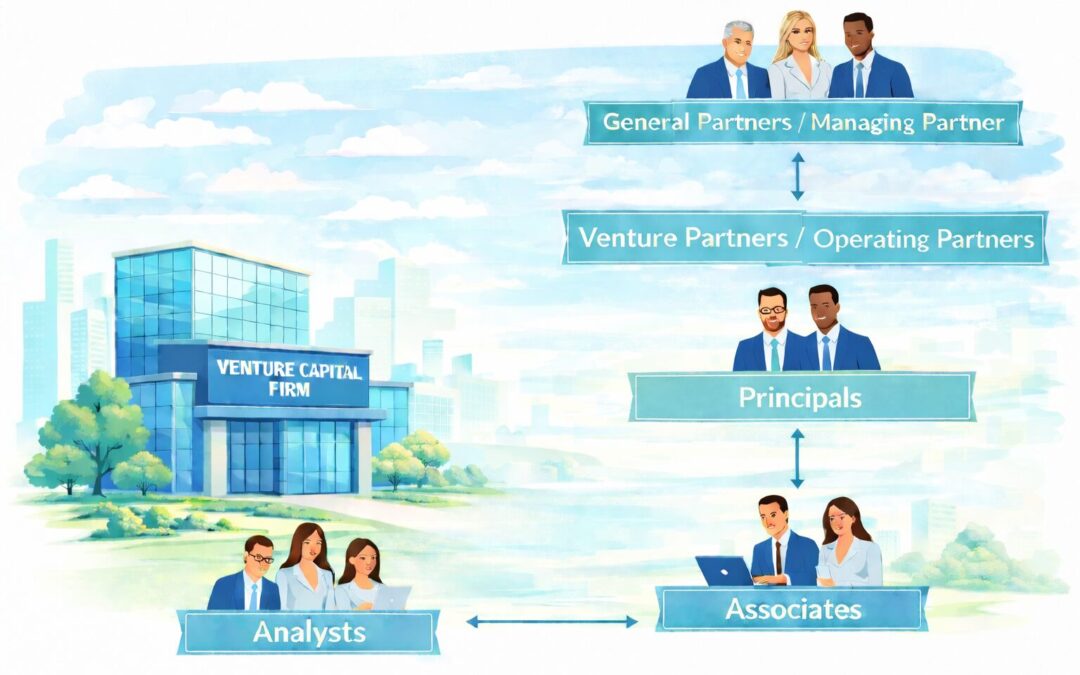
Understanding how venture capital hierarchy works is a crucial part of a startup founder’s fundraising journey. Venture capitalists (VC) are key players of the startup landscape, backing promising projects with capital and success-defining know-how.
Every founder needs to approach VCs at some point to tap into their resources. Learning more about how the venture capital firm is structured and how capital flows through the various tiers helps. Keep in mind that the larger the VC firm, the more complex its tiers and the application approval process.
Its structure is specifically designed to identify viable projects, assess the capital they require, and allocate funding. Further, the firm’s lifecycle largely influences its investment criteria and framework.
Read ahead for detailed information on how venture capital and startup evaluation work. Let’s begin with what happens when funding applications arrive and the initial assessment begins. We’ll then trace the applications through the various tiers until the investment committee (IC) approves them.

*FREE DOWNLOAD*
The Ultimate Guide To Pitch Decks
Venture Capital Hierarchy – Analysts and Associates
Analysts
The analysts in the venture capital hierarchy are responsible for gathering detailed, accurate data. They conduct the initial research to track changing market trends, upcoming sectors, and customer preference signals. Based on the data, they prepare investment memos and briefs.
Analysts are also responsible for cold calling founders and sourcing good deals. Once the process is initiated, they monitor the progress and update records. When partners higher up the hierarchy come across good opportunities, they may task the analysts with evaluating them for suitability.
Many VC firms have venture scouts on their payrolls who attend networking and other industry events to connect with founders. They are recruits or talent agents seeking startups developing disruptive concepts with the potential to deliver attractive returns.
Using the information they gather, they create deal memos and send them to the venture capital firm. The objective is always to grab the best available investment opportunities by offering capital as the lead investor. This strategy allows them to negotiate for better terms and lower dilution.
Analysts then take over the job of diving deeper into the opportunities before sending them to the associates—the next tier.
Associates
Analysts who remain with the VC firm for two years or more typically move up the venture capital hierarchy. They get promoted to the associate level, which is again crucial for filtering potential deal opportunities. These professionals also assist in the due diligence process.
Associates typically have backgrounds in sectors such as banking, consulting, and startup founders who have built and exited companies. They manage deal flow and assist in valuing startups under consideration for investment. On average, they may screen more than 100 startups per month.
A critical task that associates perform is financial modeling. This task enables them to assess the potential returns a startup can deliver when compared to its valuation. They also analyse the metrics a startup provides for accuracy, and authenticate its claims about the total addressable market.
Most importantly, when founders reach out to venture capital firms, their initial point of contact is an associate. If their applications pass this initial assessment, the associate may pass them on to the principal for checking.

Raise Capital Smarter, Not Harder
- AI Investor Matching: Get instantly connected with the right investors
- Pitch & Financial Model Tools: Sharpen your story with battle-tested frameworks
- Proven Results: Founders are closing 3× faster using StartupFundraising.com
Principal
Evaluating Deal Flows
The next entity in the venture capital hierarchy is the principal. These professionals are essentially “internal champions” who push deals through to the partners for approval. They conduct deep due diligence to uncover hidden signals about the startup’s suitability.
Principals negotiate the final terms and conditions with founders and execute the closing of the deal. They act as liaisons between associates and partners and maintain relationships with startup founders. Essentially, they manage the day-to-day operations and manage portfolio companies.
Keep in mind that principals in the venture capital hierarchy attend the demo days that incubators and accelerators organize. If you have passed through any of these programs, you’ll present your pitch, idea, and product to these entities. Convincing them can land you an initial check to launch the brand.
Principals are closely aligned to the firm’s investment strategy and lifecycle, and make decisions accordingly. Their key role is to ensure the startup’s viability so that it passes the final investment committee’s scrutiny.
Principals spend significant time networking with founders, industry experts, and other venture capital firm representatives to spot the best available deals. They are mid-level entities in the venture capital hierarchy and assist in the decision-making, which ultimately lies with the partners.
Assisting Startups
Considering that principals have often been operators themselves, they have experience in building startups. Alternatively, they may have been C-suite executives overseeing departments such as product or growth. As a result, they speak a founder’s language and understand startup challenges.
If not a startup operator or executive, the principal can have 5 to 8 years of experience at a VC firm. Combining that experience with a background in finance or banking equips them with exceptional pattern recognition skills. They develop a keen eye for identifying profitable opportunities.
Once the deal closes, the principal’s job includes working closely with the founders, offering guidance as a consultant. They’ll assist with hiring top talent, navigating crises, and raising follow-on funding rounds. These professionals also assist in establishing strategic partnerships for rapid scaling.
As the startup scales into later stages, the principal may serve on the board. Depending on the deal’s terms and conditions, the principal may have voting rights as an active board member. Or, serve as an observer and look out for the venture capital firm’s interests.
Compensation Structure
While analysts and associates are employees of the venture capital firm, principals are higher up the hierarchy. Principals receive a full salary along with bonuses. They also receive a pre-determined percentage of the fund’s carried interest—a fixed profit from all the investments they facilitate.
Principals are typically on the partner track and can expect to be promoted to partner in 3 to 5 years.
Venture Partners or Operating Partners
Not to be confused with limited partners (LPs), venture partners and operating partners are next in the venture capital hierarchy. Venture partners are typically experienced industry experts or former founders who work within the firm and have investment decision-making power.
Venture Partners
Although both venture and operating partners have senior roles in the VC firm, they are more often than not part-time. They may assist the firm on a per-project basis by helping it find specialized deals. Or by offering specialized support and high-level strategic advice.
Venture partners are typically serial entrepreneurs or ex-CEOs who have successfully exited highly successful companies. Although they are interested in remaining involved in the corporate world, they are uninterested in holding full-time positions. Or being a part of the venture capital hierarchy.
Active board members leverage their extensive networks to identify and bring in viable opportunities to the firm. In turn, the firm leverages their expertise in the sectors in which they have excelled. For instance, a founder who has exited a unicorn tech company can offer guidance about disruptive technology.
When it comes to decision-making, venture partners don’t have the authority to write checks, but their opinion carries weight. As for compensation, they receive a percentage of the returns from the specific deals they bring into the firm. Or, manage for the firm.
Operating Partners
Operating partners take on a more “hands-on” approach within the VC firm. Their job entails creating value for the firm and the portfolio companies it supports. They have exceptional expertise in the sectors in which they have previously worked and essentially act as entrepreneurs-in-residence.
Thus, these operating partners are open to offering this leverage to startup founders. For instance, when hiring an executive team, building a product roadmap, or designing a sales playbook. These partners also assist with in-depth due diligence.
Operating partner roles vary according to the size of the venture capital firm in which they work. For instance, if the firm is large, they may hold more permanent positions. However, smaller firms may choose to retain them as part-time consultants. Their compensation structure varies accordingly.
But the baseline is similar to that of the venture partners and includes a carry percentage along with a salary and bonus. Their pay is a mix of corporate-style cash and investment-style upside, reflecting the value they drive. Though, they don’t really have any check-writing power.
Keep in mind that storytelling is everything in fundraising. In this regard, for a winning pitch deck to help you here, take a look at the template created by Peter Thiel, Silicon Valley legend (see it here), that I recently covered. Thiel was the first angel investor in Facebook with a $500K check that turned into more than $1 billion in cash.
Remember to unlock the pitch deck template that founders worldwide are using to raise millions below.
Limited Partners
Limited partners (LPs) are the primary funders of the venture capital ecosystem. They are the ones who bring in the capital. LPs comprise family offices, pension funds, insurance companies, university endowments, and other high-net-worth individuals and organizations.
Together, these LPs provide 98% of the capital the VC firm will invest in potentially profitable projects. Their objective is to maximize returns within the VC firm’s 10- to 12-year lifecycle. However, LPs don’t actively participate in the decision-making process.
Their role is passive, meaning they rely on the General Partner (GP) to manage capital and its portfolio companies. LPs only get regular updates regarding the portfolio’s performance.
Limited partners don’t invest all the money they’ve committed to the VC firm at one go. The GP may raise their capital in specific tranches over a pre-determined time period. Returns take several years, as companies must mature to the point where they are ready for an acquisition or to go public.
That’s when the venture capital fund exits the investment and realizes its gains. These returns, along with the invested capital, are then returned to the limited partners. The VC fund comes to a close, and the GP may proceed to raise a new fund and start the investment cycle again.
The key takeaway here is that LPs don’t make decisions; they only have some influence over operations.
General Partner
The general partner (GP) is at the top of the venture capital hierarchy; they are the owners of the VC fund. GPs raise capital from limited partners, manage the fund, sit on startup boards, and make final investment decisions. These experts are typically the firm’s senior investors.
When it comes to approval investment, GPs write the final checks and are responsible for driving the firm’s strategy. The general partners’ returns depend on the performance of the firm’s portfolio. This is why they have a vested interest in the success of the fund and in maximizing profits.
GPs allocate millions of dollars to portfolio companies and guide them toward 10 to 12-year exits to align with the firm’s lifecycle. As for the compensation structure, GPs earn a 2% management fee, which covers the firm’s operational costs. These can include legal expenses, salaries, and rent.
GPs also earn a percentage of the fund’s profits or carried interest (carry), as it is also called. The carry is paid out after the LPs have received their initial capital and reached a specified return threshold. The carry is typically predetermined at 20% but varies with the fund’s size and performance.
Looking for some additional information about how venture capital works? Check out this video in which I have explained everything you need to know.
Managing Partner
The managing partner (MP) is the VC firm’s strategic and administrative leader. Not all funds have an MP; in many, the GP serves as the manager. The most crucial task is to maintain a close relationship with the limited partners and deliver regular updates.
The MP is at the top of the venture capital hierarchy and is responsible for approving and writing $10M+ checks. Ultimately, the MP is accountable to LPs and strategizes investments throughout the 10-year lifecycle.
Investment Committee
The investment committee (IC) is the apex board that makes the final investment decisions. It has the MP at the head, along with other senior members and top executives. Once the due diligence process is complete, the IC weighs the pros and cons and assesses the potential for risks and profits.
The members also ensure that the investment aligns with the firm’s investment thesis and expected timelines. They make the final approval, also basing their decisions on the strategic value the company can add to their portfolio.
Support Teams
Although not directly a part of the venture capital hierarchy, the firm’s support teams are crucial for its streamlined management. Each firm hires an extensive support group of professionals who handle various tasks, including legal, financial, and administrative work.
Though, smaller firms may also choose to outsource some of the tasks to consulting agencies to keep costs down. Team members handle compliance with investment regulations, accounting, financial monitoring, fund management, and other tasks that ensure smooth operations.
In Conclusion
Understanding this venture capital hierarchy should give you an overview of the tiers your application navigates before reaching decision-makers. You’ll have a better chance at getting approval by signing up with an expert fundraising consultant.
Leveraging their exceptional network can help you speed up the process by getting warm intros with the right people. Also, keep in mind that not all VC firms have multiple tiers. Smaller firms are more compact but provide comparable value in terms of resources other than just capital.
You may also find our free library of business templates interesting. There, you will find every single template you need to build and scale your business completely, all for free. See it here.
.



Facebook Comments