


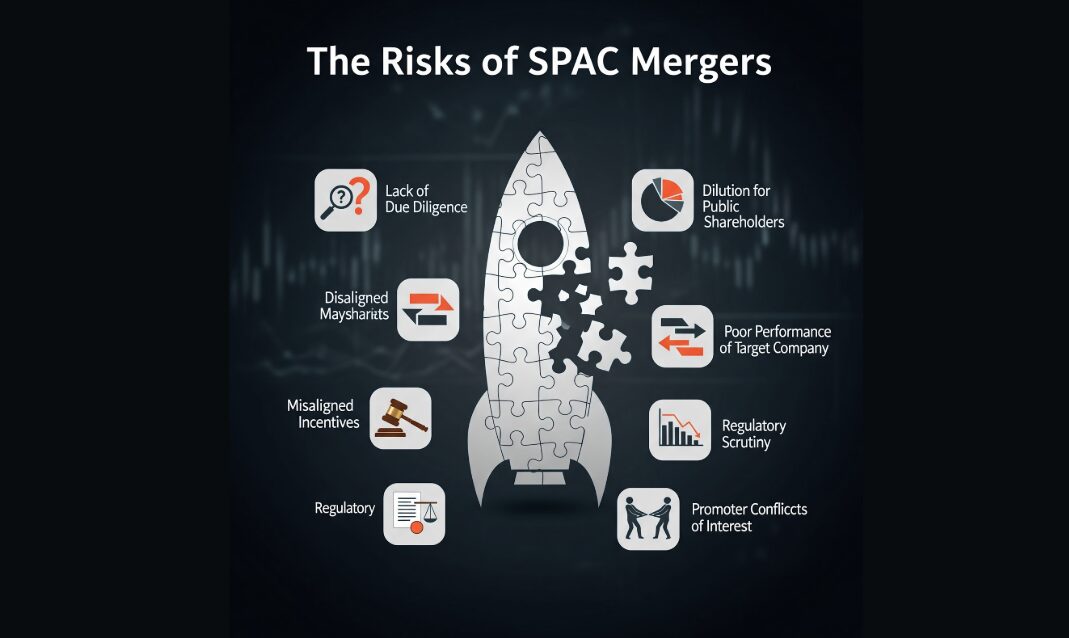
Although SPAC mergers have been garnering attention in recent years, founders need to be very cautious about such deals. Ensure that you understand the pros and cons in detail before signing the agreements. You’ll pay particular attention to clauses that result in ownership dilution.
In recent times, trends have leaned more toward acquisitions than toward taking the company public as an exit strategy. More founders would also choose to pursue a merger or acquisition rather than raise venture capital. Then there are others who choose the easier, more economical path via SPACs.
So, what exactly are SPACs? And why would you want to approach them with caution? What are the hidden risks behind partnering with a public company that can instantly take your later-stage startup to IPO? Are there any workarounds to secure your interests? Let’s dive in and find out.

*FREE DOWNLOAD*
The Ultimate Guide To Pitch Decks
What are SPAC Mergers?
A Special Purpose Acquisition Company (SPAC) is a shell company established for the sole purpose of raising capital. The SPAC sponsors build the company to file an Initial Public Offering (IPO) and raise capital from investors.
However, the SPAC objective is not to manufacture products and operate a business. Instead, it is all about merging with a private or unlisted company, enabling it to go public immediately. Consider this a back-door strategy that allows private companies to circumvent complex regulatory procedures.
While venture capitalists and other investors may support multiple companies with varying check sizes, SPAC sponsors back a single company. Keep in mind that venture capitalists (VCs) support the SPAC after assessing the credibility and track records of its sponsors.
These sponsors are typically hedge fund managers, private equity firm general partners (GP), asset managers, and other well-experienced executives. These individuals have extensive expertise in their respective sectors and an impressive track record of building and running successful companies.
Investors are also likely to back sponsors that top-tier VCs have validated in the past, for example, Sequoia Capital. Some excellent examples of successful sponsors include Chamath Palihapitiya, Reid Hoffman, and Bill Ackman.
Once instituted, the SPAC has a limited timeline. It must complete an acquisition within 18 to 24 months. If it cannot execute a transaction within this time frame, it must return the capital it raised to the investors. This transaction should cover at least 80% of the funds the sponsors have raised.
Aside from issuing an IPO, SPACs raise capital through private investment in public equity (PIPEs) and other mechanisms.
Why SPAC Mergers?
A later-stage company poised for accelerated growth can raise capital from venture capitalists and private equity firms or go public. That’s the natural progression of its growth trajectory. However, going public typically involves complex regulatory requirements.
You’ll also invest resources in terms of costs and time spent on fundraising programs and roadshows to meet institutional investors. Then again, you’ll approach an investment banker to facilitate the IPO and pay their fees and other overheads. Or, you’ll pick an easier route and enter into a SPAC merger.
This route effectively compresses the operational timeline for a company to become a publicly traded entity. You’ll also quickly overcome the typical hurdles that companies typically face right after issuing an initial public offering.
Typical downsides of SPAC mergers? Significant ownership stake dilution for the shareholders and founders, as well as inherent conflicts between the founders and SPAC sponsors.

Raise Capital Smarter, Not Harder
- AI Investor Matching: Get instantly connected with the right investors
- Pitch & Financial Model Tools: Sharpen your story with battle-tested frameworks
- Proven Results: Founders are closing 3× faster using StartupFundraising.com
How SPAC Mergers Work?
To understand the hidden risks behind SPAC deals, it’s crucial to know how they operate. SPAC sponsors create a blank-check company and register it with the SEC (U.S. Securities and Exchange Commission). They issue an IPO and list the company on a national securities exchange.
That’s how the sponsors raise capital, which they hold in a trust. Next, they identify private companies to acquire and vet them thoroughly to ensure a good fit. Once the target is finalized, the SPAC deploys its available capital to acquire or merge with it. This transaction is called a “de-SPAC” deal.
However, before the sponsors finalize the deal, they must obtain shareholders’ approval. For the deal to close, a majority of shareholders must vote in favor. Most companies targeted for acquisition are typically small, and the SPAC owns 10% to 49% of outstanding shares post-merger.
More often than not, these startups are not yet publicly traded. The objective for SPAC sponsors is to identify a company with significant scalability and profitability potential. Purchasing the company or a substantial ownership stake in it enables investors to invest before its share prices rise.
Statistics Indicate that SPACs are Surging in 2025
Historically, SPAC IPOs peaked in 2020, which was an unprecedented surge. The market saw 248 SPAC IPOs, but the number of completed de-SPACs is estimated at just 63. The following year, 2021, saw a boom in SPACs with an astounding 613 IPOs. The number of acquisitions was higher at 184.
Since then, there’s been a drastic drop in the number of new SPAC IPOs, as well as M&A deals. This downtrend is likely to reverse in 2025, driven by several factors that shape how SPAC mergers work. In 2024, the SEC adopted several new regulations to streamline and discipline SPACs.
As a result, the markets have experienced a resurgence in 2025 with well-experienced sponsors and institutional investors developing new strategies. In the first three quarters of 2025 alone, 91 new SPAC IPOs have raised an incredible $16.5B in investment.
Interestingly, SPACs account for 37% of all new IPOs in the US this year alone. Experts anticipate that the number of SPAC IPOs is likely to cross 100. However, de-SPAC deals may not keep pace with this growth. Company founders continue to be wary of entering into SPAC mergers. Here’s why:
Why Founders Should Be Wary of SPACs – SPAC Sponsor Fee
One of the biggest advantages proponents of SPACs cite is cost savings. You can expect to save on the various costs associated with taking the company public. We’ve described some of them in the foregoing sections, including underwriting fees and organizational costs.
However, SPAC mergers are not entirely low-cost either. You should factor in the fees payable to the sponsors and the “promote” that results in significant dilution. SPAC sponsors typically require a flat fee in addition to a percentage fee as payment for their expertise.
This underwriting fee can sometimes range from an incredible 5% to 5.5%. Let’s assume the investment value is $400M. In that case, the fee payable would add up to $20M at 5%. Sponsors do disclose this charge to investors when issuing the IPO, which ensures an element of transparency.
Keep in mind that storytelling is everything in fundraising, mergers, and acquisitions. In this regard, for a winning pitch deck to help you here, take a look at the template created by Peter Thiel, Silicon Valley legend (see it here) that I recently covered. Thiel was the first angel investor in Facebook with a $500K check that turned into more than $1 billion in cash.
Remember to unlock the pitch deck template that founders worldwide are using to raise millions below.
Excessive Dilution
Aside from this percentage, sponsors receive a “promote,” also called a sponsor stake or founder shares. This promote is typically 20% of the total shares after the SPAC mergers and IPOs. However, this percentage may vary depending on the terms and conditions of the M&A deal.
For example, during a deal, the SPAC invests $200M in the target company and receives shares in return. Assuming the “promote” is 20%, the company’s founders must issue an additional $40M in shares to the sponsors/managers.
Most promos are structured so that, post-IPO, SPAC sponsors own around 25% of the shares. This can result in excessive dilution for the company founders. Furthermore, the promote ultimately results in diluting the stake of SPAC investors and shareholders as well.
To understand how that works, here’s what you need to know. When SPACs raise capital, they don’t invest 100% of it in the target company. They layer in a fee that SPAC managers retain. As a result, only a portion of the capital is diverted toward investing.
This cost is essentially an upfront loss that investors carry at the time of the SPAC mergers. It will, eventually, impact the new company’s bottom line and the returns investors will get down the line. As a result, underperformance issues are one of the most significant downsides of SPAC mergers.
Calculating the Promote
Although the promote is not a conventional fee, the target company must pay it to SPAC managers. Both parties agree on the number of shares during negotiations of the de-SPAC deal. Since the target’s founders are aware of the promote, they calculate the prices per share accordingly.
Thus, they price the shares at a rate higher than the estimated price if there were no promote. Let’s try an example. A company raises $100M from the SPAC as part of the deal negotiations. In return, it commits to issuing 10 million shares at $10 per share.
In the absence of a promote, the SPAC investors would receive 10 million shares. However, the SPAC manager gets 20% of the 10 million shares or 2 million shares. The SPAC investors are thus left with only 10 million – 2 million = 8 million shares.
This example clearly shows how SPAC investors receive fewer shares for the capital they invest. Essentially, they’re paying the promote on top of the fee. To cover this cost, the post-merger company would have to work harder to deliver exceptional returns.
Performance Issues
Historically, companies entering into such mergers tend to underperform, particularly compared to traditional IPOs. Returns for investors have been poor because the company must cover the promote shortfall. The sponsors of SPAC mergers stand to gain whether or not investors make money.
As a result, investors carry a higher proportion of the risk. Performance issues also translate into declines in share value and market capitalization after the merger. This aspect clearly indicates that a potentially high valuation initially does not necessarily translate into long-term success.
Pressure Created Because of the Limited Time Frame
Once the SPAC goes public and raises capital, sponsors must complete a de-SPAC merger within 18 to 24 months. This limited timeline and the pressure to close the deal quickly can sometimes lead to poor decisions. SPAC managers may push for targets that are overvalued or below average.
They may not have time to vet the target company thoroughly and may proceed with the deal to avoid forfeiting the capital they raised. Their objective is clearly misaligned with investor interests.
As for the company entering into an M&A, it may not have enough time to prepare for a merger. SPAC mergers are typically closed within a period of 3 to 6 months, which can be an advantage. However, the target company must establish the internal infrastructure to operate as a public company.
You’ll optimize several aspects of the company, including financial reporting frameworks and internal governance and controls. On the upside, it need not worry about cultural integration and other hurdles that accompany a typical M&A. However, the drastic change in operational framework can lead to high employee turnover.
Additional Challenges
- SPAC mergers are subject to U.S. Securities and Exchange Commission (SEC) regulations. New rules require increased accountability for the financial projections SPACs release. Projections cannot be misleading or unrealistic, and target companies can be held liable and face litigation.
- If SPAC investors disapprove of the proposed acquisition, they can redeem their shares. However, high redemptions can create a significant cash shortfall for the newly formed entity, affecting its ability to operate efficiently and forcing it to seek less favorable capital sources.
- Taking a company public via traditional channels like an IPO can result in rapid share-price appreciation. In contrast, SPAC merger share prices are predetermined and have a lower potential ceiling.
- De-SPAC deals often face uncertainties related to human resources, taxes, and legal complications. Deals can fall apart after months of negotiation.
- Company founders must be extremely cautious when selecting SPAC managers. They should vet sponsors thoroughly for their expertise, track record, and alignment with the company’s long-term goals. Misalignment is a major risk.
The Takeaway!
Over the past decade or so, SPAC mergers and their pros and cons have come under increased scrutiny. Although the number of de-SPAC deals seem to be rising in 2025, you can’t overlook their potential downsides. Be aware of the risks before signing the agreement.
Having an experienced mergers and acquisitions expert at the table is a huge advantage. Trust in the professionals to guide your company in the right direction.
You may also find our free library of business templates interesting. There, you will find every single template you need to build and scale your business completely, all for free. See it here
.



Facebook Comments